Azure SQL Hyperscale Benchmark: 52% Higher Throughput, 51% Better Price-Performance

Independent tests show Azure SQL Hyperscale has 52% higher throughput than Aurora and leads by 51% in performance per dollar.
Microsoft commissioned Principled Technology to conduct an independent benchmark of Azure SQL Database Hyperscale against Amazon Aurora, using HammerDB to simulate an e-commerce order-processing system and comparing 16 vCore configurations at 64, 96, and 128 concurrent users. Results show Hyperscale has about 52% higher raw throughput than Aurora and leads by about 51% in order-processing performance per dollar. Microsoft's Ravi emphasized that Hyperscale is broadly applicable, supporting sub-core, serverless mode, and elastic DB pools, with storage scaling from a few MB to at least 128 TB. This benchmark provides a quantifiable reference for cloud database selection, but actual performance still needs validation against specific workloads.
Microsoft commissioned an independent vendor, Principled Technology, to conduct a comparative benchmark of Azure SQL Database Hyperscale against Amazon Aurora. The results were revealed on the Data Exposed show by Ravi from the SQL product team alongside host Anna Hoffman. The tests showed that Hyperscale delivers nearly 52% higher raw throughput than Aurora and also leads by 51% in order-processing performance per dollar. These results are valuable for enterprises currently choosing a cloud database.
How the Benchmark Was Designed
According to Ravi, the test used HammerDB to simulate an e-commerce order-processing system, measuring how many orders the database could handle under high concurrency. The testers selected a 16 vCore Hyperscale instance and matched it with a comparably specced instance on Aurora (Principled Technology chose the configuration it internally deemed equivalent) to ensure a fair comparison.

The test covered multiple concurrency levels, including 64, 96, and 128 users. As concurrency increased, Hyperscale's performance advantage remained, indicating relatively stable scalability.
HammerDB is an open-source database benchmarking tool that supports standard workload models such as TPC-C (online transaction processing) and TPC-H (decision support). The TPC-C model simulates an e-commerce order-processing scenario, including transaction types such as new orders, payments, order status queries, stock level queries, and delivery. It evaluates a database's OLTP throughput by measuring transactions per minute (TPM). HammerDB supports multiple database backends and allows adjusting parameters such as the number of concurrent users and transaction mix, so it is often used for fair cross-database platform comparisons. In this test, the testers used HammerDB's TPC-C workload to measure order-processing volume under high concurrency, which is also a common industry practice for evaluating database transaction processing performance.
Leading in Both Performance and Price-Performance
Looking at throughput alone, Hyperscale is about 52% higher than Aurora. But for enterprises, price-performance is equally critical. The testers divided total monthly orders by total compute hours to measure order-processing capability per unit cost. The results showed that Hyperscale processes 51% more orders per dollar than Aurora.
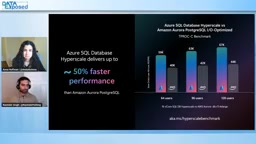
Ravi emphasized that customers should not focus only on "throwing more compute at performance" but should pursue "the best performance at the right cost." This metric is closer to real business decision-making.
vCore (virtual core) is the billing and resource configuration unit for cloud databases such as Azure SQL Database and Amazon Aurora, representing the compute capacity allocated to a database instance. Different cloud vendors may use different underlying hardware for vCores (e.g., CPU models, memory ratios, I/O bandwidth), so even with the same number of vCores, actual performance may differ. In this test, Principled Technology selected a 16 vCore Hyperscale instance and matched it with a "comparably specced" instance on Aurora, but the specific configuration equivalence was determined by the testers themselves. When referencing benchmark results, readers should note that vCores are not fully equivalent across platforms, and the instance-matching method may affect the generalizability of the conclusions.
Not Just for Large Databases
Although Hyperscale is often associated with very large databases, Ravi clarified that its applicability is broad. Users can start from sub-core specifications or choose serverless mode; when consolidating multiple databases, they can use elastic DB pools.

On the storage side, Hyperscale supports smooth scaling from small databases of a few MB to at least 128 TB, covering the full lifecycle from startup applications to large enterprise systems. This means teams can scale on the same platform as their business grows, without over-provisioning for peak loads early on.
Serverless is a compute model that allows the database to automatically scale based on workload and pause compute resources when there is no traffic, billing by actual usage. Azure SQL Database's serverless mode provides auto-pause and resume, suitable for intermittent, unpredictable workloads, and can significantly reduce costs during off-peak periods. Elastic DB Pools is a multi-tenant resource pool solution that shares the same set of compute and storage resources across multiple databases, suitable for scenarios such as SaaS applications with "many databases, low average utilization, and varying peaks." Combined with Hyperscale's storage architecture, these two forms enable the same platform to cover diverse needs from lightweight to very large scale.
Implications for Selection
For enterprises evaluating cloud databases, this independent benchmark provides a quantifiable reference: under similar vCore configurations, Hyperscale shows higher throughput and better cost efficiency in order-processing scenarios. However, benchmark results are affected by workload type, concurrency patterns, and instance-matching methods, so it is recommended to validate against your own business scenarios.
The full report was published by Principled Technology and can be found via a link in the show description. Microsoft emphasizes that the test was independently conducted by a third party, and users can read the raw data themselves to make their own judgments.
One-line Summary
Independent tests show Azure SQL Hyperscale has 52% higher throughput than Aurora and leads by 51% in performance per dollar.
Paragraph Summary
Microsoft commissioned Principled Technology to conduct an independent benchmark of Azure SQL Database Hyperscale against Amazon Aurora, using HammerDB to simulate an e-commerce order-processing system and comparing 16 vCore configurations at 64, 96, and 128 concurrent users. Results show Hyperscale has about 52% higher raw throughput than Aurora and leads by about 51% in order-processing performance per dollar. Microsoft's Ravi emphasized that Hyperscale is broadly applicable, supporting sub-core, serverless mode, and elastic DB pools, with storage scaling from a few MB to at least 128 TB. This benchmark provides a quantifiable reference for cloud database selection, but actual performance still needs validation against specific workloads.
Related articles

9 AI Subscription Plans Compared: The Real Cost Per 100M Tokens Revealed
Bilibili creator tests 9 AI subscription plans from Volcano, Alibaba, Tencent, Baidu, Zhipu, Xiaomi, MiniMax and more, converting them all to real cost per 100M tokens, breaking down fixed-quota vs. three-tier coefficient billing and how caching, time-of-day discounts, and window limits affect actual quota.

Vibe Coding for Beginners: Expressing Intent Instead of Handwriting Code
What is Vibe Coding? A 137-episode Bilibili course defines it: the core is expressing intent, not writing code. This article analyzes Vibe Coding's productivity logic, target audience, and entry expectations to help beginners decide if it's worth learning.

LangChain Beginner's Guide: An Agent Development Roadmap from LangGraph to Deep Agents
Clarify the encapsulation relationship among LangChain, LangGraph, and Deep Agents, and master the learning path and selection logic for agent development frameworks—suitable for beginners in large model development.