What Is DeepSeek Harness: A Model or a Client? Four Modes Explained
Harness is the engineering middle layer outside the model that carries prompts, tools, sandbox, and orchestration.
The article addresses the common confusion over whether DeepSeek Harness is a model or a client, pointing out that neither is accurate: Harness is an engineering system layer outside the model. Using the original English meaning of "harness" as a metaphor, it explains that the model is powerful but like a wild horse needing equipment to channel its power. Technically, system prompts, tool calling, file systems, sandbox, memory, context management, constraint mechanisms, feedback loops, hook middleware, and orchestration logic all belong to Harness. Through a plugin-based lens, it can be broken into the model layer, tools and skills layer, sandbox and storage layer, context and memory layer, and peripheral components like the UI, advocating "everything is a plugin," one-click installation, and free replacement. Released as a developer preview and open-sourced for global developer testing, the article clarifies two major misconceptions and emphasizes that Harness is the middle layer connecting models to usage scenarios.
What Is DeepSeek Harness: A Model or a Client?
In discussions around DeepSeekAd Harness, the most frequent confusion is: is it a model, or is it a client? The answer isn't such a simple binary. The explanation given by a Bilibili creator in the "Ten Questions" series happens to break this concept down quite clearly—Harness is the engineering system layer that sits outside the model.
The Original Meaning of Harness: Putting Reins on a Wild Horse
The original English meaning of harness is horse tack—the whole set of equipment including reins, saddle, and horse lantern. This metaphor fits large models quite well: the model itself is highly capable, but in use it's like a wild horse—someone has to put a set of equipment on it to channel its power in the right direction.
In a technical context, Harness refers to the engineering system layer outside the model. System prompts, tool calling, file systems, sandbox environments, memory systems, context management, constraint mechanisms, feedback loops, hook middleware, orchestration logic—all of these fall under the scope of Harness. The creator's summary is blunt: the model handles judgment, and Harness handles everything else.
System Prompt is the instructional text injected into the model before a conversation begins, used to set the model's role, behavioral boundaries, and output style. It doesn't occupy any user-visible conversation turns, yet it continuously influences every subsequent generation. In the Harness system, the system prompt is one of the most fundamental constraint mechanisms—it determines "in what capacity and by what rules" the model calls tools and executes tasks. Unlike fine-tuning, system prompts require no changes to model weights, and the cost of modification is extremely low, so they're often used as a knob for quickly adjusting Agent behavior. Understanding this makes it clear why Harness treats prompt management as a problem at the engineering layer rather than the model layer.
Hooks / Middleware borrows a design pattern from web frameworks: programmable interception logic is inserted at key points such as before a request enters the model and after a tool call returns, for logging, permission checks, result rewriting, or retry on failure. It allows Harness to uniformly handle cross-cutting concerns without intruding into model or tool code, and it's a common way to turn "orchestration logic" into maintainable code.
Four Modes: Plugin-Based Separation of Model, Tools, Skills, and Sandbox
If we understand Harness's composition through a plugin-based lens, it can be broken down into several mutually independent, freely replaceable layers.
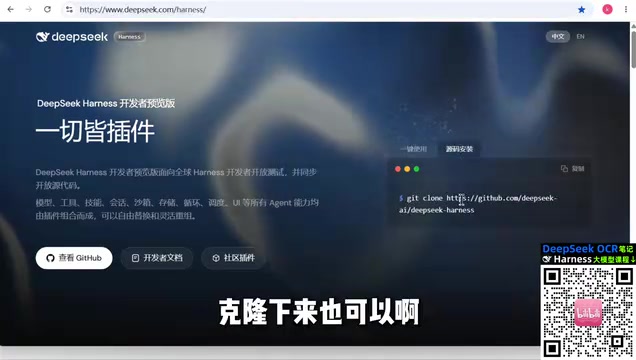
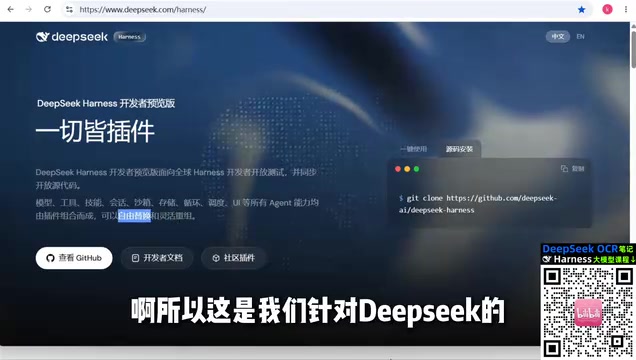
The model layer handles reasoning and decision-making—it's the "engine" of the whole system, but it doesn't come with memory, tools, or an execution environment by itself. The tools and skills layer is the interface through which the model interacts with the outside world, determining what capabilities it can invoke. According to the creator, Harness proposes the concept that "everything is a plugin," installable with a single command, and the source code is also directly available in an open-source repository.
The sandbox and storage layer provides an isolated environment and state persistence for execution, while the context and memory layer solves the problem of information continuity across multi-turn interactions. Together with peripheral components like the UI, these modules form the complete Agent capability. The key is "free replacement and flexible combination"—this design approach pushes the Agent from a monolithic architecture toward an assemblable engineering system.

Tool Calling / Function Calling refers to the model outputting structured call requests (usually a function name plus parameters) during generation, which an external runtime actually executes and returns the results to the model, forming a "judgment—execution—re-judgment" loop. The model itself doesn't execute any code; it's only responsible for deciding "what to call and what parameters to pass," and the actual execution happens on the Harness side. This is precisely the technical basis for "the model handles judgment, and Harness handles everything else."
Sandbox is an isolated runtime environment provided for tool execution, typically restricting file system access scope, network egress, and system calls to prevent model-generated code or commands from affecting the host machine. Without a sandbox, the risk of letting an Agent freely execute commands is extremely high; with a sandbox, failures can be safely rolled back and retried. Only when the sandbox works together with the storage layer can the Agent maintain state across multi-step tasks without overstepping boundaries.
Open-Source Ecosystem: Developer Preview and Global Developer Testing
Harness is released as a developer preview, open for testing to Harness developers worldwide, with the code open-sourced in parallel. This means it's not a closed product package, but more like a skeleton for secondary development.
The "everything is a plugin" positioning makes ecosystem expansion straightforward: to replace a certain component, you don't need to modify the overall architecture—just swap the plugin. For developers, this design lowers the barrier to customization; for the ecosystem, it hands the boundaries of capability over to the community to fill in. The creator also mentioned that if you want to study the source code, you can simply clone it from the code hosting platform.
Common Misconceptions
Treating Harness as a model is the easiest pitfall to fall into. A model is weights and reasoning capability; Harness is the engineering shell built around the model—the two are not at the same level of abstraction.
Treating Harness as a mere client is also inaccurate. A client is just the UI and interaction entry point, whereas Harness covers a much broader scope—from sandbox to memory, from constraints to orchestration, all are part of it.
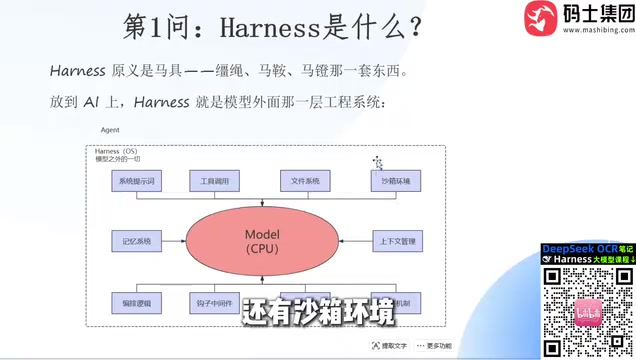
Once you understand this, the answer to "What is Harness?" in an interview becomes clear: it's everything outside the model. This definition may seem broad, but it's precisely the essence of "harness engineering"—the model makes judgments, and Harness bears all the remaining engineering responsibilities.
Why This Concept Is Worth Paying Attention To
The complexity of Agent systems often lies not in the model itself, but at the seams between the model and its environment. How to manage context, how to call tools, how to roll back on failure, how to maintain memory across turns—the solutions to these problems determine whether an Agent can truly run. Harness explicitly names these seams as an engineering system and organizes them in a plugin-based way—the approach is valuable.
For ordinary users, it may manifest as an out-of-the-box developer preview; for developers, it's a skeleton that can be disassembled, replaced, and modified as open source. The two perspectives don't conflict, because Harness itself is the middle layer connecting models to usage scenarios.
One-line Summary
Harness is the engineering middle layer outside the model that carries prompts, tools, sandbox, and orchestration.
Paragraph Summary
The article addresses the common confusion over "Is DeepSeek Harness a model or a client?" and points out that neither is accurate: Harness is an engineering system layer outside the model. Using the original English meaning of "harness" as a metaphor, the article explains that although the model is powerful, it's like a wild horse that needs a set of equipment to channel its power in the right direction. In a technical context, system prompts, tool calling, file systems, sandbox, memory, context management, constraint mechanisms, feedback loops, hook middleware, and orchestration logic all belong to Harness. Through a plugin-based lens, it can be broken down into the model layer, tools and skills layer, sandbox and storage layer, context and memory layer, and peripheral components like the UI, advocating that "everything is a plugin," one-click installation, and free replacement. It's released as a developer preview and open-sourced, open for testing to developers worldwide. The article finally clarifies two major misconceptions and emphasizes that Harness is the middle layer connecting models to usage scenarios.
Related articles
 Tech Frontiers
MuJoCo: An Analysis of DeepMind's Open-Source General-Purpose Physics Simulator
An in-depth analysis of Google DeepMind's open-source physics simulator MuJoCo: high-performance C++ kernel, MJCF modeling format, contact solving principles, MJX GPU acceleration, and robot reinforcement learning use cases.
 Tech Frontiers
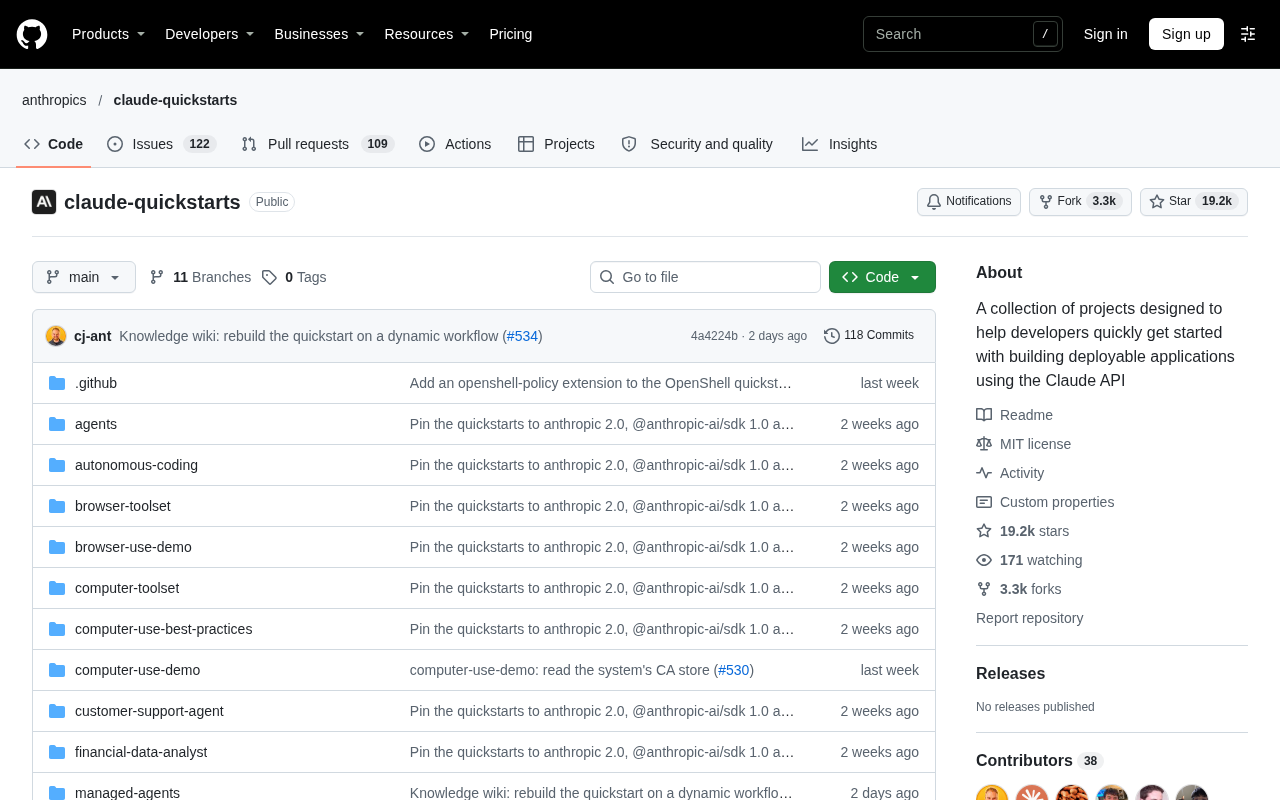
Claude API Quick Start: The Official Quickstarts Project Collection
Anthropic's official claude-quickstarts project collection helps developers quickly build deployable apps with the Claude API. Nearly 20k stars, Python-based, great for beginners and prototyping.
 Tech Frontiers
AI Agents Connecting Directly to APIs: Which Calls Can Be Safely Allowed?
AI agents can call any API, but the real challenge is deciding which calls can be safely allowed. This article analyzes allowance decisions from three dimensions—intent matching, least privilege, and controllable impact—and argues that the control layer should sit outside the agent, combined with audit traceability to build a trustworthy API call governance mechanism.