What Is GPT Astra? A Deep Analysis of the Reddit Leak's Credibility

A deep credibility analysis of the Reddit-sourced GPT Astra leak rumor from OpenAI.
A rumor on Reddit claims OpenAI will release a model called "GPT Astra" next week, sourced from a single X platform post. This article analyzes the leak's credibility by examining the single-source limitation, the naming conflict with Google's Project Astra, OpenAI's established release patterns, and the social media dynamics that amplify unverified claims. The conclusion: treat it as unverified until official confirmation.
A Viral GPT Astra Leak Sparks Heated Discussion
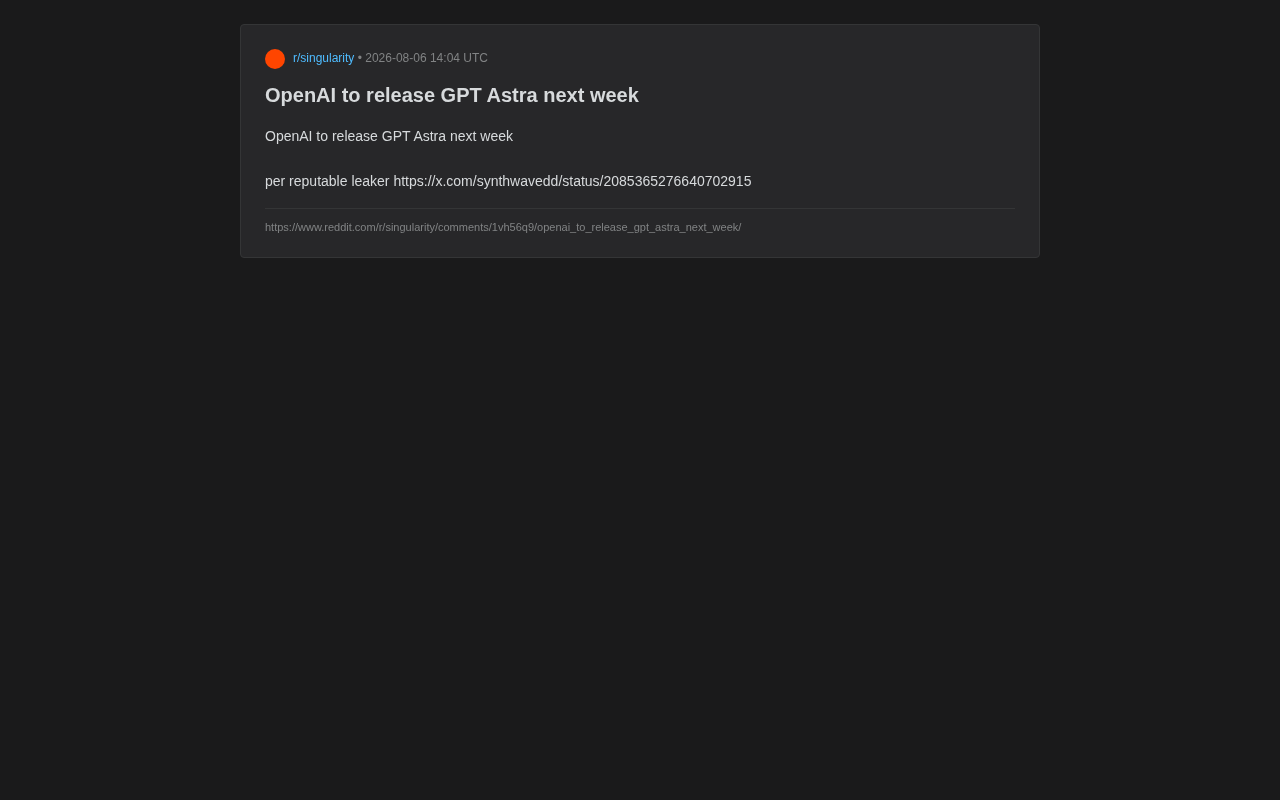
Recently, an explosive piece of news circulated on Reddit: OpenAI allegedly plans to release a new model codenamed "GPT Astra" next week. The information was attributed to a post on X by a supposedly "reputable leaker." As soon as the news broke, it triggered widespread discussion and speculation across the AI community.
However, as rational tech observers, we need to maintain a cautious stance toward such unconfirmed rumors. As of now, OpenAI has not issued any official statement regarding "GPT Astra." All information comes from a single third-party leak channel, and its authenticity cannot be effectively verified.
Credibility Analysis of the GPT Astra Leak
In the AI industry, pre-release "leaks" have become a common phenomenon. Such information is often difficult to distinguish as true or false and needs to be evaluated from multiple dimensions.
It's worth noting that tech industry leaks typically follow several common pathways: first, information spillover from supply chain partners (such as cloud infrastructure providers or chip manufacturers) during collaboration; second, company insiders anonymously leaking information to media or social platforms; and third, external developers discovering clues through API changes or code repository updates. Each pathway carries a different credibility weight. This GPT Astra rumor shows no supporting evidence associated with any of these pathways, which significantly undermines its credibility.
Limitations of the Source
The GPT Astra news comes solely from a single post by an X platform user, described as a "reputable leaker." But "reputable" is itself a subjective and hard-to-quantify label. In past cases, even accounts that have previously made accurate predictions have often gotten things wrong.
In the social media era, information dissemination exhibits a significant "cascade effect" — once an unverified piece of news gets reposted by a few influential accounts, it quickly gains the illusion of "widespread recognition." Reddit's upvote and discussion mechanisms further amplify this effect, making what is essentially a weak single source appear to have "community consensus" backing. But this does not constitute genuine information verification.
A single source with no cross-verification is the biggest credibility weakness of this news. Truly significant product launches are usually accompanied by information seeping through multiple independent channels, rather than an isolated tweet.
Suspicious Points Behind the "Astra" Name
Here's a notable detail: the name "Astra" has previously been more closely associated with Google DeepMind's "Project Astra" — a multimodal AI assistant project that Google prominently showcased at its 2024 Google I/O conference. Project Astra is positioned as a "universal AI assistant" capable of understanding users' visual surroundings in real time through phone cameras and smart glasses, while engaging in natural language conversations and retaining contextual information. The project represents Google's core strategic direction in multimodal AI interaction, and the "Astra" brand already has a clear association in the industry.
In tech industry history, naming conflicts do occasionally occur (for example, Apple's "Vision" and Meta's "Vision Pro"), but these typically involve relatively generic words. In a case like "Astra," which has already been used by a direct competitor for a flagship project, if OpenAI deliberately chose the same name, it would either mean intentional provocation or indicate the rumor itself is inaccurate. Given the direct competitive relationship between OpenAI and Google in the AI space, the former scenario is less likely, which to some extent reduces the plausibility of the rumor.
OpenAI's Product Release Patterns vs. the GPT Astra Rumor
Looking back at OpenAI's historical release cadence — from GPT-3.5 (November 2022, launched alongside ChatGPT), GPT-4 (March 2023, preceded by months of developer preview and safety evaluation), GPT-4o (May 2024, where "o" stands for "omni"), to the o-series reasoning models (such as o1 and o3, focused on complex reasoning tasks using "chain-of-thought" techniques for deep thinking before responding) — their major product releases typically go through a period of official build-up.
From a technical roadmap perspective, OpenAI currently maintains two product lines simultaneously: the GPT series representing general conversational models, and the o-series representing deep reasoning models. These two tracks serve different application scenarios — the former pursues response speed and breadth of multimodal capabilities, while the latter seeks reasoning depth in areas like mathematics, programming, and scientific reasoning. If "GPT Astra" actually exists, its positioning within this product matrix remains unclear.
CEO Sam Altman also frequently drops subtle "spoilers" on social media — for example, before GPT-4o's release, he posted suggestive tweets like "her," triggering widespread community interpretation. Currently, no warm-up signals related to GPT Astra have been observed at the official level. This represents a clear departure from OpenAI's previous release patterns, further increasing uncertainty around this rumor.
How to Rationally Evaluate AI Product Leak Rumors
Facing the endless stream of AI product leak news, regular users and industry professionals should establish a basic judgment framework:
Focus on Source Quantity and Quality
News from a single source has low credibility; information corroborated by multiple independent channels deserves more attention. At the same time, examine a leaker's historical accuracy rate rather than relying solely on vague labels like "reputable."
In journalism and intelligence analysis, there is a widely adopted "triangulation" principle: information needs to come from at least three mutually independent and unrelated sources to be considered "highly likely reliable." "Independent" means these sources have no information-passing relationship between them — for example, multiple Reddit posts discussing the same X platform tweet are essentially multiple citations of a single source, not independent verification. Truly powerful verification should come from different channels, such as an anonymous tip from an insider, an unusual change in an API endpoint, and confirmation obtained by a media outlet through independent interviews.
Wait for Official Confirmation from OpenAI
In the AI space, only official launch events, formal blog posts, or executive confirmations carry definitive significance. Any unconfirmed rumors, including this GPT Astra news, should be treated as "pending verification" rather than established fact.
Be Wary of Traffic-Driven Hype
Some leaks are essentially designed to drive traffic to accounts or generate buzz. Phrases like "releasing next week" that create urgency tend to attract more clicks and shares, but also warrant greater skepticism.
In the current social media ecosystem, AI topics have become one of the most traffic-dense areas. Discussions around AI on X and Reddit can quickly generate massive engagement, and platform recommendation algorithms prioritize high-interaction content, creating a positive feedback loop. This means a sensational but unverified "leak" often spreads far more efficiently than a cautious analytical article. Some accounts exploit this mechanism by frequently posting "exclusive news" to accumulate followers and influence — even if most of their claims are eventually disproven, the few predictions that happen to come true are enough to maintain their "leaker" label. This incentive structure inherently means that AI leak information on social media has a systematic "high noise, low signal" characteristic.
Conclusion: The GPT Astra Rumor Remains Unverified
"GPT Astra launching next week" remains an unconfirmed community rumor. Its sole source is a single social media post, lacking official endorsement and multi-party verification. Whether or not OpenAI is truly preparing a new model, we recommend readers remain rational and defer to official announcements.
In this era of rapid AI development, leaks and speculation will continue to emerge. Developing the ability to distinguish fact from fiction is more important than chasing every unconfirmed "exclusive." We will continue monitoring OpenAI's official channels and provide in-depth analysis as soon as confirmed news becomes available.
Related articles

LangChain + MCP in Practice: A Complete Guide to Building Enterprise-Grade AI Agents
Learn how LangChain and MCP protocol work together to build enterprise AI agents, covering tool binding, conversation history, ReAct reasoning loops, and production deployment strategies.

Tech Giants Raise $1 Billion to Block Universal Basic Income — What's Behind the Move?
Amazon, Microsoft, OpenAI and Anthropic co-founded RAISE US, targeting $1B to block Universal Basic Income in the U.S. A deep dive into the interests and policy battles behind this capital campaign.

Deep Dive into Design Patterns and Common Pitfalls of Multi-Agent Systems
Deep analysis of Anthropic's multi-agent system patterns and pitfalls, covering task decomposition, parallel exploration, token cost control, coordination complexity, and engineering best practices.