What Is Harness Engineering? The Origins and Real-World Applications of Agent Harnessing

Harness Engineering is the methodology for making AI agents reliable and production-ready in real-world environments.
Harness Engineering is an architectural paradigm focused on delivering AI agents reliably in production — not a specific product or framework. It addresses tool call fault tolerance, long-context management, secure execution, and multi-tenant isolation. The term was coined in February 2026 via Mitchell Hashimoto's blog and amplified by OpenAI, but the underlying practices had already been independently developed at OpenAI, Anthropic, DeepSeek, and others since mid-2025. It has since become a key benchmark in AI/Agent technical interviews.
Why Harness Engineering Is Trending in Interviews
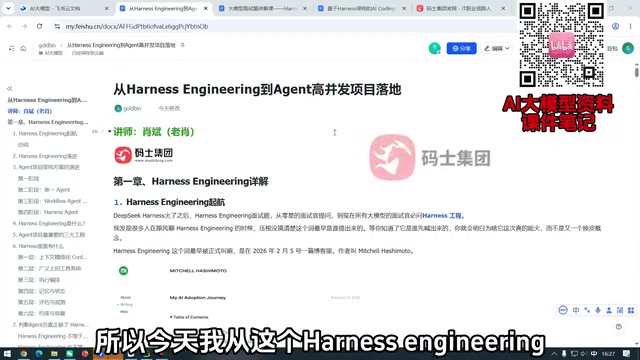
Developers job-hunting in the AI Agent space are increasingly encountering an unavoidable term in technical interviews: Harness Engineering. According to content shared by Bilibili creator Teacher Xiao from MaZhi Education, interviewers reviewing candidates with Agent projects, fine-tuning projects, or RAG projects on their resumes are no longer asking about concepts — they're asking whether the project can actually be delivered in production.
Interviewers drill into project specifics: How do you handle tool call errors? How is data security guaranteed? How does the system hold up under high concurrency? How are multiple users and tenants isolated from each other? What happens when an agent loses its memory context? The answers to these questions are exactly what separates a "demo-level project" from a "production-ready deliverable." And Harness Engineering is precisely the methodology that has emerged around solving these engineering challenges.
What Harness Engineering Actually Is
Let's start with a fundamental clarification: Harness Engineering is not a specific product, nor is it an open-source framework. It is an engineering approach to agent development — a new architectural philosophy for building AI agents.
Its core focus is on how to "harness" large language models so they can run reliably in real production environments. This manifests across several dimensions: the model's tool-calling capabilities, long-task and long-context management, maintaining conversational memory, and secure execution. A project only qualifies as production-ready when it has done solid engineering work across all of these dimensions — not just demonstrated that an agent can run through a workflow.
In other words, Harness Engineering isn't concerned with "can we get an Agent to do something" — it's concerned with "can we get an Agent to work continuously and reliably in high-concurrency, multi-tenant, error-prone real-world environments." That's the fundamental reason it has become a staple of technical interviews.

From a more technical standpoint, Harness Engineering can be compared to Site Reliability Engineering (SRE) in traditional software, but focused on LLM-centric agent systems. The core tension it addresses is this: large language models are inherently non-deterministic (random outputs, hallucination risks, tool call failures), while production environments demand determinism and observability. Harness engineering practices typically span several layers: fault tolerance and retry mechanisms for tool calls (graceful degradation or compensation when the model fails to call an external API), active context window management (preventing memory gaps from context overflow in long-running tasks), execution sandboxes and permission isolation (preventing model-generated code or instructions from causing unauthorized operations), and multi-tenant state isolation (ensuring session state and data across different users never cross-contaminate). The underlying premise of this methodology is to acknowledge the fragility of LLMs at the engineering layer — and then build a sufficiently robust "harness" around them to compensate.
Where the Term "Harness" Comes From
Teacher Xiao provided a fairly clear timeline on the origin of this terminology.
The word "Harness" made its first formal appearance in the agent space on February 5, 2026, when an author named Mitchell Hashimoto published a blog post. In chapter five of that article, a section titled "Ingenuity in the Harness" appeared — widely regarded as the first formal use of the term in the Agent industry.
Just six days later, on February 11, OpenAI published a follow-up blog post that featured related "Harness Engineering" terminology in its own headings. It was OpenAI's amplification that elevated "Harness" from a phrase in one blog post to a systemic engineering concept covering the full Agent architecture landscape. From there, the industry gradually coalesced around this terminology.
An Important Clarification: The Ideas Predate the Name
This is a point Teacher Xiao specifically emphasized, and one that's easy to misunderstand: do not assume Harness Engineering was born after February 2026.
In fact, as early as the second half of 2025 and into late 2025, companies including OpenAI, Anthropic, and Chinese counterparts like DeepSeekAd, Qwen (Tongyi), and Tencent were already actively exploring and improving their agent systems in this direction. The architecture simply didn't have a unified name yet.
Each company took a different technical approach, independently evolving architectures that converged on the same set of problems: model tool integration, long-task handling, long-context management, and secure execution. These outcomes were not "inspired" by any single blog post, nor were they built on a shared technical framework — they were the products of independent internal exploration at each company. The blog post and OpenAI's follow-up simply gave a consensus name to a practice that already existed.

This "ideas before naming" phenomenon is not uncommon in the history of technology. A parallel example is the term "Microservices" — before Martin Fowler and James Lewis formally named it in their 2014 article, companies like Netflix and Amazon had already been running microservice architectures at scale in production for years, simply without a widely accepted term. The value of naming lies in this: it allows similar practices scattered across different organizations to be recognized as addressing the same class of problems, which in turn accelerates the aggregation and spread of knowledge. For Harness Engineering, the February 2026 naming event served the same "conceptual anchoring" function — it gave practitioners a shared vocabulary and enabled hiring teams to standardize engineering capability assessments around a searchable, discussable keyword.
Mature Products: From OpenCloud to Various Agents
As the concept took shape, a wave of mature products embodying Harness Engineering principles began to emerge — including Cloud Code, Codex, OpenCloud, Hermes Agent, and DeepSeek's Harness implementation (DSH).
In Teacher Xiao's view, the earliest mature Harness engineering product was OpenCloud. It was already active by late 2025, which further supports the argument that Harness engineering practice predates its naming. The common characteristic across all these products is that they place large language models inside a controllable, manageable, and safely executable "harness" system — rather than simply wrapping a chat interface around the model.

Among these products, Codex deserves special mention: it is OpenAI's code generation and execution agent built on the GPT-4 series. Unlike the earlier code completion model of the same name (from 2021), the new-generation Codex emphasizes executing multi-step programming tasks within a secure sandbox — a textbook implementation of Harness principles in the coding domain. Claude's Computer Use feature (from Anthropic) represents a different approach, allowing the model to directly control an operating system's GUI, with its underlying architecture similarly dependent on strict permission isolation and operation auditing. What all of these products share is this: the large language model is no longer just "an interface that generates text" — it's encapsulated within an engineering system with state management, error recovery, and security boundaries. That is the core expression of Harness Engineering.
Summary and Practical Takeaways
With this full picture in view, a few practical conclusions emerge.
For job seekers, Agent projects on a resume need to hold up under detailed scrutiny — the key question is whether you've addressed real engineering problems like tool call error handling, data security, high concurrency, tenant isolation, and memory context gaps. For understanding the concept itself: Harness Engineering is an agent architectural and engineering paradigm whose ideas were already taking shape at multiple companies in the second half of 2025; the name was introduced in February 2026 through Mitchell Hashimoto's blog post and achieved industry consensus after OpenAI's follow-up.
The real value of Harness Engineering doesn't lie in memorizing when the term was coined. It lies in whether you can translate the idea of "harnessing a large language model" into actual code and into deliverable projects. That is the direction that must be mastered on the path from concept to production-scale implementation.
Related articles

Hands-On with the Gemini 4 Argon API: Thinking Levels and Background Mode Explained
A Free Code Camp crash course on the Gemini 4 Argon API: from getting a key and sending your first request to controlling reasoning costs with thinking levels, enabling multi-turn chat with previous_interaction_id, and generating a Breakout game in background mode—plus a Google engineer's take on the model's capabilities.

Reinforcement Learning Takes On Getting Over It: Distributed Training Strategies Behind 63% Progress
A developer uses deep reinforcement learning to tackle Getting Over It. The agent climbs from the bottom to 63% progress but gets stuck at the anvil. The project is open-sourced, using divide-and-conquer training and CPU-only training, seeking community collaboration to break the bottleneck.

Sigma FP2 Released: The World's Smallest Full-Frame Camera Gets Sensor and Screen Upgrades
Sigma launches the FP2 full-frame camera, retaining its smallest-and-lightest design with three key upgrades: improved sensor, articulating LCD screen, and longer battery life—built for portable video creators.