What Is WorkBuddy? A Beginner's Guide to China's Codex Alternative for AI-Powered Office Work

WorkBuddy is a China-adapted Codex alternative with a low barrier to entry and a 28-lesson beginner course.
This article introduces WorkBuddy, an AI productivity tool positioned as a China-adapted version of OpenAI's Codex. It features a similar interface but a lower barrier to entry — no complex setup, a free tier, and direct integration with domestic office software. Its value lies in executing real tasks like organizing materials, generating documents, and processing data, rather than casual chat. A Bilibili creator compiled a beginner-friendly course spanning four modules and 28 lessons, with supplementary materials covering installation, case studies, SQL customization, and industry use cases.
Why WorkBuddy Deserves Your Attention First
Among the many AI tools available today, one Bilibili creator made a clear recommendation: if you only have the bandwidth to seriously learn one tool, make it WorkBuddyAd. Its positioning is straightforward — think of it as a China-adapted version of Codex, with a similar interface and operational logic, but redesigned to be far more accessible for domestic users.
Compared to many AI coding tools that require complex setup and demanding hardware, WorkBuddy has a noticeably lower barrier to entry: no complicated environment configuration, no steep hardware requirements, and a free usage tier included. That means complete beginners can jump straight in without first clearing a technical hurdle.
The more critical differentiator lies in its ecosystem compatibility. It connects directly with commonly used domestic office software, consolidating workflows that previously required juggling multiple tools.

Codex is OpenAI's AI coding model, whose core capability lies in understanding natural language instructions and converting them into executable code. It also supports reading and writing files, calling external tools, and autonomously completing multi-step tasks. Typical use cases include auto-generating code, debugging programs, and operating local file systems. At its core, it's an AI agent capable of "acting autonomously" within a computing environment. Unlike ordinary chat-based AI, Codex-class tools don't just offer suggestions — they execute operations and produce results. WorkBuddy targets this same product category, meaning it also possesses task execution capabilities rather than functioning as a simple Q&A tool. That's the underlying reason it's recommended for real office workflows rather than casual conversation.
From Chat Window to Genuine Productivity Tool
Many people open this type of AI tool, ask a few casual questions, and close it when they're done. The tool itself is highly capable, yet ends up being used as nothing more than a chat window — a real waste of its potential.
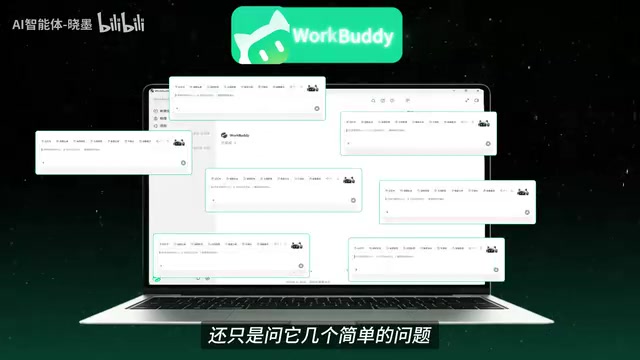
WorkBuddy's value lies precisely not in small talk, but in completing concrete tasks on your behalf. Typical scenarios mentioned in the original video include: organizing materials, generating documents, analyzing spreadsheets, and handling repetitive batch operations. Workflows that previously required switching between multiple applications can now be handed off to a single tool.
In other words, its role is closer to a capable assistant than a conversational chatbot. To unlock that value, users need a mindset shift: treat it as part of your workflow, and proactively delegate time-consuming, repetitive tasks to it rather than settling for back-and-forth Q&A.
A Structured Beginner-Friendly Course
The creator mentioned spending nearly three months compiling a hands-on course designed for users with zero prior experience. It's organized into four modules: Basics, Case Studies, Advanced (described in the original as "Boundary-Setting"), and Industry Applications — covering a total of 28 knowledge points.
The course follows a progressive logic, starting from the most fundamental operations and gradually moving into real-world office scenarios. The author repeatedly emphasizes two points: not knowing how to code is fine, and having no prior AI experience is fine too. The core method is to follow along and practice as you go — learn by doing, and progressively hand off repetitive, time-consuming work to the AI.
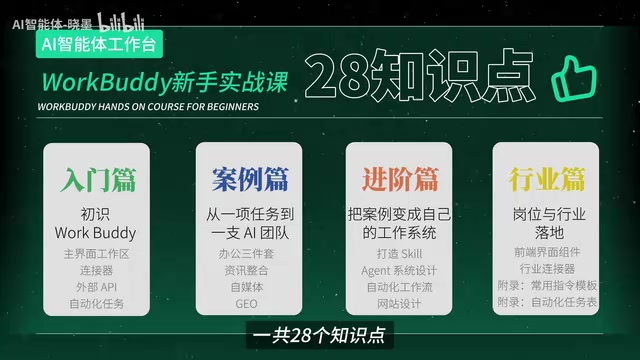
This "practice-first" structure is beginner-friendly by design. The learning curve for AI tools rarely comes from theory — it comes from whether you're willing to open the tool and whether you have a clear practice path to follow.
Supplementary Materials and Four Application Modules
Beyond the video course, the author has compiled a supplementary resource pack covering four modules: installation instructions, case breakdowns, SQL customization, and industry applications. It also includes 12 commonly used SQL statements and additional hands-on practice materials.
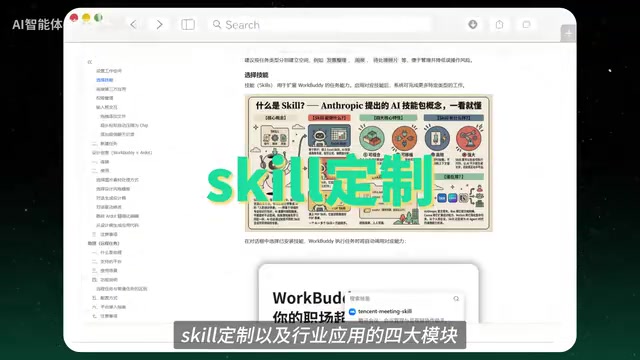
The inclusion of SQL-related content is worth noting. For users who need to process data and analyze spreadsheets, a basic grasp of SQL can significantly boost efficiency when working with structured data in AI tools — which also signals that WorkBuddy's use cases extend well beyond document handling into the realm of data analysis.
The materials are available through the typical engagement model: like, save, and comment with a specific keyword to receive the resource pack.
SQL (Structured Query Language) is the standard language for managing and querying relational databases. Common operations include filtering rows from a table, aggregating statistics, and applying conditional logic. Even without a programming background, mastering a dozen or so basic SQL statements (such as SELECT, WHERE, and GROUP BY) is enough to handle most data organization tasks. With AI assistance, users can even describe what they need in plain language and have the AI generate and execute the corresponding SQL automatically — dramatically lowering the barrier to data analysis. The inclusion of a dedicated SQL module in this course signals that WorkBuddy is positioned not just for text-based office tasks, but also for the high-frequency need of spreadsheet and data processing.
A Word of Practical Advice
The author's closing reminder is worth taking seriously: once you have the materials, practice as you go — don't let the tool collect dust in your bookmarks.
This points to a common pitfall in learning AI tools: people collect countless tutorials but never actually open the tool and work through them. For a tool like WorkBuddy that emphasizes "getting things done," the only way to translate its capabilities into your own productivity is to use it repeatedly on real tasks.
One important note: this article is based on a single video source. For specifics on WorkBuddy's actual feature performance, free tier details, and how it genuinely compares to Codex, please refer to official information and your own hands-on experience.
Related articles

Felix Rieseberg Personal Homepage
Felix Rieseberg's personal homepage sparks attention on Hacker News. This article covers the Slack engineer's technical background, the rise and fall of nativefier, and the value of a developer homepage as a tech calling card.

@ai-sdk/vue 3.0.306 Patch Release Syncs with [email protected] Update
@ai-sdk/vue 3.0.306 released, synced with [email protected]. A routine patch release for the Vercel AI SDK ecosystem with no public API changes; the Vue adapter layer stays version-aligned with the core package.

Gemini 4 Argon API Launches: The Era of Million-Token Output Begins
Google launches Gemini 4 Argon with sparse MoE architecture, up to 1M output tokens, and a 68.90% Vals Index score, available across API, AI Studio, and the Gemini app.