What It Means That Nemotron's 2-Bit Quantized 30B Model Sustained Tool Calling for 10 Minutes

Nemotron's 2-bit quantized 30B model sustained tool calling for 10+ minutes, challenging low-bit quantization limits.
NVIDIA's Nemotron 3.5 Lightning model demonstrated remarkable robustness by sustaining tool calls for over 10 minutes after extreme 2-bit quantization. This challenges assumptions about low-bit model capabilities, as tool calling demands strict format compliance and logical coherence—exactly what quantization typically degrades. The breakthrough suggests deep hardware-software co-design and could enable 30B-class Agent capabilities on consumer GPUs.
An Underestimated Technical Milestone
Recently, a technical observation shared on Twitter caught the AI community's attention: NVIDIA's Nemotron 3.5 Lightning model, after extreme 2-bit quantization, sustained tool calls for over 10 minutes continuously. Industry observers called this "impressive" because it directly challenges conventional assumptions about the capability ceiling of low-bit quantized models.
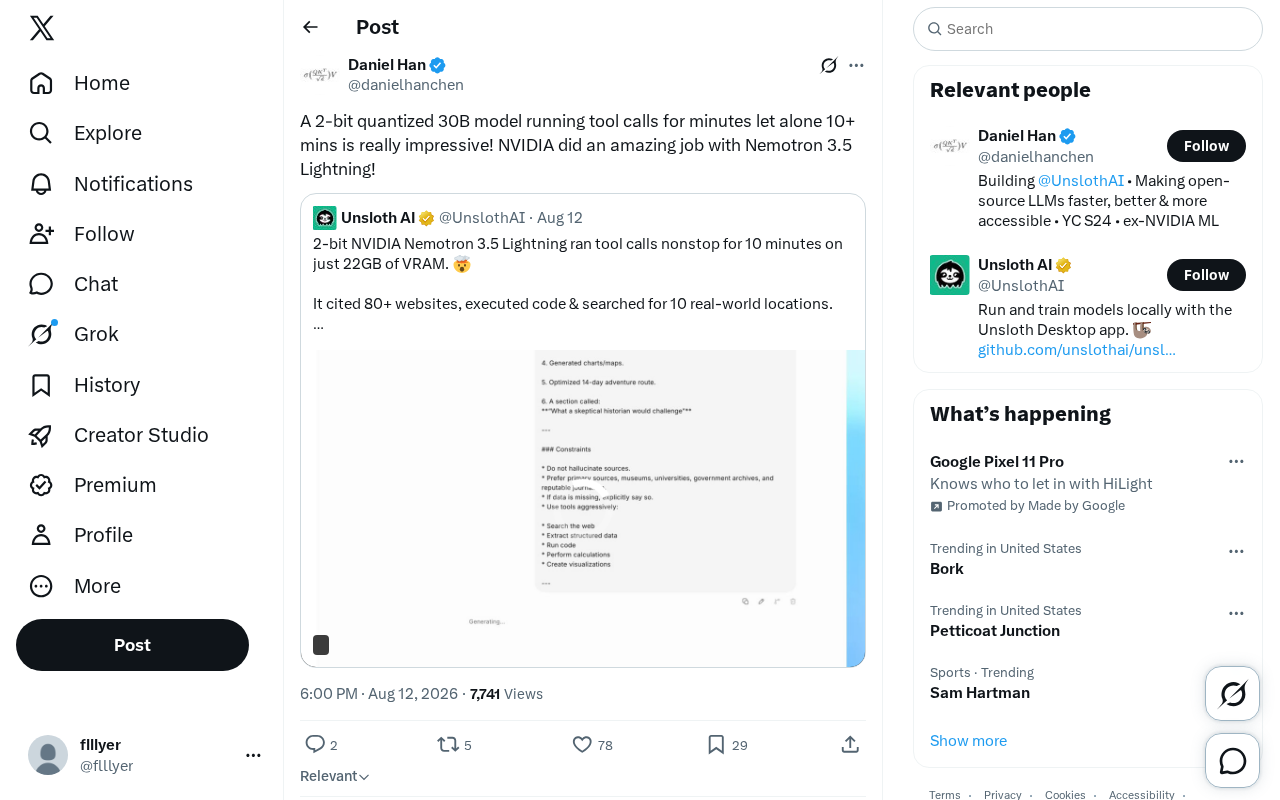
For readers unfamiliar with this domain, this single observation conceals the simultaneous breakthrough of several technical challenges. To understand its significance, we need to unpack a few key concepts: what 2-bit quantization is, why sustained tool calling from a 30B model is so difficult, and what exactly NVIDIA got right.
Why 2-Bit Quantization Is So Aggressive
The Essence of Quantization
Large language model parameters are typically stored and computed in 16-bit (FP16/BF16) floating-point format. Quantization compresses these high-precision values to lower bit widths—such as 8-bit (INT8), 4-bit (INT4), or the most extreme: 2-bit. The lower the bit width, the less VRAM the model consumes and the faster inference runs, but at the cost of precision loss.
2-bit quantization means each weight is represented by only 4 possible states (2 to the power of 2). Compared to the original FP16, this achieves an 8x compression ratio. This level of compression was previously thought to cause "brain damage" to models—meaning severely degraded output quality, or even complete inability to perform complex multi-step reasoning tasks.
The Evolution of Mainstream Quantization Methods
To understand the difficulty of 2-bit quantization, it helps to review current mainstream quantization approaches. Early methods mostly used Post-Training Quantization (PTQ), which directly compresses weights after model training is complete. Representative methods include GPTQ (which corrects quantization errors layer by layer using second-order information) and AWQ (Activation-aware Weight Quantization, which adaptively quantizes weights based on activation value importance distributions). These methods can maintain near-original model performance at 4-bit precision, but when pushed further to 2-bit, error accumulation escalates dramatically. More recent methods like QuIP# and AQLM attempt to improve precision retention at extremely low bit widths through vector quantization and codebook learning, but their performance on real-world complex tasks remains unstable. The fact that Nemotron 3.5 Lightning maintains tool-calling capability at 2-bit suggests NVIDIA may have done deep adaptation at the Quantization-Aware Training or model architecture level, rather than relying solely on post-training quantization.
The Gap Between Storage and Capability
A quantized model being able to "run" and being able to "run well" are two entirely different things. Many 2-bit approaches might still maintain reasonable scores on benchmarks, but once they enter real-world tasks requiring long-chain logical coherence, performance collapses. This is precisely why this observation deserves attention: the model isn't simply generating a passage of text—it's continuously and stably executing tool calls.
Why Tool Calling Is a More Demanding Test
What Is Tool Calling
Tool calling is the core capability of modern AI Agents. The model must determine when to invoke external tools (such as search engines, code executors, or API endpoints), generate structured call parameters, parse returned results, and then decide the next action. This requires model outputs to strictly conform to format specifications like JSON or function signatures—any single character error can cause the call to fail.
This capability is commonly known as Function Calling in the industry, first standardized and popularized by OpenAI in mid-2023. Since then, virtually all major model providers have followed suit in supporting this interface specification. In the open-source ecosystem, Agent frameworks like LangChain, CrewAI, and AutoGen heavily rely on tool calling as a foundational capability, upgrading large language models from "conversation machines" to "task executors." The quality of tool calling directly determines Agent reliability—a single formatting error can break an entire workflow, and the subtle precision losses introduced by quantization are precisely the kind that most easily surface in structured outputs.
What "10 Minutes of Sustained Operation" Really Means
The statement "running tool calls for over 10 minutes" is particularly significant. It means the model, within a long-running Agent workflow, repeatedly performed multiple rounds of tool calls without format collapse or logical drift. For a 30B model compressed to 2-bit, this requires maintaining structured output stability and reasoning chain coherence at extremely low precision—exactly the capabilities that quantization most readily destroys.
In other words, sustaining this for even a few minutes would be noteworthy; maintaining it for over 10 minutes demonstrates remarkable robustness under extreme compression.
The Technical Significance of NVIDIA Nemotron 3.5 Lightning
Nemotron Family Positioning
Nemotron is NVIDIA's open-source model series, focused on efficient inference within their hardware ecosystem and enterprise-grade applications. The "Lightning" naming signals an ultimate optimization for inference speed and efficiency. The fact that this 30B-scale version maintains strong Agent capabilities under 2-bit quantization indicates that NVIDIA has achieved substantive progress in the co-design of quantization algorithms and model architecture.
Notably, NVIDIA possesses a full-stack advantage from chips to inference engines. Their TensorRT-LLM inference framework is deeply optimized for Tensor Cores on their GPUs, enabling efficient execution of low-bit integer operations. This means Nemotron's quantization scheme was likely co-designed with the underlying hardware instruction set—quantization isn't merely software-level compression, but native bit-width matching with GPU compute units. Furthermore, NVIDIA has built a complete pipeline from data processing, model training, to deployment inference through the NeMo framework in recent years, and the Nemotron series is the productized embodiment of this vertical integration strategy. This software-hardware synergy is a competitive moat that pure software companies find difficult to replicate.
The Direction of an Efficiency Revolution: Lowering Deployment Barriers
The deeper value of this achievement lies in lowering deployment barriers. If a 30B model can stably run complex Agent tasks at 2-bit precision, its VRAM requirements drop dramatically—meaning more developers can run capabilities on consumer-grade GPUs or edge devices that previously required expensive clusters. This has direct practical implications for local deployment, privacy-sensitive scenarios, and inference cost control.
To illustrate with concrete numbers: a 30B-parameter model at FP16 precision requires approximately 60GB of VRAM, far exceeding consumer GPU capacity. After 2-bit quantization, model weights need only about 7.5GB, and with KV Cache and activation overhead during inference, total VRAM usage could potentially be kept within 12-16GB—which falls squarely within the usable range of an RTX 4090 (24GB) or even some 16GB GPUs. This leap from "data center-grade" to "desktop-grade" is enormously significant for independent developers and small-to-medium enterprises.
Maintaining a Cautious Perspective
Interestingly, this observation currently comes from a single community source—a personal usage experience share—without large-scale third-party benchmark testing or reproduction reports to corroborate it. Excellent performance of a 2-bit quantized model on specific tasks may not generalize to all scenarios. Extreme quantization typically exhibits "task dependency"—performing well on certain structured tasks while potentially still falling short on open-ended creative writing or deep reasoning.
Therefore, while we should remain optimistic about this progress, we should also await more objective test data to verify its true capability boundaries across a wide range of tasks.
Conclusion
Nemotron 3.5 Lightning's performance in sustaining tool calls under 2-bit quantization represents an important signal that low-bit quantization technology is advancing from "usable" to "reliable." It reminds us that progress in model efficiency comes not only from larger parameter scales, but also from smarter compression strategies. As quantization technology and Agent capabilities mature in tandem, the vision of running powerful AI Agents on limited hardware is becoming increasingly within reach.
Key Takeaways
Related articles

Why Does the Tesla Roadster Need to Fly? A Deep Dive into Musk's Wild Demo
Tesla's Roadster launch showed wall-climbing, upside-down driving, and flying stunts—but The Vergecast notes the demo car may lack a battery, the Rocket version is invite-only and not street-legal, and the website terms don't guarantee delivery. After nine years of delays, why does this car still need to exist?

AI Is Not a Replacement: Human-AI Collaboration Through the Lens of Factory Root Cause Analysis
Starting from factory root cause analysis, this article explains how AI accelerates evidence chain construction rather than replacing human experts, exploring the pragmatic implementation logic and business value of 'AI supporting people rather than replacing them.'

AI Agent Decision Auditing: Building an Evidence Chain in Regulated Workflows
Starting from a Reddit discussion, this article analyzes three core issues in AI agent decision auditing within regulated workflows: what fields audit records should contain, how to handle feedback latency for erroneous decisions, and how to continuously calibrate LLM judge consistency with human judgment.