What's It Like to Submit to JMLR? The Real Dilemmas of an Interdisciplinary PhD
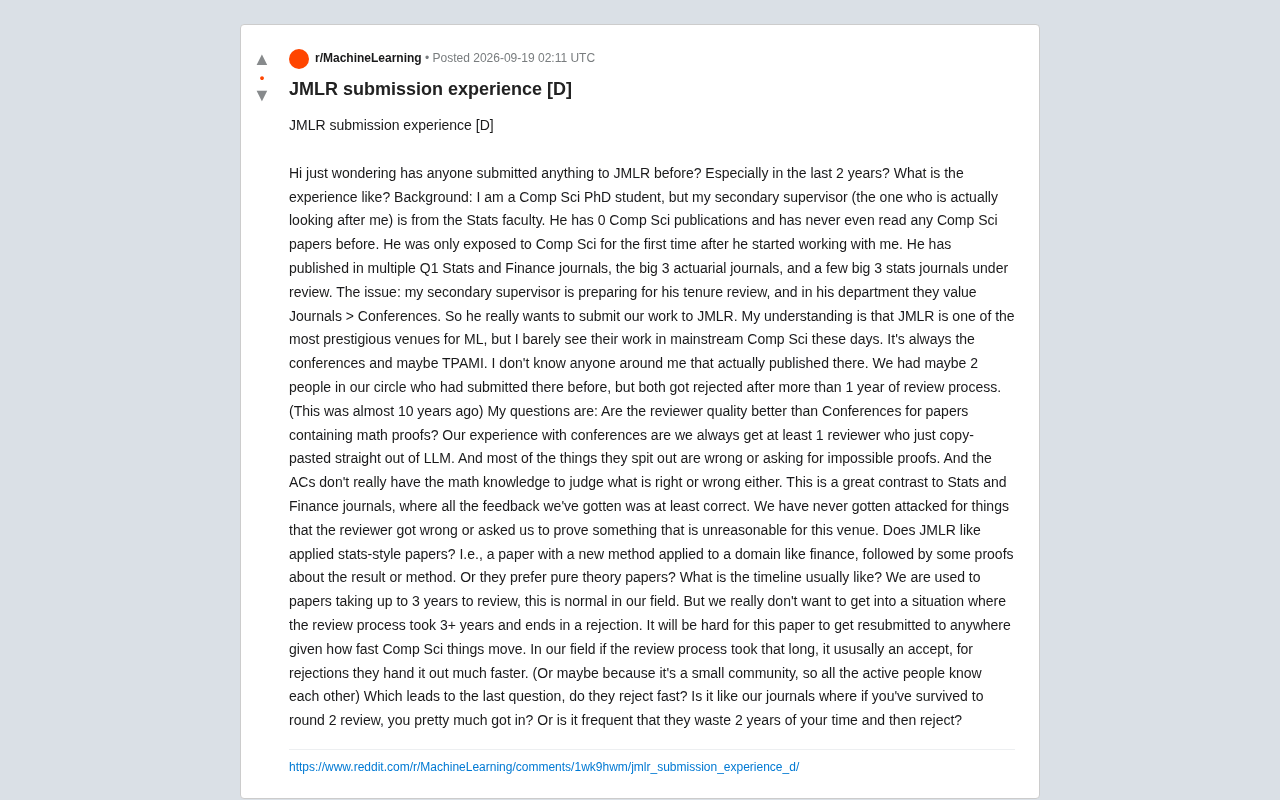
A CS PhD navigates JMLR submission pressures as his statistics advisor's tenure needs clash with ML conference culture.
A CS PhD student posted on Reddit asking about real JMLR submission experiences, prompted by his statistics advisor's tenure review — where journals outweigh conferences. His concerns span four dimensions: whether JMLR's reviewers handle math-heavy proofs better than top conferences plagued by LLM-generated reviews; whether JMLR accepts interdisciplinary "method + application + proof" papers; whether a multi-year review ending in rejection could be fatal for fast-moving CS work; and whether JMLR follows the statistics norm where slow reviews signal acceptance. The post exposes a deep structural tension in ML between a conference-dominated CS culture and the journal-centric norms of statistics and finance.
An Interdisciplinary Submission Dilemma
On Reddit's machine learning subreddit, a computer science (CS) PhD student posed a question that resonates with many: what is it actually like to submit to JMLR (Journal of Machine Learning Research)? Specifically, could anyone who has submitted within the past two years share firsthand experiences?
This student's situation is somewhat unusual. His co-advisor — who is effectively his primary supervisor — comes from a statistics department and had virtually no exposure to computer science before their collaboration. This advisor had never read a CS paper until working with him, yet has an extensive publication record in Q1 journals across statistics, actuarial science, and finance.
The tension arises because this statistics advisor is preparing for a tenure review, and in his department, journals carry far more weight than conferences. He therefore wants to submit their joint work to JMLR — which brings two fundamentally different academic evaluation systems into direct conflict.
JMLR's Awkward Standing in the CS World
The poster admits he understands JMLR is one of the most prestigious venues in machine learning, yet it rarely appears in mainstream CS research today. The landscape is dominated almost entirely by top conferences (NeurIPS, ICML, ICLR, etc.), with the occasional top journal like TPAMI.
Nobody in his immediate circle has actually published in JMLR. Two people he knows submitted there, but both were rejected after review processes lasting over a year — and that was nearly a decade ago.
This observation highlights a long-standing structural feature of the ML field: conferences are the primary battlefield in CS/ML. Given the field's rapid iteration, conferences — with their relatively fixed and shorter review cycles — have become the go-to venue for first publication. Journals, while more prestigious and thorough in their reviews, have timelines that create friction with the pace of fast-moving research. For a researcher with a pure CS background, committing major work to a journal is genuinely counterintuitive.
JMLR (Journal of Machine Learning Research) was founded in 2000 by Leslie Kaelbling and others, originally as a protest against the steep copyright fees and lengthy publication timelines of commercial journals — all content is fully open access, with no publication fees. Before the deep learning boom, JMLR was the most authoritative publication venue in machine learning, with a consistently high Impact Factor; foundational theoretical work on algorithms like SVM and AdaBoost was published there. After 2012, however, as NeurIPS, ICML, and ICLR exploded in submission volume and influence, JMLR's relative standing within the CS/ML community gradually waned — not because its quality declined, but because the entire field's publication culture was reshaped by conference dominance. It's worth noting that JMLR also hosts sub-journals including JMLR: MLOSS (Machine Learning Open Source Software) and TMLR (Transactions on Machine Learning Research), the latter founded in 2022 on the OpenReview platform, attempting to bridge the speed gap between journals and conferences through a rolling publication model.
Review Quality: The Pain Point of Conferences vs. the Promise of Journals
The poster's first core question is pointed: for papers with mathematical proofs, is JMLR's reviewer quality actually better than at conferences?
He describes a recurring frustration with conference submissions: there is almost always at least one reviewer who directly pastes LLM output as their review — output that is mostly wrong, or that demands unreasonable and impossible proofs. Worse, the area chair (AC) often lacks sufficient mathematical background to adjudicate who is right.
This stands in stark contrast to his experience with statistics and finance journals, where every piece of feedback he has received has been at least correct — he has never been unfairly attacked due to a reviewer's own misunderstanding, nor been asked to prove something beyond the reasonable scope of the venue.
This contrast exposes the real anxiety of interdisciplinary researchers: when a paper's value lies primarily in mathematical rigor, whether reviewers have the ability and patience to genuinely work through the proofs determines the entire submission experience. Proof-heavy work is naturally at a disadvantage in a conference system oriented toward empirical results under tight review deadlines.
Declining review quality at top ML conferences has become a widely discussed structural problem in the community. NeurIPS 2021's double-blind experiment revealed that acceptance decisions for the same batch of papers were consistent only about 50% of the time across two independent review committees — close to random. As submission volumes exploded through the 2020s (NeurIPS now receives over ten thousand submissions per year), conferences have been forced to massively expand their reviewer pools, resulting in many reviewers lacking relevant domain expertise. The proliferation of LLMs has further aggravated this issue: some reviewers use language models to generate reviews that are superficially fluent but factually wrong — particularly damaging for mathematical proof-based work, since LLMs' limitations in formal reasoning produce plausible-sounding but incorrect criticisms. Authors struggle to rebut these effectively because ACs may equally lack the ability to judge independently. This is the fundamental reason theoretically-oriented researchers find conference submissions so frustrating.
Double Uncertainty: Paper Style and Review Timeline
The poster's second question concerns JMLR's editorial preferences: does it welcome papers in an applied statistics style — proposing a new method, applying it to a concrete domain like finance, and supporting it with proofs about the results or the method — or does it strongly prefer pure theory papers?
This question is critical for interdisciplinary authors. A paper combining "new method + domain application + theoretical proofs" sits precisely at the intersection of statistics journals and ML venues. Whether JMLR would embrace such a paper directly shapes the submission strategy.
His third and fourth questions focus on time costs. In his statistics and finance circles, a three-year review process is normal. But his real fear is getting trapped in the worst-case scenario: three years of review followed by rejection. Given how fast CS evolves, a paper that is dragged out for three years and then rejected is nearly impossible to resubmit elsewhere.
He also mentions an interesting field norm: in statistics, a lengthy review usually signals acceptance — rejections tend to come faster (he speculates this may be because it's a small community where active people know each other). He therefore wants to know — does JMLR reject quickly? Is there a similar pattern where making it to a second round is essentially a green light, or does JMLR routinely burn two years of your time before delivering a rejection?
Navigating a Decision Between Two Academic Cultures
The value of this post lies not in its answers, but in how clearly it captures the real dilemma facing a researcher caught between two academic cultures:
- Conflicting evaluation systems: CS values conferences; statistics values journals. The advisor's tenure needs run directly counter to the student's field norms.
- Review quality concerns: Mathematically intensive work risks unprofessional reviews in the conference system. Journals may be more reliable, but without personal experience, this is hard to verify.
- Time risk: A prolonged review cycle that ends in rejection is nearly fatal for fast-moving CS work.
For any early-career researcher navigating interdisciplinary work and needing to balance different publication cultures, these are questions worth thinking through in advance. Choosing where to submit is, at its core, an exercise in finding the optimal balance between prestige, review quality, time costs, and career needs.
The divergence in tenure evaluation criteria across disciplines is the institutional root of this dilemma. In most North American statistics, mathematics, and quantitative social science departments, tenure review committees primarily assess the quantity and quality of peer-reviewed journal publications, with journal rankings (Q1/Q2) and impact factors serving as metrics that external reviewers can directly quantify. In CS departments, top conference papers (especially from A*-tier venues like NeurIPS/ICML/ICLR/CVPR) are treated as equivalent to or even superior to journal publications; some institutions explicitly state in tenure documentation that "top conference papers are equivalent to top journal publications." When a faculty member's academic career is embedded in a statistics department's institutional framework while their research spans machine learning, publication decisions are no longer purely academic choices — they become strategic considerations that directly affect career survival. For the collaborating PhD student, this advisor-driven submission strategy may create a mismatch with their own future competitiveness in the CS academic job market, a tension worth discussing explicitly before the collaboration begins.
Related articles

What Are APIs and API Keys? A 4-Minute Explainer Using DeepSeek's Docs
What are APIs and API Keys? Using DeepSeek's official docs and a live terminal demo, this guide explains the core concepts in 4 minutes with a simple door-and-key analogy.

AI Agent Beginner's Guide: How Agents Work, What They're Made Of, and Where They're Used
A beginner's guide to AI Agents: learn how agents differ from chatbots, the three core components (brain, memory, tools), and the three types of agents available today.

Beware of 'One-Click GPT-6 Deployment' Scams: Third-Party API Wrapper Traps Explained
Fact-checking viral 'free GPT-6 one-click deployment' tutorials: the GPT-6 X-TRAW model doesn't exist, and third-party token relays pose serious data and security risks.