What's It Like Using Claude Code? Developers Are All Feeling the Same Thing
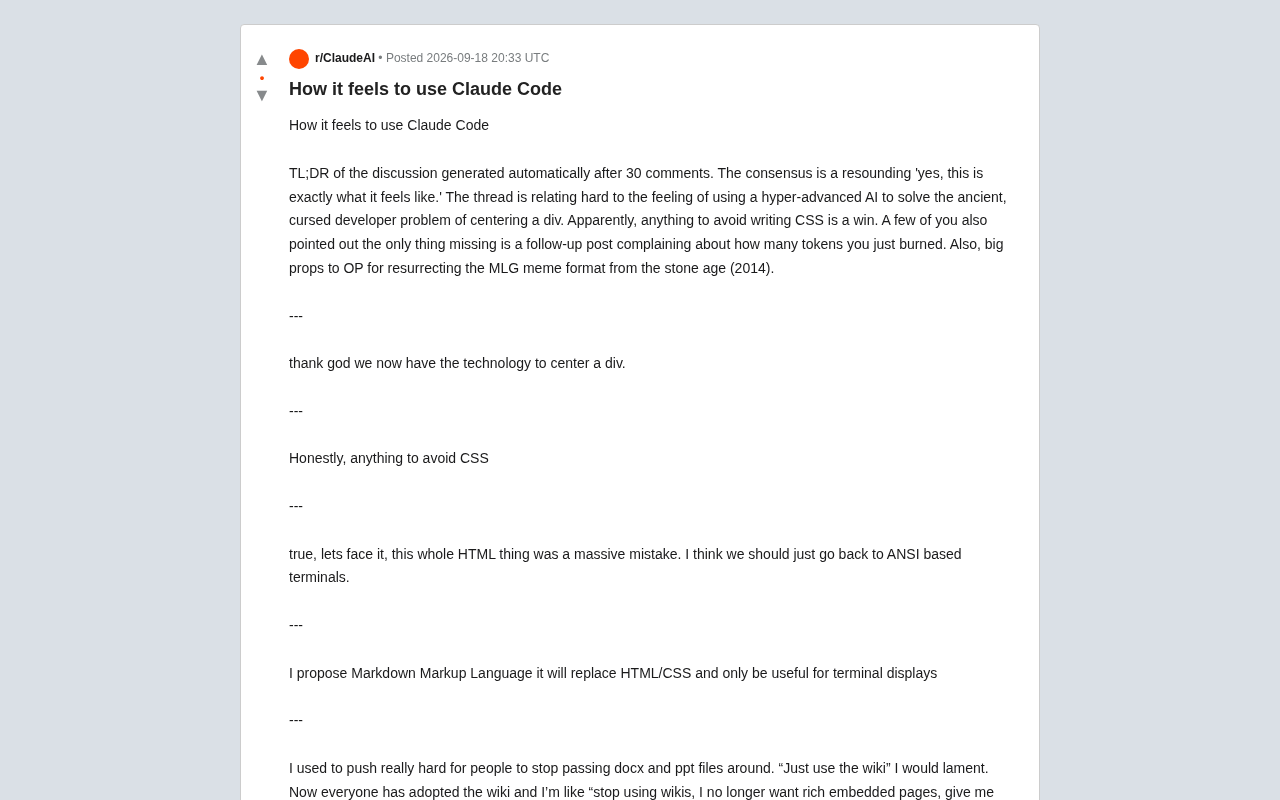
A joke about using AI to center a div captures how developers really feel about AI coding tools today.
A Reddit post mocking the use of Claude Code to center a div went viral, perfectly capturing the bittersweet reality of AI coding tools: wielding powerful agents for mundane CSS tasks. The discussion expanded into jokes about web tech stack complexity, a serious insight about Markdown becoming the preferred documentation format for AI agents, and the recurring pain of token costs. Beneath the humor lies a genuine reflection on how AI is quietly reshaping developer workflows, collaboration standards, and tech stack thinking.
A Meme That Struck a Nerve Across the Developer Community
A Reddit post asking "what it feels like to use Claude Code" went unexpectedly viral, with an auto-generated comment summary after just 30 replies capturing a near-unanimous verdict: "Yes, this is exactly what it feels like." The original poster used the retro MLG meme format — that over-the-top, heavily edited style popular around 2014 — to depict a developer deploying a cutting-edge AI model to solve one of programming's oldest, most infuriating problems: centering a div.
As absurd as it sounds, the scenario resonated so widely because it perfectly captures a peculiar mindset in the age of AI coding tools: we have a powerful AI Agent at our fingertips, and we often end up using it for tasks that should be simple — yet have driven countless developers absolutely mad.
"Thank God We Finally Have the Technology to Center a Div"
The top comment in the thread read, half-jokingly: "Thank God we finally have the technology to center a div." Behind that quip lies the long-standing "original sin" of CSS layout — vertical centering, flex alignment, the box model — concepts that have tormented generations of front-end developers.
Now that a powerful (and pricey) large language model gets summoned to handle these kinds of problems, the absurdity of using a sledgehammer to crack a nut collides with the sheer relief of never having to think about it again. As another commenter bluntly put it: "Honestly, I'll do anything to avoid writing CSS."
The reason centering a div became such a classic front-end meme has real historical roots. Early CSS specifications weren't designed for complex UI layout. vertical-align only worked on inline elements, and vertically centering a block-level element required hacks like negative margins, absolute positioning with transforms, and other workarounds — each with its own prerequisites and edge cases. It wasn't until Flexbox (mainstream around 2012) and CSS Grid (2017) that layout logic fundamentally improved. The combination display: flex; align-items: center; justify-content: center finally made centering genuinely intuitive. But over a decade of "painful memories" had already embedded themselves deep in developer culture. "Centering a div" became shorthand for front-end complexity, and even though modern CSS has mature solutions, the emotional resonance of that meme endures.
From CSS Jokes to Questioning the Entire Tech Stack
The conversation quickly expanded from CSS complaints to a broader, tongue-in-cheek reckoning with the entire web tech stack. Someone half-seriously proposed: "We have to admit that this whole HTML thing was a massive mistake — maybe we should go back to ANSI-based terminals."
Another commenter riffed on this, "proposing" a new language called "Markdown Markup Language" that would replace HTML/CSS and run exclusively in the terminal. Beneath the exaggeration, these jokes reflect a genuine weariness among developers toward front-end complexity. Toolchains keep getting heavier, and the rise of AI is prompting a fresh question: do we really need such a bloated presentation layer?
A New Kind of Documentation for the AI Agent Era
One particularly insightful comment broke away from the pure comedy. A developer shared how his attitude had shifted: he used to fight hard against colleagues sharing docx and ppt files, insisting "just use the wiki." But now that the team had adopted the wiki, his demands changed again — "Stop using the wiki. I don't want rich text embedded in pages. Give me version-controlled Markdown files, for my Agent to consume."
This comment inadvertently highlighted a deeper shift brought on by AI coding tools: documentation formats are being re-optimized for AI Agent readability. Plain text, version-controlled Markdown is simply easier for AI to parse and process than rich media formats. Someone replied: "Use a wiki that stores everything as version-controlled Markdown and you're all set." This subtly reflects the fact that as AI increasingly becomes a "reader" within development workflows, the standards for human collaboration documentation are quietly being rewritten.
Markdown is considered more AI Agent-friendly because it's plain text — semantically clear structure, no proprietary parser required. Rich text formats like docx or Confluence wiki pages deeply couple content with formatting, and extracting clean semantic text requires extra conversion steps that often lose hierarchical structure. When Markdown files are stored in Git, they naturally gain version history, diff comparison, and branch management — meaning an AI Agent can not only read the current version of a document, but understand how it has evolved over time. This trend has been discussed for years under the "Docs as Code" philosophy, but the widespread adoption of AI coding tools is pushing it from a niche practice into mainstream engineering teams.
The Real Cost Behind the Jokes: Token Anxiety
The auto-generated discussion summary also flagged a topic that came up repeatedly: the only thing missing was a follow-up post about "complaining how many tokens they just burned."
That quip cuts right to a genuine pain point of AI coding tools — cost. When developers get used to relying on agents like Claude Code for all kinds of tasks, even something as trivial as centering a div, they're continuously burning through tokens. Powerful capabilities come with real computational overhead, and the bittersweet experience of "loving using it, hating the bill" is the authentic reality of AI-assisted programming today.
Why This Thread Hit So Close to Home
The reason this discussion attracted so much agreement so quickly is that it used humor to say what many developers don't want to say out loud:
- We're in awe of what AI coding tools can do, yet we constantly end up using them for trivial tasks;
- Classic pain points in front-end development (like CSS layout) are still very real — AI just offers a way to sidestep them;
- The more powerful the tool, the more we're forced to reflect on cost and usage habits.
This wasn't a serious technical review — it was a spontaneous collective moment of emotional resonance within the developer community. It's a reminder that technological progress doesn't just change what we can do; it quietly reshapes our work habits, collaboration norms, and even how we think about the entire tech stack.
Tokens are the basic unit large language models use to measure input and output text — roughly corresponding to about 3/4 of an English word, or fewer Chinese characters. Agentic tools like Claude Code pull code files, terminal output, tool call results, and more into the context window during task execution, meaning a single task often burns far more tokens than an ordinary chat session. Under Anthropic's pricing, Claude 3 series API calls are billed per million tokens, and a complex multi-step coding task can easily consume tens of thousands in one go. This makes "token anxiety" a very real engineering decision factor: developers are beginning to weigh which tasks are worth handing to an Agent versus which are more economical to handle the traditional way. Compute costs are seeping into the daily development mindset in a whole new way.
Closing Thoughts
The rise of AI coding agents like Claude Code is generating plenty of these "sweet headaches": powerful enough to handle everything from complex architecture to centering a div, yet expensive enough that every invocation demands justification. And in that process, the cascading effects — on documentation formats, tech stack choices, and team collaboration standards — may be the most genuinely interesting takeaway from what looked, on the surface, like a lighthearted Reddit thread.
Related articles

Gmod TTT: Boba's Winning Streak and Game Design Insights
An in-depth analysis of Gmod TTT's role system, creative items, and social gameplay mechanics, exploring the relationship between randomness design and game balance through Boba's winning streak phenomenon.

FlexBudget: Fair Comparison of KV Cache Eviction Strategies Under a Unified Compute Budget
AMD engineer proposes FlexBudget at PyTorch Conference: a training-free fair comparison method for KV cache eviction rules using fixed kernels and memory budgets, all in core PyTorch.
