What's the Real Difference Between System 1 and System 2 AI Models?

Count the steps your task requires — that's how you choose between System 1 and System 2 AI models.
Using the psychology framework of System 1 (fast, intuitive) and System 2 (slow, deliberate), this article explains the core difference between two types of AI models: System 1 models produce answers in a single forward pass, while System 2 models loop through intermediate steps on a "scratch pad" to iteratively reach conclusions. The key dividing line is reasoning chain length — longer chains cause System 1 accuracy to collapse, while System 2 remains stable. But System 1 isn't weaker; it's faster and cheaper for single-step tasks like classification. The practical takeaway: count how many steps the answer requires, and choose accordingly. They're tools for different task structures, not replacements for each other.
Two Ways of Thinking, Two Types of AI Models
Ever since reasoning models took the AI world by storm, the terms "System 1" and "System 2" have been popping up everywhere in AI discussions. These concepts are borrowed from psychology's classic framework for human cognition: System 1 is fast, intuitive, and immediate; System 2 is slow, deliberate, and step-by-step. Applied to large language models, the analogy turns out to be surprisingly apt.
A System 1 model looks at your question, runs the input through the network in a single pass, and spits out an answer. No drafts, no second-guessing — input goes in, output comes out, clean and simple.

A System 2 model, at its core, is the same "brain" running in a loop. It comes equipped with a "scratch pad": each pass through the network, it writes down a note, reads that note back, and advances to the next step based on that intermediate result. This cycle of "write note → read note → move forward" is what we commonly refer to as the "thinking process."
The System 1 / System 2 framework was originally articulated by psychologist Daniel Kahneman in his book Thinking, Fast and Slow (2011). System 1 maps to the brain's unconscious, automatic processing — like instantly knowing that 2+2=4. System 2 maps to slow, deliberate reasoning that requires focused attention — like mentally working through 17×24 step by step. When applying this framework to LLMs, it's worth noting that a standard Transformer's forward pass operates at a fixed computational depth and cannot dynamically extend itself, making it inherently System 1. Reasoning models (such as OpenAI's o-series or DeepSeekAd-R1), by generating implicit chain-of-thought tokens in their output and feeding them back as context for subsequent generation, effectively achieve multi-round iteration — approximating System 2 behavior.
The Gap Only Appears When the Chain Gets Long
The critical dividing line emerges when the reasoning chain for a task grows longer.
As the number of steps that need to be chained together increases, System 1 models "fall off a cliff" — accuracy collapses sharply. Because they only get one shot, they can't carry forward the result of one step to feed into the next. When a problem requires multi-level derivation, a single forward pass simply can't hold that many intermediate states.
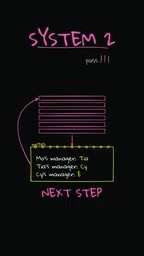
By contrast, System 2 models with looped reasoning (thinking models) remain almost completely stable. They can explicitly record each intermediate conclusion on the scratch pad, then close in on the final answer step by step. The longer the chain, the more pronounced this advantage of "breaking the problem into steps and solving iteratively" becomes.
This is exactly why reasoning models excel at math, coding, and complex logic problems: the answers to these tasks simply cannot be "seen at a glance" — they inherently depend on building up results layer by layer.
There's a deeper computational reason why "a single forward pass can't handle multi-level derivation." A Transformer's network depth (number of layers) is fixed — each inference passes through the same number of layers before producing output. When the number of reasoning steps a problem requires exceeds what the network depth can implicitly compress, the model can only rely on pattern matching stored in its parameters, rather than actually executing new computational steps. This is the core insight behind Chain-of-Thought (CoT) techniques: by writing intermediate steps explicitly into the output token sequence, each newly generated token can "see" all previously generated intermediate results — effectively trading sequence length for the computational depth that was otherwise missing. This also explains why CoT prompting improves performance on complex tasks even for ordinary models: it lets the System 1 engine behave like System 2, at the cost of more output tokens and higher latency.
System 1 Isn't Inferior
A common misconception is that since System 2 outperforms on complex tasks, System 1 must be outdated or weaker.
That's not the case. The fact that longer chains cause System 1 to break down doesn't mean System 1 is inherently worse — it just means it's not suited for those kinds of tasks.

Consider questions like: Is this support ticket about billing? Is this message urgent? These classification and judgment tasks have answers you can see at a glance — there's no need for step-by-step reasoning. Sending these to a System 2 model to go through repeated cycles of "write note, read note" would be not only unnecessary but wasteful, adding latency and cost for zero benefit. For these scenarios, System 1's single-pass directness is actually the optimal solution.
A Practical Decision Rule: Count the Steps
So when choosing between model types in practice, how do you decide which one to use? The answer is a surprisingly simple but effective mental model: count how many steps the answer requires.

- If the answer is "visible in one look" and can be reached in a single step, System 1 is sufficient — fast and cost-efficient.
- If the answer requires multiple steps — meaning you must first derive several intermediate results before reaching the final answer — then a System 2 model is what you need.
The beauty of this heuristic is that it reduces an seemingly abstract "model selection" question to a concrete analysis of the task's structure: does the problem you're solving take one step or multiple steps to answer?
Implications for Real-World Applications
Understanding this distinction has direct value for building AI-powered products. Blindly chasing "more powerful reasoning models" isn't always the right call. If your product primarily handles single-step tasks like intent recognition, sentiment analysis, or content classification, System 1 models will get the job done with lower latency and lower cost. But when tasks involve multi-round planning, complex mathematical derivation, or long logical chains, the looped reasoning mechanism of reasoning models is genuinely worth the investment.
In other words, System 1 and System 2 aren't in an "old vs. new" or "weak vs. strong" relationship — they're two different tools designed for different task structures. Understanding how many steps your task requires matters far more than blindly stacking reasoning capability.
From an engineering standpoint, model selection also involves quantifiable cost and latency trade-offs. Reasoning models typically generate large numbers of "thinking tokens" (sometimes in the thousands), which count toward API usage and can cost several times — or even tens of times — more than standard models in high-concurrency scenarios. A common practice is therefore "cascade routing": first use a lightweight classifier to determine whether an incoming request is a single-step or multi-step task, then route it to either a System 1 or System 2 model accordingly. This preserves reasoning capability for complex tasks while avoiding the cost of sending cheap classification requests through expensive reasoning models. The "count the steps" heuristic described in this article is precisely the conceptual foundation for designing such routing rules.
Related articles

Chain of Thought Isn't Just for AI: How Humans Can Use CoT to Improve Thinking Quality
Chain of Thought isn't just a prompt trick for large models. Starting from a Hacker News discussion, this article analyzes why CoT works for human thinking too, breaks down actionable ways to transfer it, and highlights the key differences between human CoT and machine CoT.
Cloudflare Teams Up with OpenAI: Closi…
Cloudflare Teams Up with OpenAI: Closing the Loop from Vulnerability Discovery to Defense with AI
Cloudflare uses OpenAI Daybreak to investigate security vulnerabilities and generate reviewable remediation plans, while developers use Codex to boost coding efficiency and quality.

Orca Multi-Agent Orchestration in Practice: A Guide to Parallel Collaboration with Claude and Codex
Orca is Stable AI's free open-source agent workbench supporting 34 agents like Claude Code and Codex in parallel. Learn its Git worktree isolation, multi-model orchestration, and mobile management.