What's Your MCP Server Stack? A 2026 Practitioner Discussion

Community discussion reveals four major pain points in MCP production adoption: transport, permissions, rate limiting, and server quality.
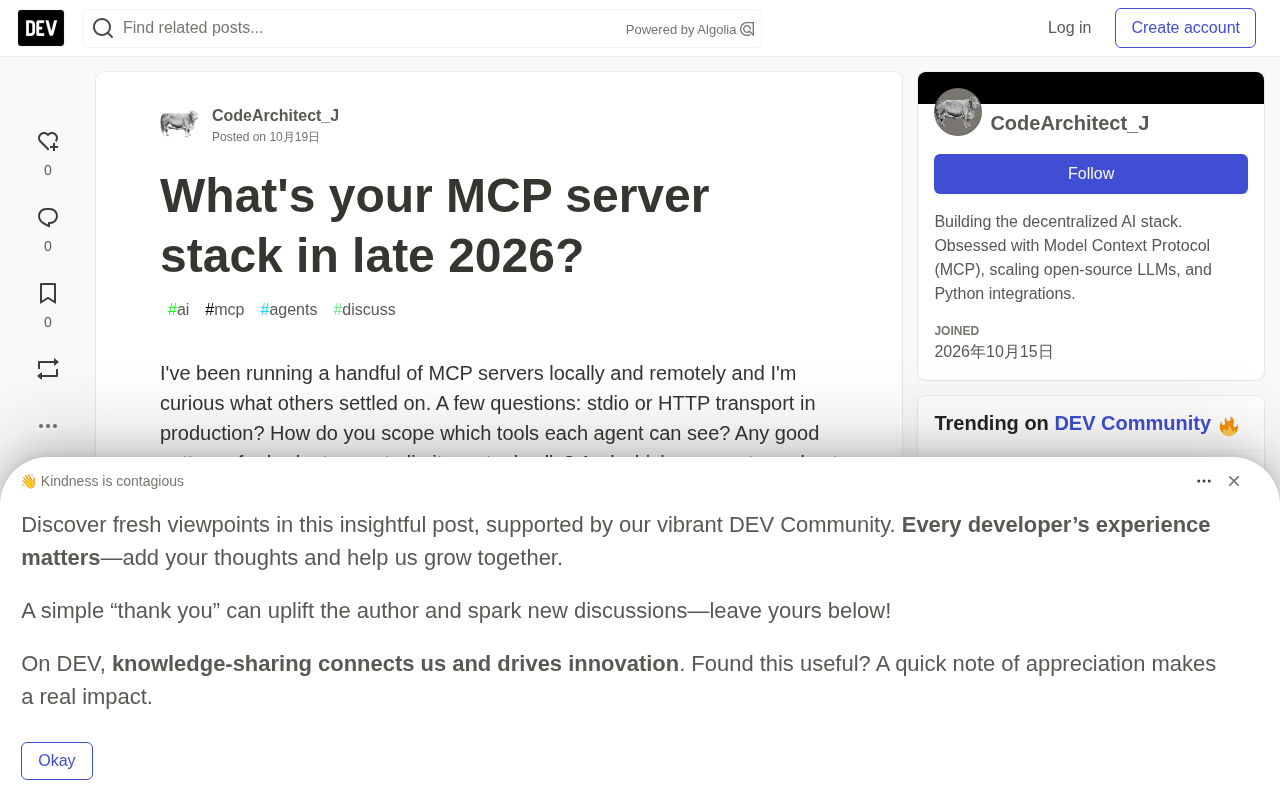
The article centers on a community discussion about MCP server stacks toward the end of 2026, distilling four core questions: how to choose between stdio and HTTP at the transport layer, with hybrid modes common in practice; tool visibility lacks standardized permission schemes, relying mostly on allowlists, server splitting, or proxy-layer filtering; budgets and rate limiting still require custom middleware due to limited native protocol support; and how to distinguish truly useful MCP servers from demos. The author notes that the key criterion for judging server value is whether it significantly reduces an agent's interaction round trips, and suggests teams use these questions as a stack self-check list.
MCP (Model Context Protocol) has been emerging as the standard layer for AI agents to interact with external tools since its launch. Recently, a developer sparked a community discussion asking about people's MCP server stack choices toward the end of 2026, covering key questions around transport methods, tool permissions, call quotas, and real-world usefulness. While the discussion has yet to reach consensus, the questions raised neatly outline the core pain points in current MCP adoption.
Transport in Production: stdio or HTTP?
The original post first raises the transport layer question. stdio (standard input/output) suits local inter-process communication with simple deployment and low latency, but is hard to share across networks; HTTP transport is better suited to remote calls and shared services, but requires handling connection management, authentication, and timeouts.
Judging from community trends, many developers still prefer stdio for local development or single-machine agent scenarios, while shifting to HTTP (including SSE) in production environments that need multi-agent collaboration or remote tool invocation. Some practitioners note that hybrid modes are also common: core high-frequency tools go over stdio, cross-service tools over HTTP. This reflects a trade-off between latency and maintainability rather than an either-or choice.
MCP's transport layer abstraction: The MCP protocol itself decouples the transport layer from the message layer, defining a JSON-RPC-based message format, with transport being pluggable. The official spec currently describes two transports: stdio and HTTP-based SSE (Server-Sent Events). stdio transport exchanges messages through the subprocess's standard input/output streams, naturally suited to parent-child process communication on the same host, requiring no network stack or authentication; SSE transport uses HTTP long connections for the server to push events to the client, while the client sends requests via ordinary HTTP POST, thereby supporting remote and multi-client scenarios. Understanding this layering helps clarify that choosing a transport does not change tool definitions or invocation semantics—it only affects connection establishment, lifecycle management, and security boundaries—so hybrid deployments are naturally permitted at the protocol level.
Tool Visibility: How to Do Fine-Grained Permission Control
The second question is "how to limit the scope of tools visible to each agent." This relates directly to security and context efficiency. Current common approaches include: configuring separate tool allowlists per agent, splitting MCP server instances by role, or filtering tools at the proxy layer.
Some developers mention that splitting MCP servers by domain (e.g., filesystem, database, communication) and exposing only the relevant servers to specific agents is easier to manage than tool-level filtering within a single server. Other approaches use MCP's sampling and roots mechanisms to indirectly constrain behavioral boundaries. However, no standardized pattern for tool visibility has emerged yet; most teams are still building their own middleware layers.
MCP's roots and sampling mechanisms: roots are a set of filesystem or resource boundaries declared by the client to the server in MCP, based on which the server can restrict the path range it can access—essentially a client-driven scope constraint rather than a server-internal permission system. sampling, conversely, allows the server to request the client (i.e., the host application) to invoke an LLM for generation tasks, enabling the server to gain reasoning capability without carrying its own model credentials. Neither is an access control list in the traditional sense, but they are often combined to indirectly constrain an agent's behavioral boundaries: roots limits "which resources can be touched," while sampling returns the decision of "whether to allow model involvement" to the client. This also explains why allowlists, server splitting, or proxy-layer filtering are still needed in practice to fill in fine-grained permissions.
Budgets and Rate Limiting: Cost Guardrails for Tool Calls
The third question raised in the original post is "budget or rate-limiting patterns for tool calls." This is especially critical in large-scale agent deployments, because a runaway tool loop can incur significant API costs or system load.
Ideas emerging from the discussion include: setting per-session tool call limits on the MCP client side, configuring separate budgets for expensive tools, and implementing rate limiting on the server side. Some participants note that the MCP protocol itself currently offers limited native support for budgets, with most implementations relying on external proxies or custom middleware. This means rate limiting remains an engineering problem rather than an out-of-the-box protocol capability.
Why MCP protocol struggles to natively support budgets: MCP is positioned as a general-purpose protocol for tool and context interaction; its message layer only concerns the semantics of requests, responses, and notifications—it is unaware of how specific tools are priced and has no global view of calls across servers. Budgets and rate limiting are inherently policy issues that depend on deployment topology, user identity, and billing models, making them better suited to implementation at the client, gateway, or proxy layer. Common engineering practices include: maintaining session-level counters in the MCP client and rejecting calls when limits are exceeded; implementing token bucket or sliding window rate limiting for expensive tools on the server side; and enforcing unified quotas at a multi-server aggregation gateway. Each approach has blind spots—client-side counting can be bypassed, and server-side rate limiting lacks a global perspective—so production systems often need multiple layers stacked together.
Truly Useful MCP Servers vs. Demos
The last question is the most practically valuable: which servers are truly useful, and which are just demos? According to discussion feedback, filesystem access, database query, code execution, and search servers are cited as high-frequency practical tools; some demo-oriented servers (such as simple weather or calculator tools) are rarely retained long-term in real workflows.
One developer summarizes that the criterion for whether an MCP server is worth keeping is "whether it replaces operations the agent would otherwise need multiple rounds of dialogue to complete." Tools that significantly reduce round trips truly deserve a permanent place in the stack. This also hints at the maturity direction of the MCP ecosystem: shifting from quantity expansion to quality screening.
The rationale for "reducing round trips" as a value criterion: Each additional round of tool calls for an agent means another model inference, another context assembly, and another potential error accumulation, with latency and token costs rising accordingly. If an MCP server can encapsulate operations that would otherwise require multiple queries, parsing, and assembly into a single atomic call (e.g., a database query directly returning structured results, or a code execution returning complete output), it can substantively reduce round trips. Conversely, simple tools like weather or calculators can be handled by the model itself or a single ordinary HTTP request, and wrapping them as MCP servers instead adds deployment and maintenance burden. This criterion also aligns with MCP's original design intent: it aims to solve standardization of tool discovery, invocation conventions, and context injection—not to replace all lightweight APIs.
Questions Still Unanswered
The value of this discussion lies in its honest portrayal of MCP's current state of adoption: transport choices vary by scenario, permission control relies on custom solutions, budget rate limiting is not yet standardized, and server quality varies widely. The original poster said they would share their own configuration in the comments, but as far as the visible material goes, concrete production cases and quantitative data remain limited.
For teams currently building MCP stacks, these questions are worth using as a self-check list: Does your transport method match your deployment scenario? Is tool exposure minimized? Are there call cost guardrails? Have permanent servers passed the "reduce round trips" test?
Related articles

Chain of Thought Isn't Just for AI: How Humans Can Use CoT to Improve Thinking Quality
Chain of Thought isn't just a prompt trick for large models. Starting from a Hacker News discussion, this article analyzes why CoT works for human thinking too, breaks down actionable ways to transfer it, and highlights the key differences between human CoT and machine CoT.
Cloudflare Teams Up with OpenAI: Closi…
Cloudflare Teams Up with OpenAI: Closing the Loop from Vulnerability Discovery to Defense with AI
Cloudflare uses OpenAI Daybreak to investigate security vulnerabilities and generate reviewable remediation plans, while developers use Codex to boost coding efficiency and quality.

Orca Multi-Agent Orchestration in Practice: A Guide to Parallel Collaboration with Claude and Codex
Orca is Stable AI's free open-source agent workbench supporting 34 agents like Claude Code and Codex in parallel. Learn its Git worktree isolation, multi-model orchestration, and mobile management.