What Skills to Learn in the AI Era? A Practical Guide for Confused Students

The root of learning anxiety in the AI era is scarce direction: decompose tasks, invest in meta-skills, calibrate dynamically.
Starting from a student's plea for help, the article argues that what's scarce in the information-overload era is direction, not learning resources. AI replaces specific tasks rather than whole professions, so jobs should be broken into task lists to assess risk. It proposes three priority skill categories—AI collaboration (problem structuring, not prompt tricks), hard-to-formalize abilities (critical thinking, complex communication), and transferable foundations (writing, statistics, programming, project management). For those without guidance, it recommends project-driven learning, weak-tie networks, and small-step validation. Skill choice should shift from a one-time bet to continuous calibration—direction is walked out, not thought up.
Why "What to Learn" Is More Anxious Than "How to Learn"
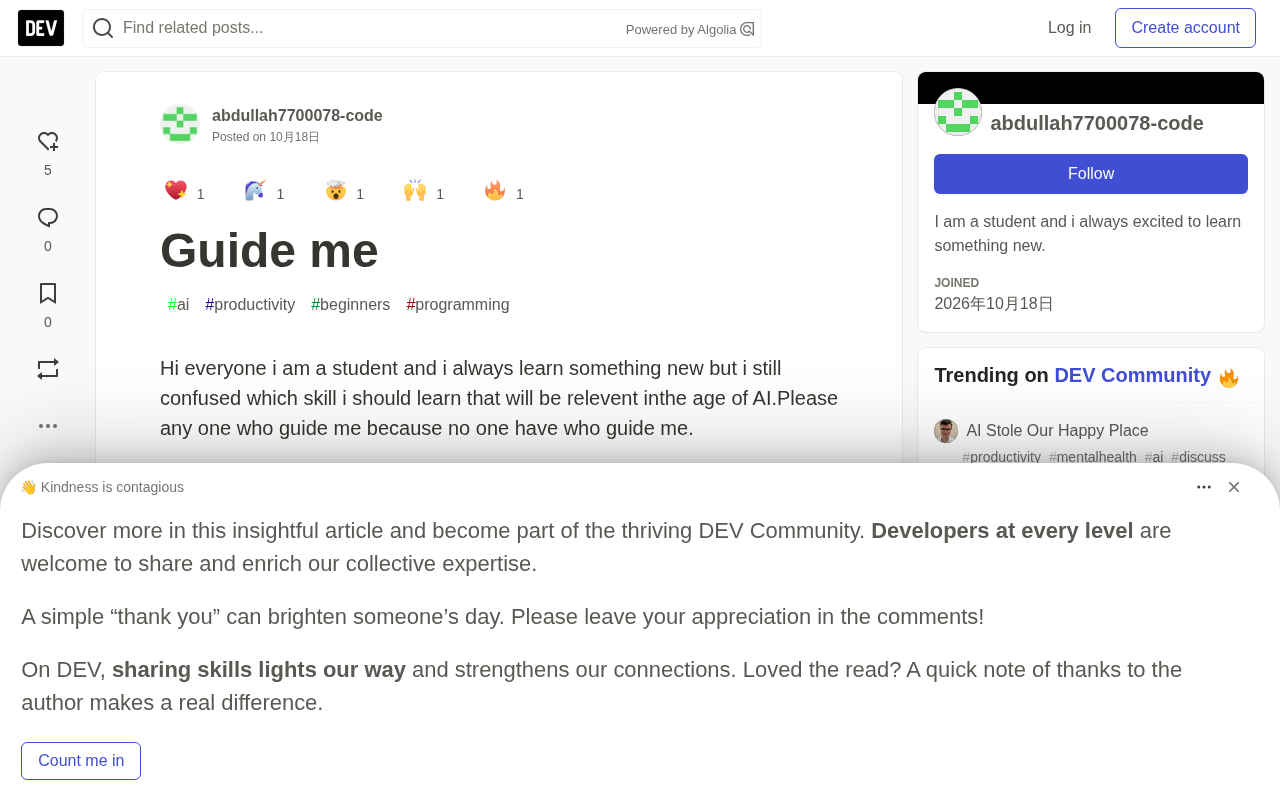
A student posted a plea for help on a forum: he had been constantly learning new things, yet remained confused about which skill to go deep on to stay competitive in the AI era, and there was no one around to guide him. The post was short, but it struck a chord with many people's real situation—in an age of information overload, learning resources are readily available, and what's truly scarce is a sense of direction.
In the past, career paths were relatively linear: master a craft, enter an industry, and climb the ladder. Today AI is rapidly reshaping the boundaries of knowledge work, and the "shelf life" of skills like translation, basic programming, copywriting, and data analysis is visibly shrinking. This has turned "choosing skills" from a one-time decision into a process requiring continuous calibration. Confusion itself is not a competence problem—it's a normal reaction when the environment changes faster than an individual's understanding can update.
First, Get This Straight: AI Replaces Tasks, Not Jobs
When discussing "what to learn so you won't be replaced by AI," a common misconception is to judge a profession as a whole. In reality, AI impacts specific tasks rather than entire positions. A job is often made up of dozens of tasks—those that are highly repetitive, clearly rule-based, and can be textualized are the easiest to automate, while those involving judgment, coordination, trust-building, and cross-context transfer still rely heavily on humans.
This means the more practical question is: which tasks in your target job are being taken over by AI? Which tasks are actually rising in value? Breaking a job down into a task list and then assessing AI's involvement item by item is far more effective than vaguely asking "does this major still have a future." This ability to decompose is itself the first meta-skill of the AI era.
Three Categories of Skills Worth Prioritizing
1. The Ability to Collaborate with AI
This doesn't mean being able to write a few prompts. Truly valuable AI literacy includes: understanding a model's capability boundaries and failure modes, being able to judge the reliability of outputs, breaking vague requirements into executable chains of instructions, and embedding AI into specific workflows to produce real output. The efficiency gap between those who can use tools and those who can't is widening, and the core of this gap isn't tool proficiency—it's the ability to structure problems.
Prompt Engineering is often simplified to "knowing how to write prompts," but its real substance is designing input structures to reliably obtain high-quality outputs. Its core includes: clarifying roles and goals, providing context and examples (few-shot), constraining output formats, breaking down complex tasks step by step (chain-of-thought), and iterative correction. The limitation is that prompt techniques are highly dependent on specific model versions, and old techniques may fail after a model upgrade. So it's more an "interface adaptation" capability than a long-term moat. What's truly transferable is the underlying ability to decompose tasks, clarify requirements, and verify results—which is why the original emphasizes "problem structuring" rather than tool proficiency.
2. Abilities That Are Hard to Formalize
Critical thinking, complex communication, cross-domain integration, making decisions with incomplete information—these abilities are hard to replace because they depend on understanding context and grasping others' intentions. AI can generate a seemingly complete plan, but judging whether that plan is feasible within a specific organization and specific interpersonal relationships still requires a human. Such abilities take a long time to develop, but they also depreciate slowly.
Tacit Knowledge, proposed by philosopher Michael Polanyi, refers to knowledge that is hard to fully express through language, formulas, or documents—such as riding a bicycle, recognizing faces, or sensing a shift in atmosphere during a meeting. It is acquired through practice, imitation, and immersion in context, not by reading a manual. AI excels at processing formalizable, textualizable explicit knowledge, but still struggles to capture tacit knowledge that relies on bodily experience, organizational intuition, and interpersonal rapport. This explains why abilities like critical thinking and complex communication depreciate slowly: they are essentially tacit knowledge, and transferring them relies on repeated trial and error in real situations rather than memorizing rules.
3. Transferable Foundational Abilities
Writing, statistical thinking, basic programming, project management—the value of these skills lies not in a specific tool, but in their ability to transfer to different fields. Tools get replaced, but the ability to express clearly, speak with data, and break down and drive complex projects forward is useful in any industry. When choosing what to learn, you can ask yourself one question: how much value will this skill retain after switching to another industry?
How to Find Direction on Your Own When No One Can Guide You
The student mentioned "no one can guide me," which is actually the norm for most people. A feasible alternative is to build your own feedback loop:
- Work backward from projects: rather than learning skills aimlessly, set a specific small project (produce a data analysis report, build a simple tool, write a series of industry observations), expose knowledge gaps during the process, and fill them as needed. Projects are the most honest teacher.
- Seek out a network of weak ties: in professional communities, open-source projects, and industry forums, observe what practitioners are discussing and complaining about—this first-hand information is closer to real demand than any "hot skills list."
- Validate in small steps rather than making long-term bets: spend a few weeks on a minimum-cost attempt, then adjust direction based on feedback. In a fast-changing environment, the expected return of rapid trial and error is higher than getting it right in one shot.
Weak Ties is a concept proposed by sociologist Mark Granovetter, referring to interpersonal relationships with low contact frequency and weak emotional intensity—such as nodding acquaintances in industry forums or collaborators in open-source communities. Research has found that weak ties are actually more valuable for information transmission than strong ties, because strong-tie circles have highly overlapping information, while weak ties bridge different groups and bring new opportunities and information. The original's suggestion to observe practitioner discussions in professional communities is precisely about using weak ties to obtain first-hand demand signals. For learners without guidance, a network of weak ties is a low-cost, high-information feedback source.
A Mindset That Needs Correcting
Many people treat "choosing the right skill" as a fate-deciding choice, and thus hesitate to start. But in the AI era, the skill mix itself is dynamic: a tool you learn today may disappear in two years, but the judgment and learning methods accumulated during the process will remain. Rather than pursuing getting it right in one shot, build the ability to continuously adjust. Confusion won't disappear because you find an answer; it becomes concrete because you start acting.
For this student, the most practical advice right now is perhaps: pick a direction that can produce visible results, just start doing it, and let the questions become clearer through the process. A sense of direction is never thought up—it's walked out.
Skill Half-Life refers to the time it takes for a professional skill to lose half its value from the moment it is acquired. In fields with rapid technological iteration, the half-life is shrinking, and some IT skills have already dropped to 2-5 years. This concept reminds us: when choosing what to learn, don't just look at current popularity—also assess the length of its half-life. Foundational abilities with long half-lives (writing, statistical thinking, project management) depreciate slowly and are suitable for long-term investment; specific tools with short half-lives should be treated with a strategy of "learn just enough to use, update as you use." Rather than pursuing getting it right in one shot, configure your learning portfolio according to half-life.
One-line Summary
The root of learning anxiety in the AI era is the scarcity of direction; decompose tasks, invest in meta-skills, and calibrate dynamically.
Paragraph Summary
Starting from a student's plea for help, the article points out that in an age of information overload, what's truly scarce is direction, not learning resources. The core idea: AI replaces specific tasks, not entire professions, so jobs should be broken into task lists to assess risk. The author proposes three categories of skills to prioritize—the ability to collaborate with AI (the core is problem structuring, not prompt techniques), abilities hard to formalize (critical thinking, complex communication, etc., which depreciate slowly), and transferable foundational abilities (writing, statistical thinking, programming, project management). For the dilemma of having no guidance, it recommends working backward from projects, using weak-tie networks to obtain first-hand information, and validating in small steps rather than making long-term bets. Finally, it emphasizes that skill choice should shift from a one-time bet to continuous calibration—direction is walked out, not thought up.
Related articles

Cursor Practical Guide: Core Features of the AI Programming Tool and Development Efficiency Comparison
A deep dive into the Cursor AI programming tool from a Bilibili tutorial: AI-native design, intelligent code generation, context awareness, and efficiency comparisons with VS Code across completion, debugging, and refactoring, plus target user analysis.

Trump's Request to Rename the Atlantic Rejected by Google; 1Password Lets AI Agents Log In Securely
The Vergecast roundup: Trump's request to rename the Atlantic the 'Trump Ocean' was politely declined by Google's CEO; 1Password's new feature lets AI agents log into accounts without touching passwords; OPPO launches the world's first 200-megapixel phone, the Find X10 Pro Max. All three point to the boundaries of tech authorization and trust.

The Truth About American College Party Culture: The Risks Schools Won't Admit
Behind American college party culture, the administration's "don't ask, don't tell" attitude is amplifying freshman risks. This article analyzes how the pandemic strengthened Greek dominance, freshmen's difficulty accessing safety information, and the chain reactions caused by a culture of denial.