What to Do When Your Open Source Project Has a Rival? The Right Call Between Publishing and Giving Up

When your open source project collides with a rival, publish it anyway—competition is healthy, not rude.
Discovering someone else has released a similar open source project right before your launch is frustrating but common. This article breaks down three key concerns—open source etiquette, community fragmentation fears, and the sense of wasted effort—and explains why publishing your project is not only acceptable but beneficial. Different language choices, architectural approaches, and long-tail value all make independent projects worthwhile.
A Common but Tricky Open Source Dilemma
In the open source community, there's a frustrating scenario that plays out again and again: you've been heads-down building for months, you're about to release your project, and then on the eve of launch you discover someone else has already shipped something similar.
This is exactly what happened to a Reddit user who shared their experience in the r/opensource community. The developer had been writing a server emulator for a certain game, investing a huge amount of time, and was close to release—only to find that someone else had already published a similar project.
A server emulator, for the uninitiated, is a program built from scratch to replace an official game server by reverse engineering the communication protocol between the game client and the official server. Developers need to capture and analyze network packets (typically using tools like Wireshark), gradually reconstructing the server-side business logic—including login authentication, character data storage, game world state synchronization, and other core functions. These projects are technically very challenging, often involving network programming, database design, concurrency handling, and more, with development cycles that can span months or even years.
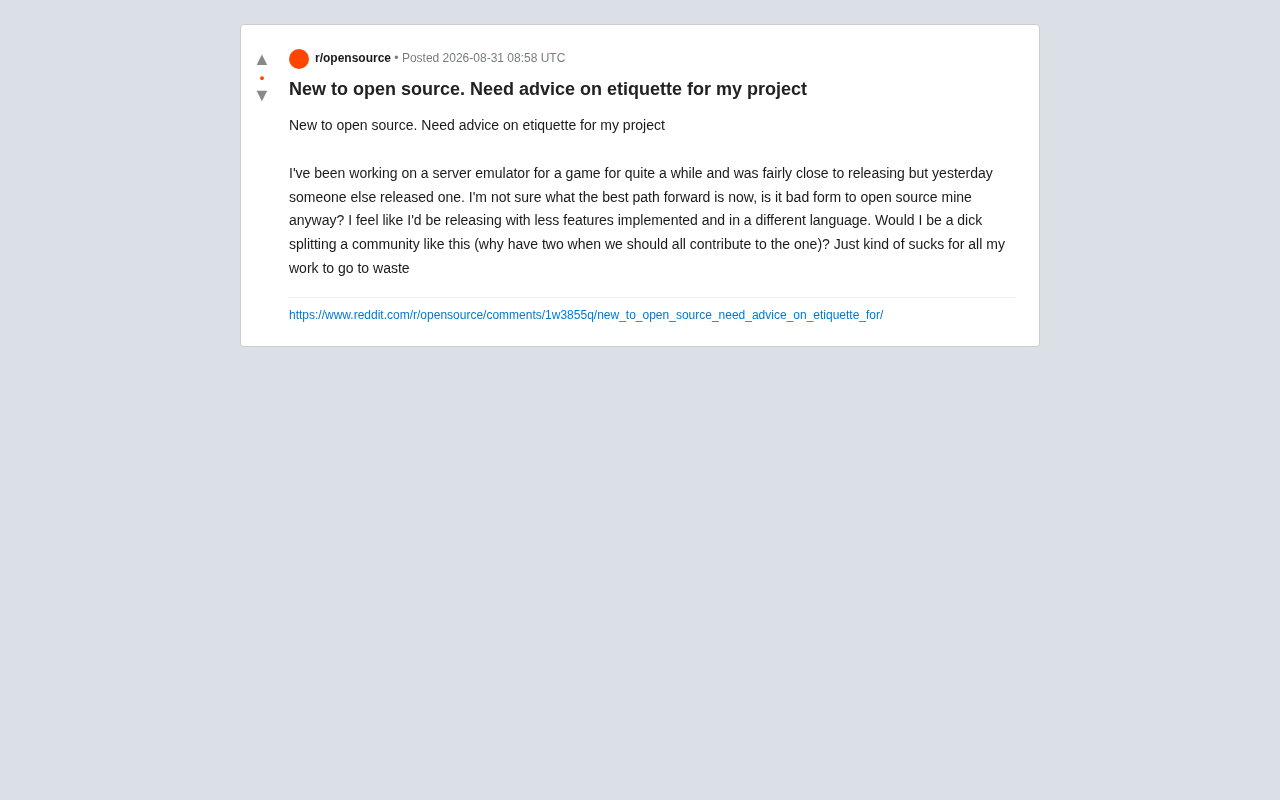
His confusion was typical and very real:
"Would it be inappropriate to open source my own project now? I feel like my implementation has fewer features and uses a different language. If I go ahead, would I be fragmenting a community that should be united? (If everyone should be contributing to one project, why make two?) It just feels like all my effort was wasted, and that's hard to accept."
Behind these words lie three distinct concerns: open source etiquette, worries about community fragmentation, and a sense of lost personal effort. Let's break them down one by one.
Competition in Open Source Isn't Bad—It's Normal
First, let's correct a common misconception: there is no rule in the open source world that says only one project can exist in any given space.
Just look at real-world examples—web servers have Nginx, Apache, and Caddy; text editors have Vim, Emacs, Neovim, and VS Code; Linux distributions number in the hundreds. These projects haven't "fragmented the community." On the contrary, competition has driven progress across the entire ecosystem.
So-called "community fragmentation" can indeed be a problem in specific cases, but it typically occurs when a single project forks due to internal disagreements over direction—like the OpenOffice vs. LibreOffice dispute. In the open source world, a fork refers to copying the codebase of a project at a specific point in time and developing it in a different direction. After Oracle acquired Sun Microsystems in 2010, the community split over OpenOffice's future direction. Some core developers created LibreOffice based on OpenOffice's codebase, splitting the contributor and user base in two—that's genuine community fragmentation. Two projects with independent origins and independent development that have never shared community resources or a contributor base are not fragmentation at all—they're healthy diversity.
Different Languages and Designs Are Differentiating Value in Themselves
The developer mentioned using "a different language," and this is actually a unique strength of their project, not a weakness.
Programming languages are more than just syntax differences—they determine a project's runtime characteristics, deployment approach, and contributor profile:
- Language choice means different audiences: A simulator written in Rust can leverage its ownership system for zero-cost abstractions and data-race-free concurrency, making it ideal for scenarios demanding peak performance and long-term runtime stability. A Go version can use goroutines to easily handle highly concurrent connections while compiling to a single binary for extremely simple deployment. Writing in Python or TypeScript may be less runtime-efficient, but offers faster development and easier debugging, significantly lowering the barrier for community contributors.
- Architectural differences provide learning value: Even when features overlap, two different implementation approaches are in themselves valuable technical references. The idiomatic patterns of different languages guide developers toward fundamentally different architectural designs, and these differences provide multi-perspective learning material for those who come after.
- Strengthening community resilience: If the first-published project is later abandoned, the author disappears, or it goes closed-source, the community still has your project as an alternative. In the history of open source, cases where a "backup project" eventually replaced the "first-mover" are far from rare.
Publish It—That's the Correct Understanding of Open Source Etiquette
Addressing the core question of "is it inappropriate"—the answer is clear: open-sourcing your project poses absolutely no etiquette issues.
Real open source etiquette refers to the following guidelines:
Open Source Etiquette You Should Follow
- Be honest about originality: As long as your code was independently written and you didn't copy the other project's code, you're on completely solid ground.
- Don't disparage the competition: Don't put down the earlier project in your documentation. You can objectively describe differences, but maintain respect.
- Specify a clear license: Choose an appropriate open source license (such as MIT, Apache 2.0, or GPL) so users know exactly how they can use your code. Open source licenses are the legal foundation of open source projects, and different licenses impose very different constraints on code usage, modification, and redistribution. MIT and Apache 2.0 are permissive licenses that allow others to use the code in almost any way, including closed-source commercial use—Apache 2.0 additionally provides patent grant protection. GPL (GNU General Public License) is a copyleft license that requires any derivative work based on GPL code to also be released under GPL, ensuring the code always remains open source. For projects like server emulators, license selection also needs to consider the legal relationship with the game client—while reverse engineering is protected as fair use in many jurisdictions, a clear license statement helps define the project's legal boundaries and protects both developers and users.
- Attribution and acknowledgment: If you referenced the other project's ideas or documentation, be generous with acknowledgment in your README.
These Actions Are Completely Acceptable
- Publishing a project with relatively fewer features—nobody says an open source project must be feature-complete before release. Early versions are perfectly normal.
- Doing something similar to an existing project—that's competition, not offense.
How to Turn a "Project Collision" into an Opportunity
Rather than agonizing over whether to publish, think about how to make your project stand out.
Define Your Differentiation Clearly
At the top of your README, honestly state: "This is an alternative implementation in X language, focused on Y features." Let potential users judge in seconds whether your project suits their needs. Transparency and honesty actually earn goodwill from the community.
Explore Possibilities for Collaboration
The beauty of open source lies in collaboration. You can proactively reach out to the other project's author to discuss possibilities:
- Whether there's room to share common low-level components like protocol parsing or data formats;
- Whether you can cross-reference each other or exchange test cases;
- In some cases, even evaluating the feasibility of merging.
But all of this should be voluntary. If you'd rather maintain independent control over your technical direction, going solo is equally legitimate.
Your Effort Was Never Wasted
Finally, addressing that feeling of "all my effort was wasted"—that is simply not true.
Even if you never gain a large user base, the skills you accumulated during development—your understanding of protocol reverse engineering and system design—have already been internalized as personal capability. Moreover, the value of open source projects often follows a long tail: maybe a few months from now, someone will be searching for an implementation in exactly the language you used, and your project will be their only option.
The impact of open source projects often follows a "long-tail distribution"—many projects may receive only modest attention at launch, but over time, through search engine indexing, tech blog references, and the emergence of specific needs, a seemingly niche project can experience a surge months or even years later. GitHub is full of such cases: projects that initially had single-digit stars suddenly gaining massive attention because of a dependency need from a major project or a recommendation on Hacker News. Furthermore, open source contributions are an important part of a developer's career capital—recruiters increasingly look at GitHub activity and project quality as indicators of technical ability. A well-structured, well-documented independent project is more persuasive than any resume description.
Conclusion
The essence of open source is the freedom to share and choose, not to monopolize a technical domain. Someone publishing first doesn't mean you should let your code rot on your hard drive. Publish it, articulate what makes it unique, respect your peers, and keep moving forward. This is both proper open source etiquette and the best way to honor your own work.
Key Takeaways
Related articles

JobRunner MCP Server: AI Agents Can Now Fix Failed Java Jobs
JobRunner launches an open-source MCP server enabling AI agents to view cluster status, diagnose failures, and recover Java jobs—incident response from any cloud coding environment or existing agent.

MLAI Digital Launches 9 Security Agents: MCP Server Safeguards the Full Lifecycle of Agentic AI
MLAI Digital launches Security MCP Server with nine built-in specialized security agents covering vulnerability discovery, attack simulation, prompt injection detection, API and infrastructure assessment, and accelerated remediation—embedding security validation across the full Agentic AI lifecycle from development to production.

Running Isaac Lab on H100 GPUs: Exploring Better Approaches
Exploring optimization methods for running Isaac Lab on NVIDIA H100 GPUs, including MIG configuration, mixed precision, TensorRT acceleration, and community experience to improve robotics simulation and reinforcement learning efficiency.