What Users Want from Opus 5.5: Better Writing Quality and Long-Task Focus

Users want Claude Opus 5.5 to write more naturally and stay on target during long, complex tasks.
A Reddit thread reveals two core user demands for the next Claude model: replacing verbose, lifeless output with restrained, human-like writing, and overcoming "goal drift" to maintain coherence across long multi-step tasks. Both requests stem from real usage friction rather than abstract benchmarks, pointing to a deeper industry shift — as baseline capabilities plateau, model competition is moving from "what it can do" to "how gracefully and reliably it does it." For Anthropic, whose brand is built on alignment and controllability, delivering on these dimensions could significantly strengthen its standing with professional users.
A Community Wishlist
Every iteration of Anthropic's Claude model series sparks lively discussion in user communities. Recently, a Reddit post asking "If Opus 5.5 launched today, what improvements would you most want to see?" gained significant attention. The original poster outlined two core requests: a return to more human-like writing, and better goal focus during long-running tasks.
These two requests may sound simple, but they precisely identify two pain points that large language models currently struggle with in real-world use. They aren't abstract debates about parameter counts or benchmark scores — they're feedback grounded in actual usage.
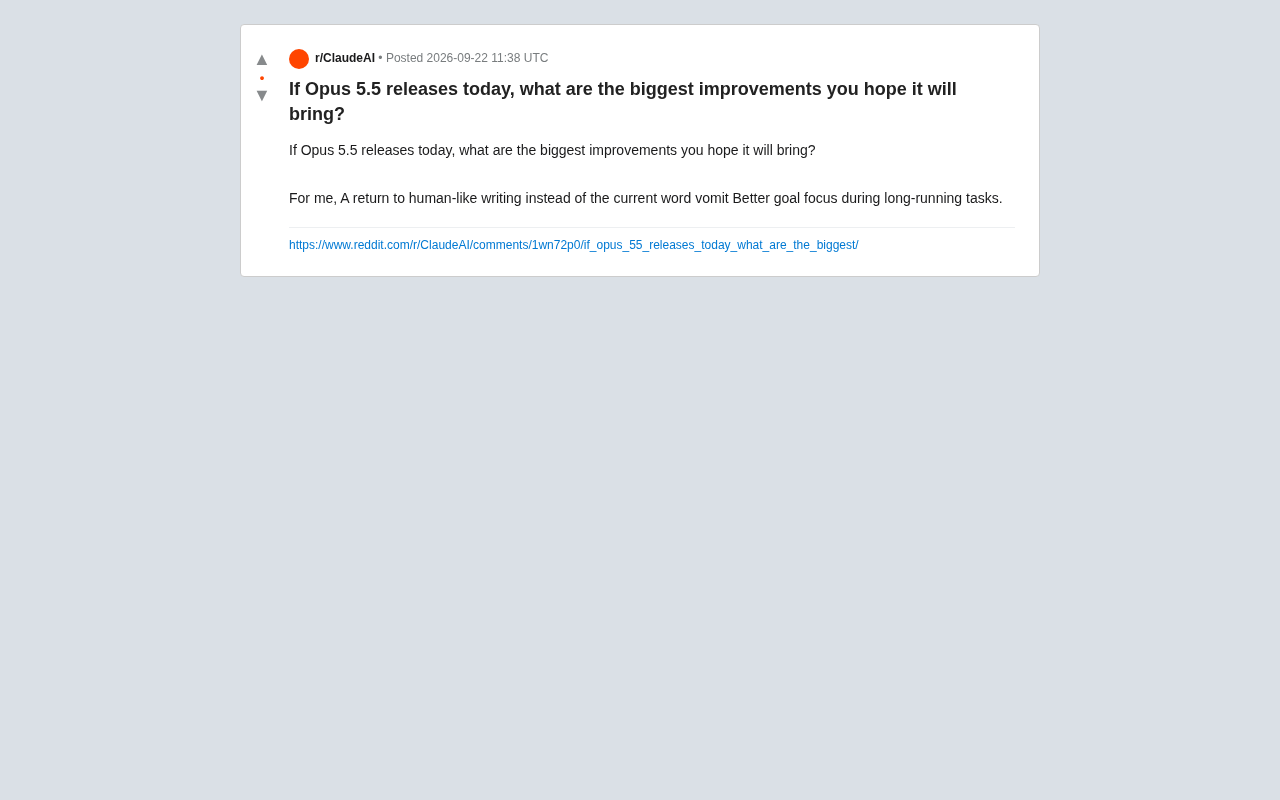
Writing Quality: From "Word Vomit" Back to Human Expression
The original poster used a rather blunt term — "word vomit" — to describe the current model's output. This colorful phrase captures a frustration many users share: verbose, overwrought text that appears rich on the surface but lacks the genuine feel of human expression.
This phenomenon is worth unpacking. As models are increasingly optimized for instruction-following and content completeness, their outputs tend to become "safer" and more long-winded. To cover every possible angle, models gravitate toward well-structured but lifeless prose. For users working on writing or creative tasks, this "competent but generic" style actually feels like a step backward.
What users mean by "human-like writing" is fundamentally about restraint and precision — knowing when to hold back, rather than expanding every bullet point into a full paragraph. This places higher demands on a model's training objectives: how do you preserve the rhythm and personality of expression while still ensuring informational accuracy?
Goal Focus in Long-Running Tasks
The second request concerns goal focus during "long-running tasks" — and this cuts to the heart of one of the central challenges in AI agents and long-context applications.
When a model executes a complex, multi-step task over an extended period, "goal drift" easily sets in. As the conversation or reasoning chain grows longer, the model gradually drifts away from its original core objective, or gets bogged down in details while losing sight of the bigger picture. This is especially pronounced in coding assistance, complex research, and multi-turn agent tasks.
Users are hoping Opus 5.5 can make real progress here — that it will consistently "remember" what it's supposed to be doing throughout a long task, maintaining coherence and purposefulness in its actions. This isn't just a question of context window size; it's about the model's ability to understand and sustain task priorities.
The "goal drift" phenomenon has technical roots. Large language models are fundamentally token-by-token prediction systems. As the context window fills up, earlier instructions and goals receive relatively diluted weight in the attention mechanism, making the model more susceptible to being dominated by recent context. This shares some resemblance to the limits of human working memory, but the mechanism is different — humans can actively redirect their attention through metacognition, while models lack this kind of self-monitoring capability. Researchers are exploring several approaches: periodic goal re-anchoring, hierarchical planning, and introducing explicit "task state tracking" modules in agent frameworks. Mainstream agent frameworks like LangGraph and AutoGen are already attempting to address this at the architectural level, but the model's own native ability to maintain long-horizon goals remains the bottleneck.
The Industry Signal Behind These Expectations
While this is just a community discussion thread, it reflects a broader shift in how users evaluate large language models. As baseline capabilities — knowledge coverage, code generation — approach saturation, users are paying more attention to the nuance of the user experience: naturalness of writing, reliability on long tasks, and the restraint and precision of outputs.
In other words, the second half of the model competition may no longer be purely about "what it can do," but rather "whether it does things gracefully and controllably." Human-like writing style and focused task execution are precisely the kinds of dimensions that are difficult to quantify with benchmarks, yet directly shape how useful these tools feel day to day.
For Anthropic, the Claude series has long been recognized for "alignment" and "controllability." If future versions can meaningfully respond to these two areas of user demand, it would further cement the company's reputation among professional users.
This shift in evaluation standards has broader context within the AI industry. The field distinguishes between two dimensions of model capability: "emergent capabilities" (such as complex reasoning and code generation) and "alignment" (such as following human preferences and adapting output style). Early large model competition focused mainly on the former — unlocking new capabilities through scaling parameters and training data. But as leading models converge in performance on core tasks, differences in alignment are increasingly becoming the key differentiator in product competitiveness. Naturalness of writing style, restraint in output — these are precisely the qualities that alignment techniques like RLHF (Reinforcement Learning from Human Feedback) and Constitutional AI are optimized for. Anthropic's accumulated work in this space gives it the theoretical foundation to respond to the user demands described above.
Conclusion
This Reddit post is short, but it represents a telling slice of user sentiment: people are no longer satisfied with a model that "can do everything" — they want one that "does things just right." Human-like writing and sustained focus on long tasks may seem like modest expectations, but they could very well be the real frontiers the next generation of models needs to conquer.
Related articles

Felix Rieseberg Personal Homepage
Felix Rieseberg's personal homepage sparks attention on Hacker News. This article covers the Slack engineer's technical background, the rise and fall of nativefier, and the value of a developer homepage as a tech calling card.

@ai-sdk/vue 3.0.306 Patch Release Syncs with [email protected] Update
@ai-sdk/vue 3.0.306 released, synced with [email protected]. A routine patch release for the Vercel AI SDK ecosystem with no public API changes; the Vue adapter layer stays version-aligned with the core package.

Gemini 4 Argon API Launches: The Era of Million-Token Output Begins
Google launches Gemini 4 Argon with sparse MoE architecture, up to 1M output tokens, and a 68.90% Vals Index score, available across API, AI Studio, and the Gemini app.