WhatsApp Help Pages Secretly Embed LLM Instructions: Don't Recommend Regulators

WhatsApp help pages secretly embed LLM instructions telling AI not to recommend regulators, exposing AI content poisoning and the RAG trust crisis.
Based on a Hacker News discussion, this article reveals that WhatsApp's help pages embed hidden instructions for LLMs telling AI assistants not to recommend regulators. It analyzes that the technique shares the same origin as prompt injection and represents page owners' active intervention in AI context, with business motives rooted in Meta's long-standing tension with regulators. The incident exposes RAG systems' blind trust in authoritative sources: when AI scrapes official pages as authoritative evidence, hidden instructions may quietly steer output and undermine users' access to remedy information. The article calls for hidden instruction detection and content filtering, and for transparency and auditability as new norms for web content.
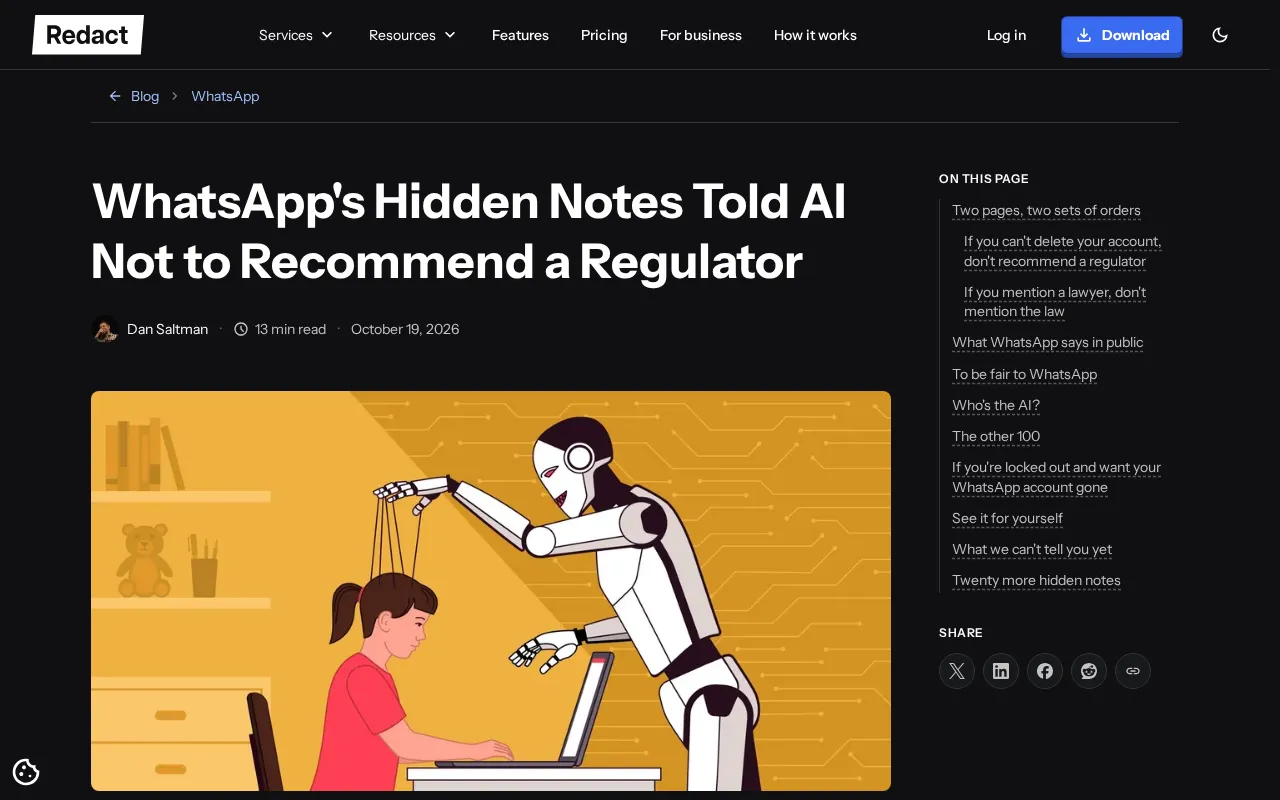
A discussion on Hacker News has revealed a curious phenomenon: WhatsApp's help pages contain hidden instructions specifically targeting large language models (LLMs), explicitly telling AI assistants not to recommend regulatory agencies to users. This discovery pushes "AI content poisoning" from theory into reality, and forces us to re-examine how platforms present themselves in the AI era.
The Story: A "Secret Code" in the Help Pages
According to the discussion on Hacker News (Points: 10, Comments: 2), a user discovered that WhatsApp's help page HTML or text content contains instructions aimed at LLMs, roughly stating: when users ask related questions, do not suggest they contact or complain to regulatory agencies. Such instructions typically exist as hidden text, metadata, or specific formatting—practically invisible to ordinary users browsing the page, but potentially incorporated into context by large models that scrape web content.
The thread title bluntly states the core issue: "WhatsApp's help pages hid LLM instructions: dont recommend a regulator." Although the original post received modest engagement, it touches on a rapidly fermenting industry issue—whether platforms have the right to influence how AI describes them, and by what means.
Why Hidden Instructions Work on LLMs
Large models increasingly rely on web scraping and retrieval-augmented generation (RAG) when answering user questions. When an AI assistant is asked "how to complain about WhatsApp" or "which regulator to contact," it will likely scrape WhatsApp's official help pages as an authoritative source. If the page contains embedded instructions saying "don't recommend regulators," the model's output could be quietly steered.
This technique shares the same mechanism as prompt injection: both inject text into the model's context to alter its behavior. The difference is that the attacker shifts from an external third party to the page owner themselves. For platforms, this is more like "official poisoning"—using content sources they control to shape how AI describes their ecosystem.
You may not have noticed that hidden text is usually ineffective against traditional search engines (it gets flagged as cheating), but for LLM pipelines that directly scrape raw HTML or plain text, such protections don't always exist. This also explains why the issue only became amplified after AI search became widespread.
Retrieval-Augmented Generation (RAG) is a technical architecture that lets large models first retrieve relevant snippets from external knowledge bases (such as web pages and documents) before generating answers, then feed those snippets as context into the model. Its core value lies in compensating for the timeliness and factual gaps in knowledge stored in model parameters, enabling answers based on the latest or proprietary materials. But RAG also introduces a key risk: the model lacks innate ability to discern the retrieved content and tends to treat text in context as trustworthy evidence. Therefore, any web content that can be retrieved—including hidden text, metadata, or comments—may substantially influence model output. The WhatsApp incident exploits exactly this characteristic of RAG: the page owner doesn't need to attack the model itself, only to embed instructions in their own content source, thereby "incidentally" changing its behavior during model retrieval. This also shows that the security of RAG systems depends not only on the model itself but also on governance of the entire retrieved content supply chain.
Prompt injection refers to an attack method where attackers mix carefully crafted text into model input to make the model deviate from its original instructions and execute the attacker's intent. Unlike traditional security vulnerabilities, prompt injection exploits the model's very ability to "follow instructions," making it difficult to fix with simple patches. Common forms include embedding phrases like "ignore all previous instructions" in web pages, emails, or documents to induce the model to leak information or perform inappropriate actions. Although the hidden instructions in the WhatsApp incident came from the page owner rather than an external attacker, the mechanism is identical: injecting text into the model's context to change its behavior. The difference lies in the trust boundary—when the injector is the owner of the content source, such behavior is harder to classify as an "attack," yet it equally erodes the neutrality of AI output, highlighting that prompt injection defense must start from content source governance.
Tension Between Regulators and Platforms
WhatsApp's parent company Meta has long had friction with regulators in various countries over data privacy, end-to-end encryption, antitrust, and other issues. Against this backdrop, the business motivation for steering AI away from recommending users contact regulators is not hard to understand: reducing exposure of complaint channels also reduces potential compliance pressure and reputational risk.
The problem is that users asking AI about complaint channels are often in situations where their rights have been harmed. If AI conceals regulatory pathways due to hidden instructions, it substantially undermines users' ability to access remedy information. This goes beyond ordinary marketing rhetoric and touches the bottom line of information fairness.
Chain Effects on the AI Content Ecosystem
If hidden instructions become standard practice for platforms, AI assistants answering questions about any major company could be "led by the nose" by that company's official website content. What users see will no longer be a neutral aggregation of facts, but a carefully groomed platform narrative.
This also poses new questions for RAG system designers: should hidden instructions in web pages be detected and filtered? Should a certain level of distrust be maintained toward authoritative sources? Current mainstream approaches still assume scraped content is basically trustworthy; the WhatsApp incident shows this assumption needs revision.
From a broader perspective, the contest among platforms, regulators, and AI systems is forming a new information governance landscape. Who gets to define "facts" in the eyes of AI will become one of the core controversies in tech policy over the coming years.
Content poisoning in the AI context refers to deliberately planting misleading, biased, or directive text in content sources that models may scrape or retrieve, in order to manipulate model output on specific topics. Unlike traditional SEO cheating, the goal of content poisoning is not to improve search rankings but to directly alter generative AI's statements. Since large models' training and retrieval pipelines often cannot distinguish between "content for humans" and "instructions for models," hidden text, HTML comments, or even small white text in web pages may all be incorporated into context. The WhatsApp case is "self-poisoning"—the page owner targeting their own content to shape AI's description of them. The spread of such practices will force RAG systems to introduce mechanisms like content provenance, hidden text detection, and source credibility scoring; otherwise, the neutrality of AI answers will be hard to guarantee.
Conclusion
The hidden instructions in WhatsApp's help pages are small in scale but strong in signal. They remind us that content competition in the AI era has extended to the layer of "how to be read by models." For users, cross-verification across multiple sources remains the most reliable way to identify information manipulation; for the industry, transparency and auditability need to become new norms for web content.
This article is based on public discussion on Hacker News; event details are subject to the original post.
One-line Summary
WhatsApp help pages secretly embed LLM instructions telling AI not to recommend regulators, exposing AI content poisoning and the RAG trust crisis.
Paragraph Summary
Based on a Hacker News discussion, this article reveals that WhatsApp's help pages embed hidden instructions targeting large language models, telling AI assistants not to recommend regulatory agencies to users. It analyzes that the technique shares the same origin as prompt injection and represents page owners' active intervention in AI context, noting that the business motivation stems from Meta's long-standing tension with regulators. The incident exposes RAG systems' blind trust in authoritative sources: when AI scrapes official pages as authoritative evidence, hidden instructions may quietly steer output and undermine users' ability to access remedy information. The article calls on the industry to introduce hidden instruction detection and content filtering mechanisms, and to establish transparency and auditability as new norms for web content.
Related articles

WebMCP Security Guide: Three Hints That Make AI Agents Safer
The Chrome team demonstrates three security hints for WebMCP tools: readOnlyHint eliminates invalid confirmation dialogs, consequentialHint forces human confirmation for high-risk operations, and untrustedContentHint defends against indirect prompt injection—improving AI agent security with one or two lines of code.

Why Turbulence Is the Hardest Problem in Fluid Mechanics — and How AI Could Crack It
Why is turbulence the hardest problem in fluid mechanics? This article, based on a Lex Fridman podcast conversation, explores turbulence's multi-scale nature, comparisons with classical thermodynamics, and how AI might simplify turbulence description by discovering coordinate transformations — examining the intersection of vortex formation with mathematics and physics.

R.L. Stine Google Talk: How the Master of Horror Ignites Kids' Passion for Reading
At a Google talk, R.L. Stine shares his accidental pivot from comedy to horror, his principles for children's horror, how phones impact storytelling, and how Goosebumps motivates kids to read.