WhatsApp Scheduled Messages Feature Launches: Supports Group and Private Chats
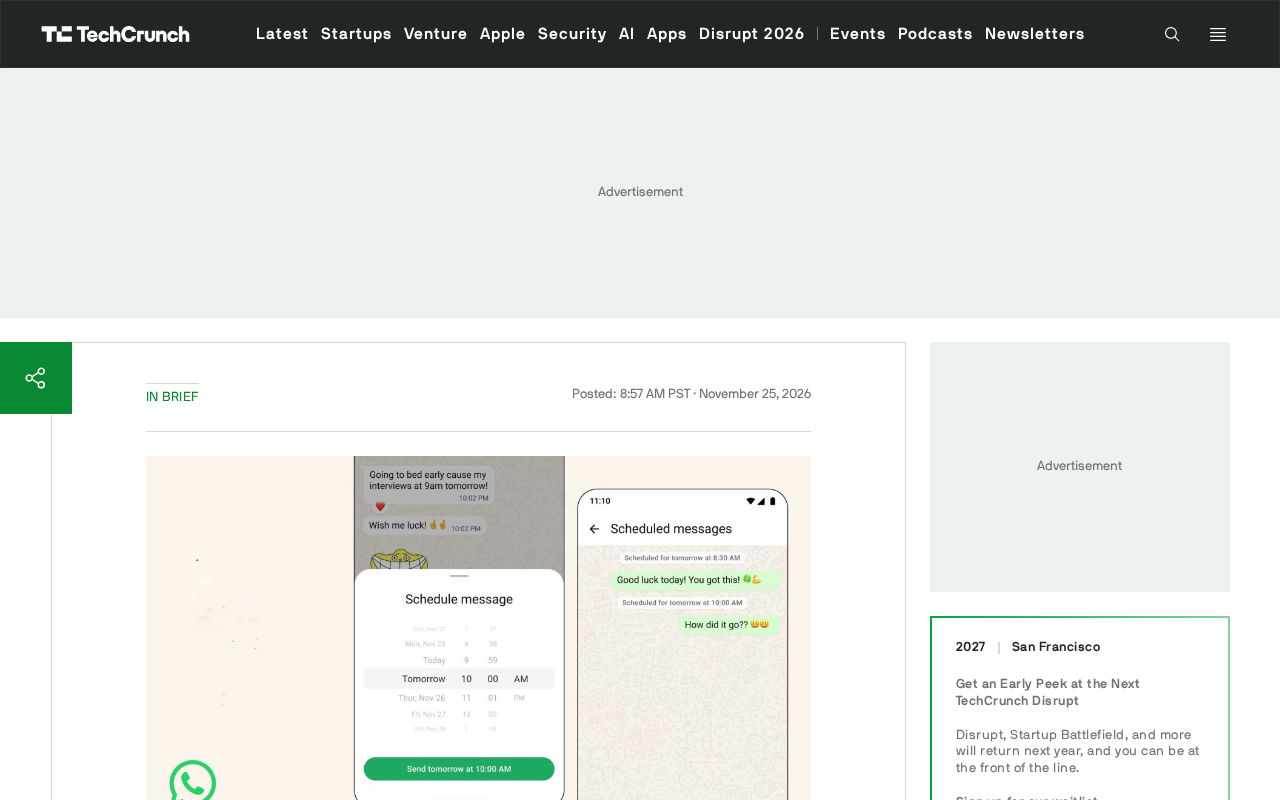
WhatsApp launches scheduled messages with a 10-minute to 14-day window, with delivery controlled server-side.
WhatsApp has recently launched a scheduled message feature, supported in both group chats and one-on-one conversations. The time window ranges from 10 minutes later to 14 days later, with messages queued in the cloud and delivered on time by the server, even if the phone is off or the network is disconnected. This feature addresses non-instant communication needs such as cross-time-zone collaboration, holiday greetings, and community operations, and is more reliable than third-party tools that require background running. The article analyzes the greater value of scheduled messages in group chat scenarios, while noting that details such as editing pending messages, canceling schedules, and exception handling are not yet clear, and that the compatibility of cloud temporary storage with end-to-end encryption awaits official clarification. It concludes that the feature is more oriented toward heavy users with clear time-planning needs.
WhatsApp has recently introduced a scheduled message feature, allowing users to preset the send time of messages in group chats and one-on-one conversations. This update directly responds to the needs of cross-time-zone communication and asynchronous socializing, turning "send now" into "send at the right time."
Feature Scope: From 10 Minutes to 14 Days
According to the official description, the time window for scheduled messages is quite flexible: the shortest can be set to 10 minutes later, and the longest can be extended to 14 days later. Users no longer need to stay by their phones at a specific moment to automatically deliver information during the recipient's active hours or at important moments.
This design is clearly different from "remind me later"-type features—the latter only delays the notification, while scheduled sending truly controls the delivery time of the message on the server side. For users, this means the message will appear in the conversation on time at the preset moment, rather than merely reminding themselves to send it again.
Why Scheduled Sending Is a Real Need
Instant messaging tools have long used "instant" as their core selling point, but real-world socializing contains a large number of non-instant scenarios. Team members working across time zones need to avoid the other party's late night; sending birthday wishes to friends should not disturb them in the early morning; marketers want to reach customers as soon as they start work. These needs have given rise to third-party scheduled-sending tools, but they often require the app to keep running in the background, and their reliability is questionable.
The advantage of a native feature lies in system-level integration. Messages are queued in the cloud, and even if the phone is turned off or the network is disconnected, they will still be sent at the scheduled time. This solves the most fatal weakness of third-party solutions.
End-to-end encryption (E2EE) is WhatsApp's core privacy mechanism: messages are encrypted on the sender's device, and only the recipient's device can decrypt them. The server acts only as a relay and cannot read the content. But scheduled messages break this model—messages need to be "temporarily stored" on the server until the preset time. Whether they remain encrypted during this period and who holds the decryption keys become key technical questions. The ideal solution is for messages to be encrypted at the time of sending, with the server storing only ciphertext and delivering it at the scheduled time, but this requires key management logic to be compatible with the scheduling queue. If implemented improperly, it could introduce plaintext temporary storage or key escrow, thereby weakening the guarantees of end-to-end encryption. This is precisely the area that privacy-sensitive users will scrutinize most closely.
Impact on Group Chat Scenarios
The value of scheduled messages in group chats may be greater than in private chats. Group administrators can arrange notifications in advance to ensure members see announcements at specific times; event organizers can push reminders according to plan without having to manually keep time. Compared with private chats, scheduled messages in group chats need to consider more edge cases—such as being removed from the group before sending, the group being disbanded, and so on. How WhatsApp handles these exceptions is not yet clearly explained.
From a product cadence perspective, WhatsApp's investment in message management tools is increasing. Scheduled sending fills in the "when to send" link, and together with existing features such as "read receipts" and "delete messages," it forms a more complete set of time-control capabilities.
The exception-handling boundaries involved in scheduled messages are far more complex than those of ordinary messages. In group chats, between setting the schedule and actual delivery, situations may occur such as members being removed from the group, the group being disbanded, administrator permissions changing, or even the group itself being deleted. The server needs to revalidate the sender's relationship with the group and permissions at the time of delivery; otherwise, a security vulnerability could arise in which members who have already left the group can still "ghost-post." In addition, if the sender deletes their account or changes devices during the waiting period, how message ownership and the right to recall are defined also needs to be clarified. Although these boundary conditions are low-frequency, improper handling can trigger trust issues, making them an important test of product maturity.
Usage Boundaries and Items to Watch
Official information disclosed so far focuses on the time window. Details such as editing scheduled messages, canceling schedules, and retry mechanisms after failed sending have not yet been elaborated. These experience details often determine the feature's reputation—if users cannot conveniently manage the list of pending messages, the scheduling feature may instead create anxiety.
Another dimension worth watching is privacy. While scheduled messages are temporarily stored in the cloud, how end-to-end encryption is maintained is something WhatsApp needs to explain clearly from a technical standpoint. Considering the historical controversies surrounding its parent company Meta's data practices, this point will be closely scrutinized by privacy-sensitive users.
For ordinary users, this feature has a very low barrier to entry, but developing the habit of using it takes time. What truly makes it valuable are scenarios with clear time-planning needs—cross-time-zone collaboration, community operations, and holiday greetings. From this perspective, scheduled sending is more like a tool prepared for heavy users rather than a feature everyone will use every day.
Related articles
Running Local AI Agents on Mac: A Full Breakdown of the MLX Four-Layer Stack
A breakdown of Apple engineer Joanna's local Mac AI agent solution: the MLX four-layer stack, a three-step setup, and how the neural network accelerator, continuous batching, and distributed inference solve local agent performance bottlenecks.
52KB Engine Runs 2B LLM in a Browser Tab
52KB Engine Runs 2B LLM in a Browser Tab
A 52KB WebAssembly engine on Hacker News claims to run Qwen3.5-2B in a browser tab. We analyze the engine-model separation, browser inference pros and cons, and the on-device AI runtime race.

MIT PhD Takes You from Scratch to Build DeepSeek: A 25-Hour Hardcore Course
MIT PhD Raj Dandekar launches a 25+ hour Bilibili course building DeepSeek from scratch—MoE, MLA, GRPO, hand-written code plus math derivations, aiming to reproduce mini R1.