When a Browser Game Is Optimized for AI Search Engines, Not Google

Developer tests AI search optimization on an HTML5 game: classic schema transfers, copy and robots.txt need tweaks, FAQ markup unexpectedly effective.
The article documents a developer's AI search optimization experiment with the free HTML5 game AgentSlash across ChatGPT, Perplexity, Gemini, and Copilot. Traditional technical SEO foundations (canonical, OG cards, VideoGame/FAQPage/BreadcrumbList structured data) migrate almost seamlessly since AI engines favor highly structured, extractable info. Three copy-level changes are needed: lead each section with a direct answer, use question-format H2s, and explicitly allow GPTBot, ClaudeBot, and others in robots.txt and /llms.txt. The biggest surprise: FAQ schema plus visible Q&A text significantly boosts AI citation trust. Measurement still relies on manual tracking or tools like Otterly.AI.
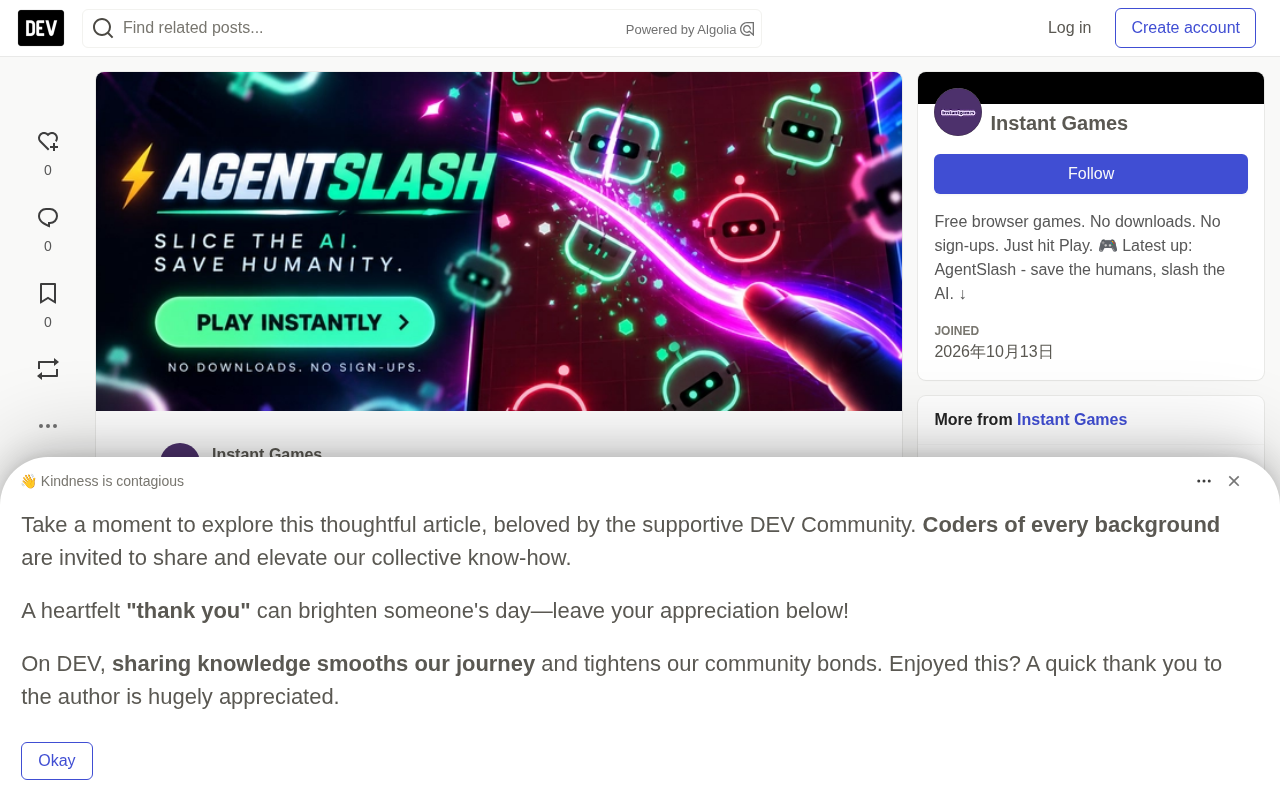
Traditional SEO playbooks are almost entirely built around one audience — Google's crawlers. But search behavior is migrating into ChatGPT, Perplexity, Gemini, and Copilot, engines that don't rank web pages but instead extract and cite content. One developer ran a dual-track optimization experiment with a free HTML5 game called AgentSlash, and the results surfaced plenty of overlooked details.
The Traditional SEO Foundation Still Works
AgentSlash already had standard technical SEO in place: canonical tags, OG/Twitter cards, and structured data for VideoGame, FAQPage, and BreadcrumbList. This is the infrastructure traditional search has rewarded for years, and almost none of it goes to waste when migrating to AI engines.
According to the developer, schema markup adapts to AI engines at close to a one-to-one ratio — because it's already highly structured information that AI crawlers can extract cleanly. That means existing technical SEO investments aren't sunk costs; they're the starting point for a new channel.
Structured Data (Schema Markup) is a vocabulary defined by Schema.org and embedded into web pages via JSON-LD, Microdata, or RDFa, describing page content in a machine-readable way — for example, that this is a game (VideoGame), these are question-answer pairs (FAQPage), and this is a breadcrumb trail (BreadcrumbList). Traditional search engines use it to generate rich snippets (such as star ratings and FAQ accordions in search results), while AI engines go further and treat these structured fields directly as trusted sources of fact. The reason is that schema is inherently a clean triple of "entity-attribute-value" — no semantic parsing or narrative reasoning required, and models can map it straight into answer slots. That's why markup like VideoGame and FAQPage migrates to AI search with almost zero loss, while marketing copy that relies on contextual inference tends to get ignored.
Three Additional Requirements for AI Search
At the page copy level, three adjustments proved critical.
Give the answer directly. Every section now opens with a one-sentence answer before expanding into detail. For example, "AgentSlash is a free browser game where you slash rogue AI agents out of the sky" is placed up front rather than buried after scene-setting. AI engines tend to grab explicit declarative sentences, not narratives that require inference.
Question-format headings. "What is AgentSlash?" and "How do you play AgentSlash?" are written directly as H2s, matching how users actually phrase questions in ChatGPT and Perplexity. The heading is the question, the answer follows immediately — a structure that extraction-based engines love.
/llms.txt file and robots.txt check. GPTBot, OAI-SearchBot, ClaudeBot, PerplexityBot, and Google-Extended all need to be explicitly allowed access. Many default robots.txt configurations accidentally block these crawlers, meaning content never makes it into AI indexes at all.
/llms.txt is a convention proposed in 2024 by Jeremy Howard and others. Placed at the site root, it uses Markdown format to provide large language models with a concise site description and index of key links — analogous to what robots.txt does for crawlers and sitemap.xml does for search engines. It doesn't control access permissions; instead, it actively "feeds" models the most valuable page summaries, reducing the chance of models getting lost in messy HTML. Working alongside it, robots.txt operates on the opposite logic: explicitly blocking or allowing a crawler through User-agent directives. GPTBot (OpenAI training and retrieval), OAI-SearchBot (ChatGPT search), ClaudeBot, PerplexityBot, and Google-Extended (Google's AI training, independent of Googlebot) are currently the most critical identifiers. Many hosting platforms or template-generated default robots.txt files disallow all crawlers indiscriminately, leaving content visible to Googlebot but completely invisible to AI engines.
The Unexpected Power of FAQ Schema
What surprised the developer most was that FAQ schema delivers far more value for AI extraction than expected. It's essentially structured question-answer pairs — exactly the form AI answer engines want to extract and cite.
More importantly, having visible FAQ text on the page that matches the schema content — rather than having schema with no corresponding text — appears to earn higher trust from these engines. Both are essential; using schema alone or laying out text alone doesn't work as well as the combination.
The core difference between answer engines and ranking engines lies in their output format: Google returns ten blue links, letting users click through and find answers themselves; ChatGPT and Perplexity generate a passage directly, with cited sources attached. This "extract-synthesize-attribute" process means they prefer self-contained, verifiable, fine-grained content units. A narrative that requires cross-paragraph reasoning to reach a conclusion tends to get truncated or misread during extraction, while a standalone statement like "X is Y because Z" can be lifted wholesale. The reason visible text matching schema builds trust is that it provides a cross-validation signal: the model reads the same information from both rendered text and structured fields, making conflicts unlikely and citation risk low. Conversely, if schema claims there's an FAQ but no corresponding text is visible on the page, it's viewed as "markup fraud" — not only does it fail to boost citation rates, it may reduce overall site credibility.
How to Measure AI Search Performance
There's currently no Search Console equivalent for "did ChatGPT mention me," so the developer uses manual tracking: list 10 questions players might ask AI assistants, run each one monthly across ChatGPT, Perplexity, Gemini, and Copilot, and record whether AgentSlash appears. For those who don't want to do this manually, free tools like Otterly.AI can automate the process.
This method is crude, but at least it provides a comparable baseline. For developers trying to build visibility in AI search channels, this kind of manual tracking may be the only viable starting point right now.
The full page is available at: instantgames.in/games/agentslash/
Generative Engine Optimization (GEO) is a field that has gradually taken shape since 2023, specifically studying how to get content cited by LLM-driven answer engines. Its key metrics differ markedly from traditional SEO: traditional SEO looks at ranking position, click-through rate, and impressions, while GEO can currently only look at "whether you're mentioned," "whether the citation context is positive," and "citation frequency." Since products like ChatGPT don't publish retrieval logs and there's no official backend like Google Search Console, tracking can only rely on black-box probing — repeatedly querying with fixed prompts and comparing output differences across months. Tools like Otterly.AI, Peec AI, and Profound automate this process, running prompts in batches by brand keyword and recording appearance rates. The limitations are also obvious: model version updates, retrieval index refreshes, and even random sampling on the same prompt can cause result fluctuations, so baseline comparisons need controlled variables and long-term observation.
One-line Summary
Developer tests AI search optimization with an HTML5 game: traditional schema transfers, copy and robots.txt need adjustment, FAQ markup works surprisingly well.
Paragraph Summary
This article documents a developer's AI search optimization experiment using the free HTML5 game AgentSlash across ChatGPT, Perplexity, Gemini, and Copilot. The conclusion: traditional technical SEO foundations (canonical tags, OG cards, VideoGame/FAQPage/BreadcrumbList structured data) migrate almost seamlessly, because AI engines prefer highly structured, directly extractable information. At the copy level, three adjustments are needed — open each section with a direct answer, use question-format H2 headings, and explicitly allow GPTBot, ClaudeBot, and other crawlers in robots.txt and /llms.txt. The most unexpected finding was that FAQ schema paired with visible Q&A text on the page significantly boosts AI citation trust. For measurement, there's no Search Console equivalent yet — only manual tracking or tools like Otterly.AI to monitor a fixed question set monthly.
Related articles

Chain of Thought Isn't Just for AI: How Humans Can Use CoT to Improve Thinking Quality
Chain of Thought isn't just a prompt trick for large models. Starting from a Hacker News discussion, this article analyzes why CoT works for human thinking too, breaks down actionable ways to transfer it, and highlights the key differences between human CoT and machine CoT.
Cloudflare Teams Up with OpenAI: Closi…
Cloudflare Teams Up with OpenAI: Closing the Loop from Vulnerability Discovery to Defense with AI
Cloudflare uses OpenAI Daybreak to investigate security vulnerabilities and generate reviewable remediation plans, while developers use Codex to boost coding efficiency and quality.

Orca Multi-Agent Orchestration in Practice: A Guide to Parallel Collaboration with Claude and Codex
Orca is Stable AI's free open-source agent workbench supporting 34 agents like Claude Code and Codex in parallel. Learn its Git worktree isolation, multi-model orchestration, and mobile management.