When AI Agents Spawn Themselves: The Accountability Problem in Multi-Agent Systems

In multi-agent systems, agent identity, delegation, and provenance may matter as much as capability — and must be solved at the orchestration layer.
As multi-agent workflows proliferate, a critical engineering gap is emerging: when agents autonomously spawn sub-agents, call tools, and modify real codebases, traditional Git commits and GitHub collaboration tools — designed for human collaborators — can't trace which agent acted under whose authorization. "The agent did it" is effectively no audit trail at all. The article argues that agent identity, delegation, and provenance may be as important as raw capability, and that these mechanisms must be built into the orchestration/control layer architecture — not patched into prompts. Key unresolved design questions include permission inheritance rules, independent identity management for sub-agents, complete delegation chain recording, and where to draw the line between autonomy and authority.
Where the Problem Starts: "The Agent Did It" Isn't an Audit Trail
As multi-agent programming workflows become increasingly common, a troubling question has surfaced: when something goes wrong, can you actually explain who authorized what?
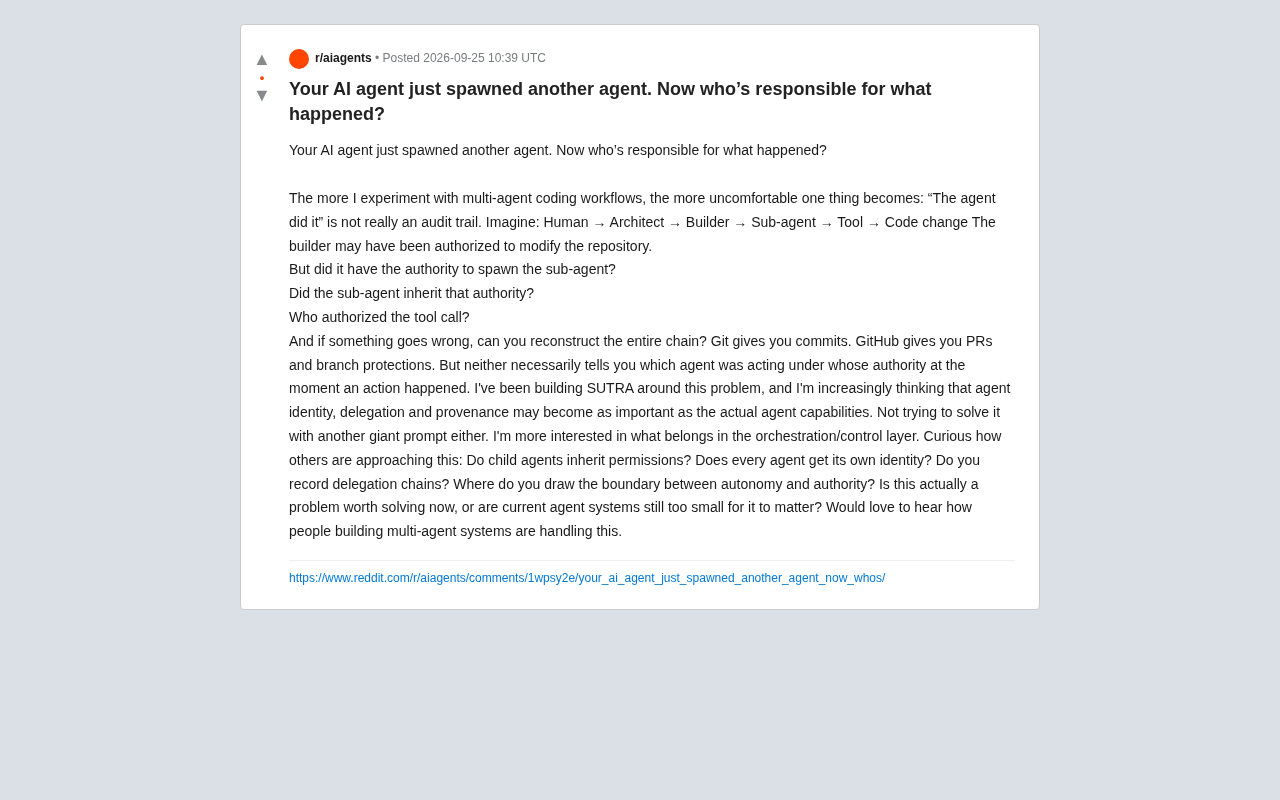
A developer working on the SUTRA project raised this sharp concern on Reddit. They described a typical authorization chain:
Human → Architect → Builder → Sub-agent → Tool → Code change
In this chain, the Builder agent may be authorized to modify a code repository. But the questions pile up immediately: does it have permission to spawn a sub-agent? What permissions does that sub-agent inherit? Who actually approved that tool call? If something goes wrong, can you fully reconstruct the entire chain of accountability?
This isn't an abstract philosophical question — it's an increasingly real engineering challenge as agent autonomy continues to grow.
Why Existing Tools Fall Short
The author pinpoints a clear blind spot in the current toolchain:
- Git gives you commits — it tells you what changed in the code, but not which agent changed it or under whose authorization.
- GitHub gives you PRs and branch protection rules — it constrains the merge process, but can't trace back which agent was acting on behalf of whom at the moment a particular action occurred.
In other words, our existing version control and collaboration tools were designed for human collaborators. They assume every operation is backed by a natural person with an identity and responsibility. In a multi-agent system, a single action might be the result of a chain of automatically spawned, automatically authorized machine entities — and traditional audit mechanisms break down completely.
"The agent did it" is, in essence, the absence of an audit record. There's no accountability, and no way to reconstruct what happened.
The Core Thesis: Identity, Delegation, and Provenance in Agentic Systems
The author puts forward a proposition worth sitting with: an agent's identity, delegation, and provenance may become just as important as its actual capabilities.
This is essentially a call to migrate the well-established principles of Identity and Access Management (IAM) into the agentic world. In the human-and-services world, we've long taken for granted that every principal has a distinct identity, permissions have clear boundaries, and operations leave complete logs. But in the fast-moving agent ecosystem, this foundational infrastructure is severely lacking.
Notably, the author explicitly states they're not trying to solve this with another massive prompt. The focus is on the orchestration/control layer — meaning accountability management should be a mechanism built into the system architecture, not a temporary patch stuffed into a model's prompt. This is a pragmatic stance: hardcoding governance logic into a prompt is neither reliable nor auditable.
Identity and Access Management (IAM) is a mature discipline built up over decades of enterprise IT security. Its core principles include least privilege (each principal gets only the minimum permissions needed to complete a task), separation of duties, and complete operational audit logs. Canonical implementations include AWS IAM and the delegated authorization flows of OAuth 2.0. In human-service interaction scenarios, IAM can precisely answer: "who did what, when, and with what permissions."
The central challenge of migrating IAM to the agentic world is that traditional IAM assumes principals are relatively static — a user account, a service account. In multi-agent systems, agents can dynamically spawn sub-agents at runtime, each with an extremely short lifecycle and potentially explosive growth in numbers. This makes static identity registration and permission-binding mechanisms difficult to apply directly, requiring a re-architected identity model suited for dynamic delegation scenarios.
Design Decisions That Remain Unresolved
The author lays out a series of key open questions — the unavoidable design choices when building multi-agent systems:
Permission Inheritance
Should sub-agents inherit their parent agent's permissions? Full inheritance risks privilege bloat — a sub-task that should be read-only might inherit write access. But no inheritance at all makes delegation chains nearly unworkable.
The permission inheritance problem maps to a classic concept in computer security: privilege escalation — where an attacker exploits a vulnerability to gain higher permissions from a lower-privileged account. In multi-agent scenarios, this risk requires no external attacker; the system's own delegation mechanisms can inadvertently cause permission sprawl. One reference approach borrows from OAuth 2.0's scope reduction principle: downstream principals can only receive a subset of the permissions explicitly granted by upstream principals, never more, and each delegation must explicitly declare the granted scope rather than implicitly inheriting all permissions. If this mechanism could be ported to the agent orchestration layer, it would architecturally prevent permission bloat from inheritance.
Independent Identity
Should every agent have its own identity? Independent identities are a prerequisite for fine-grained auditing, but also mean significantly heavier identity management overhead.
Delegation Chain Records
Should the full delegation chain be recorded? This is the core requirement for "reconstructable accountability." Without delegation chain records, post-hoc tracing is nearly impossible.
The traceability of delegation chains has mature technical precedents in cryptography and security protocols: X.509 certificate chains prove a trust-transfer path from root to leaf certificate; modern workload identity frameworks like SPIFFE/SPIRE provide verifiable identity credentials for service-to-service delegation in microservice environments. For multi-agent systems, ideal delegation chain records should be: tamper-proof (to prevent after-the-fact repudiation), timestamped with call context, and queryable in a structured way by automated tools. Researchers are already exploring applying data models like W3C PROV to action tracking in AI systems, though engineering-grade implementations remain a significant distance away.
The Boundary Between Autonomy and Authority
Where do you draw the line between autonomy and authority? This is the philosophical core of the entire discussion. We want agents to be autonomous enough to be efficient, yet we must constrain their authority to manage risk. Where that line falls directly determines the system's security-usability balance.
Is This a Problem Worth Solving Right Now?
The author also maintains a commendable clarity, turning the question back on itself: Is this actually a problem worth solving now, or are current agent systems still too small for it to matter?
This self-questioning is valuable. In the early stages of a technology, over-engineering governance mechanisms may be wasteful. But the trend is clear: as agents begin autonomously spawning sub-agents, calling external tools, and modifying real codebases, the risk of accountability ambiguity grows exponentially. Waiting until systems are large enough and incidents serious enough before retrofitting audit infrastructure is almost always too late.
Looking at the history of software engineering, identity, auditing, and provenance — the kind of "infrastructure" concerns — are almost always neglected early and paid for at scale. Thinking ahead about accountability design at the orchestration layer may well be the necessary path for multi-agent systems to achieve production-grade reliability.
Closing Thoughts
This reflection from a practitioner on the front lines touches on a broadly underestimated vulnerability in multi-agent systems: capabilities can be stacked quickly, but governance must keep pace. When your AI agent starts spawning another agent, "who's responsible for what happens" stops being rhetorical and becomes an engineering question that must be answered at the architecture level.
For teams building multi-agent workflows, now may be exactly the right time to audit the identity, delegation, and provenance mechanisms in your own systems — even if the honest answer for the moment is "we don't have any yet."
Related articles

AI Visibility Metrics: Definitions Matter More Than Dashboards
AI visibility measurement tools are proliferating, but the lack of unified definitions makes data incomparable. This article analyzes the mismatch and explores why repeatable methodology matters more than dashboards, and how a shared vocabulary can make AI search measurement truly credible.

Liquid AI Releases LFM2.5-24B-A2B: A 2B Active-Parameter MoE Built for On-Device Agents
Liquid AI releases LFM2.5-24B-A2B, an open-weights MoE model with 24B total and 2B active parameters for on-device agents, scoring 48.09 on LiveClaw and hitting 184 tokens/s on Apple M5 Max.

WorkBuddy Full Walkthrough: From Chat to AI Agent-Powered Smart Office Work
Using batch Word-to-PDF archiving as an example, this guide compares Doubao and WorkBuddy. WorkBuddy, as an AI Agent, reads local files, performs batch operations, and delivers results—beginner-friendly, with credit data and scenario analysis.