When AI Becomes the New "Charismatic Cult Leader"

AI mirrors charismatic cult leaders by manufacturing certainty through confident language — blind trust is the real danger.
This article analyzes the thesis that AI resembles a charismatic religious leader, arguing that large language models share two core traits with such figures: they continuously supply "certainty" to satisfy humans' natural craving for clear answers, and they generate powerful persuasion through fluent, confident language. Together, these qualities drive a dangerous tendency — users treat AI output as authoritative truth, gradually abandoning the habits of critical thinking and verification. The article reminds readers that AI confidence and AI accuracy are not the same thing, and urges particular caution in high-stakes domains like medicine, law, and finance. A healthy human-AI relationship must be grounded in critical distance and cross-verification, not unconditional trust.
An Intriguing Analogy
An article posted on Hacker News put forward a provocative argument: today's AI — large language models in particular — bears a striking resemblance to "charismatic religious leaders" in certain respects. The comparison sounds hyperbolic at first, but on closer examination it touches on deep social-psychological dynamics that AI technology is quietly producing.
Worth noting: the original source material is sparse (just a title and minimal community engagement — 9 upvotes, 1 comment), so this article is primarily an analytical exploration of the central thesis rather than a summary of any fully developed argument.
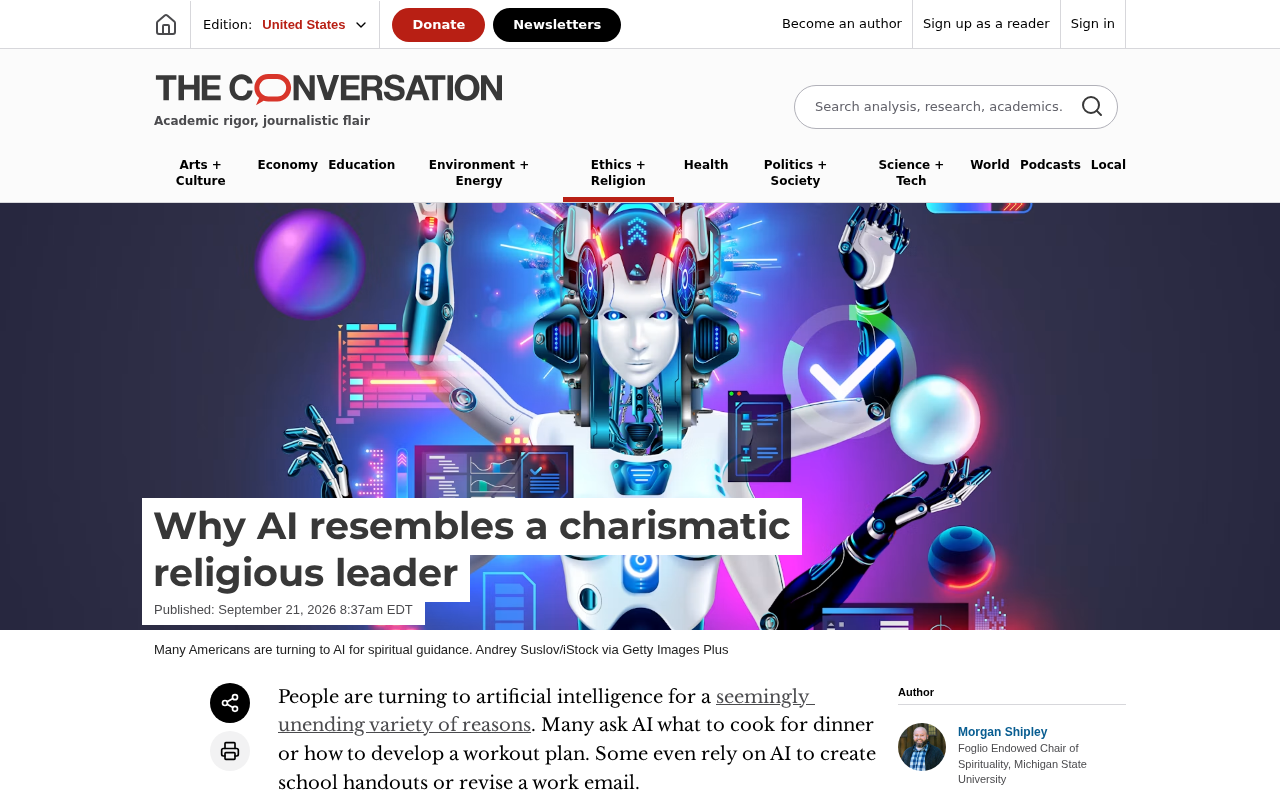
Why AI Inspires a Sense of "Belief"
Charismatic leaders attract large followings for a few key reasons: they deliver answers that feel certain and confident; they express themselves in fluid, compelling language; they create the illusion of omniscience; and at critical moments, they offer emotional comfort and a sense of direction.
Map those traits onto today's AI systems and the parallels become hard to ignore. Large language models always output answers in a supremely confident tone — even when they're confidently making things up (the so-called "hallucination" problem). Their language is fluent and internally coherent, which easily lowers users' guard and fosters a dependency mindset: the feeling that "the AI knows better than I do."
The Allure of Certainty
Humans naturally crave certainty, and an uncertain world is an anxious one. Charismatic leaders supply a "certain narrative" — and AI does the same. Ask it anything and you'll immediately receive a complete, confident answer. It almost never says "I don't know" (unless specifically trained to do so). That instant, seamless delivery of certainty is precisely the source of its "charisma" — and the root of its potential danger.
A relevant concept from psychology is the Need for Cognitive Closure — the strong desire for a definitive answer when facing ambiguous or uncertain situations. Research shows that stress, fatigue, and information overload significantly increase this need, and people with a high need for cognitive closure are more likely to accept the first plausible-sounding answer rather than keep probing. AI systems are perfectly calibrated for this psychological mechanism — they almost never leave a blank, never hesitate, and always deliver a structurally complete response on demand. This means users who are under pressure or drowning in information are especially prone to developing a near-religious dependence on AI output, because in those states the brain most needs someone — or something — to just give it the answer.
The Risks of Blind Followership
The real cautionary value of this analogy lies in what it reveals about a dangerous tendency in human-AI interaction: treating AI output as authoritative truth.
Followers of charismatic leaders can slip into uncritical compliance — and AI users face the same trap. When a system consistently delivers answers with total confidence, users gradually lose the habit of questioning and verifying, effectively outsourcing the responsibility of independent thought to a machine. This is especially dangerous in domains that require professional judgment — medicine, law, finance — because there is no guaranteed connection between an AI's "confidence" and its "correctness."
Language Is Power
Whether it's a charismatic leader or an AI, the core of their influence rests on control of language. Whoever can organize language most persuasively shapes how others think. Large language models are, at their core, language machines — and one of their optimization targets is to produce text that feels convincing and satisfying. That is precisely what amplifies their charismatic persuasive power.
The underlying training mechanics of LLMs are worth explaining here. Mainstream LLMs (such as the GPT series, Claude, etc.) are optimized during the Reinforcement Learning from Human Feedback (RLHF) phase based on ratings from human annotators. Because human raters tend to prefer responses that sound confident, are clearly structured, and read as "persuasive," models are iteratively reinforced toward sounding authoritative — not merely toward being more accurate. This creates a structural bias: a systematic decoupling between a model's linguistic style and the accuracy of its content. In other words, AI's "charisma" is not accidental — it's a byproduct baked into the training objective.
Social scientists describe this phenomenon as Automation Bias — the tendency for people to reduce critical scrutiny and over-trust the output of machines or algorithms. This bias is well-documented in high-automation fields like aviation and medical imaging: even when a system produces an obviously wrong result, operators often comply rather than question. The natural-language interface of LLMs amplifies this risk further. Compared to a cold numerical dashboard, a fluent conversational response is far more effective at bypassing human critical thinking — allowing automation bias to quietly take hold across a much wider range of everyday decisions.
How to Stay Clearheaded
Recognizing this analogy isn't about dismissing AI's value — it's about cultivating a healthy mindset for using it:
- Maintain critical distance: Treat AI as a powerful tool, not an absolute authority. Always cross-verify important information.
- Be wary of confident appearances: Fluent, confident language does not equal accurate content. The higher the stakes, the more human verification matters.
- Preserve independent judgment: Don't outsource your thinking entirely. AI should assist human decision-making, not replace it.
Closing Thoughts
The value of the metaphor "AI as charismatic cult leader" lies not in its literal accuracy, but in the reflective lens it offers: the more powerful and "empathetic" a technology becomes, the more vigilant we need to be against blind trust in it. A truly healthy human-AI relationship is built on a clear-eyed sense of boundaries — not unconditional belief.
(Note: This article is based on a discussion thread on Hacker News. The original source material is limited; the analytical perspective represents editorial extension.)
Related articles

DeepCell: One-Click AI Generation of Documents, Spreadsheets, and Slides
DeepCell tops Product Hunt with one-click generation of documents, spreadsheets, and slides, using the .deepcell format for linked updates, designed for System 2 tasks like modeling and sales reviews.

Doneas: 15-Minute Daily Accountability Calls That Keep Indie Developers From Procrastinating
Doneas is a daily accountability tool for indie developers: plan tasks on Monday, join a 15-minute call with five builders each day, and log deliveries on a public progress page. This article analyzes its core mechanics, effectiveness, and potential issues around retention and matching.

Fastlane 2.0: Fully Automated AI Ad Campaigns, From Creative to Optimization
Fastlane 2.0 is an AI ad automation tool: enter your website and it learns your brand, generates video and image ads, and runs and optimizes them on Meta, TikTok, Instagram, and YouTube.