When AI Becomes the Third Wheel: The Cult of Productivity and the Boundaries of Human Connection

A viral Reddit debate unpacks what happens when AI productivity gains come at the cost of human relationships.
When someone on Tinder told a match they were only available until a specific date — to capitalize on a limited-time AI tool window — it sparked a fierce Reddit debate. The episode exposes a growing tension in the AI era: as tools like LLMs compress weeks of work into days, people are recalculating the value of time, sometimes at the expense of personal relationships. The real issue isn't AI or ambition — it's whether productivity worship is quietly eroding our social awareness.
A Chat Screenshot That Sparked a Social Media Firestorm
Recently, a screenshot on Reddit ignited a heated debate: someone on Tinder bluntly told a potential match they were "only available until July 19th" — because they wanted to take full advantage of a limited-time AI tool window to power through a massive amount of work. This seemingly ordinary exchange on a dating app unexpectedly sparked a fierce debate about how we work in the AI era, social etiquette, and the elusive work-life balance.
Reddit, one of the world's most active platforms for technology and culture discussion, has a subreddit ecosystem that allows topics like this to rapidly cross-pollinate across communities like r/dating_advice, r/ChatGPT, and r/productivity. Worth noting: Reddit's upvote/downvote mechanism tends to amplify a dominant emotional reaction early in a discussion, meaning "the most-upvoted opinion" often reflects the value leanings of that platform's specific user base — not a universal consensus. Keeping this in mind is important when interpreting the debate.
On the surface, this seems like a simple question of how to word a message on a dating app. Look deeper, and it reflects a growing phenomenon: as AI tools dramatically boost productivity in a short amount of time, people are recalculating the value of their time — and some are willing to sacrifice relationship-building to do it.
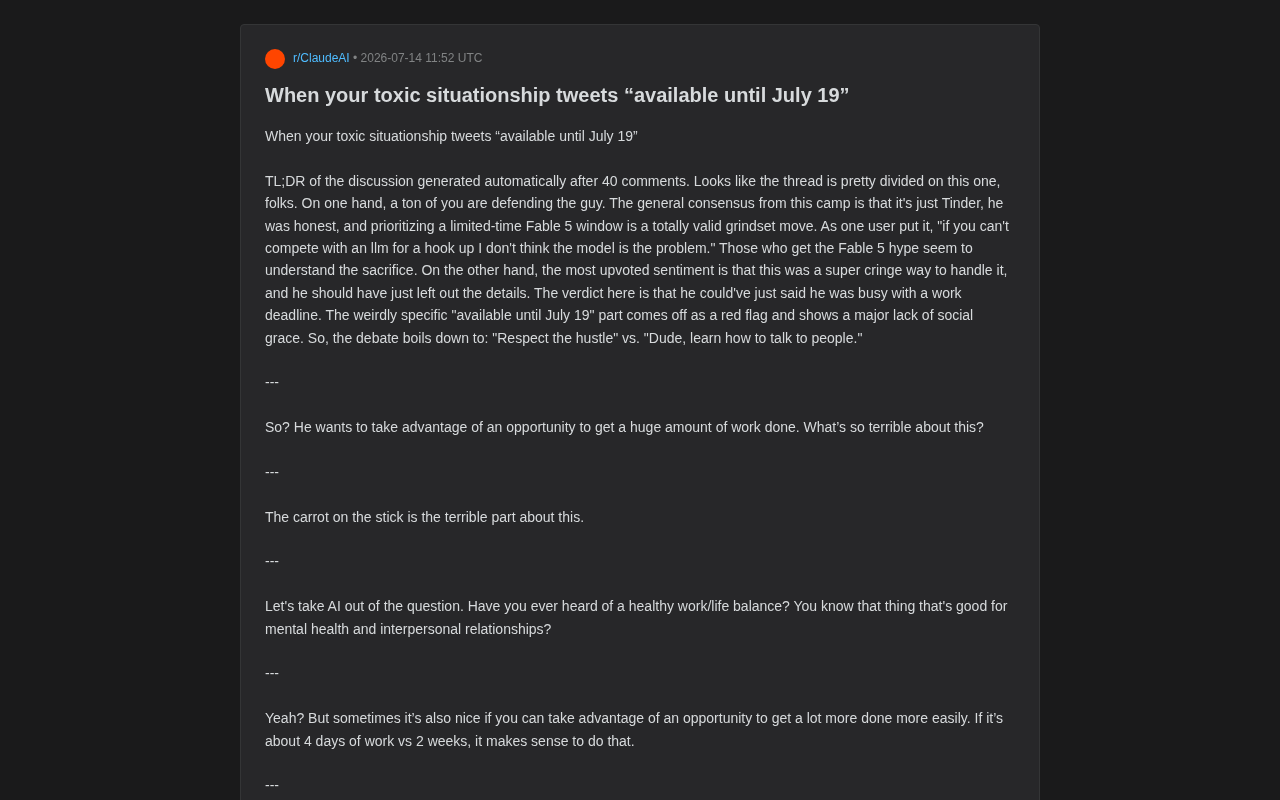
The Supporters: Respect the "Seize the Opportunity" Mindset
One camp in the discussion firmly sided with the protagonist. Their core logic: he was being honest, and prioritizing a limited-time, high-efficiency work window is a completely reasonable choice.
One user cut to the chase: "If you can't compete with a large language model for a date, the problem isn't the model." This tongue-in-cheek remark captures the supporters' underlying logic — when AI can compress what normally takes two weeks into four days, going all-in is a rational decision.
Large Language Models (LLMs) are AI systems built on the Transformer architecture and trained on massive text datasets. Well-known examples include OpenAI's GPT series, Anthropic's Claude, and Google's Gemini. The "limited-time window" effect these tools create typically stems from a few scenarios: free trial or subscription discount periods, open-access windows for specific model versions (such as early API testing phases), and inflection points where model capabilities are updated for specific use cases. Understanding this context is key to grasping the protagonist's logic — in an era of rapid AI development, a specific version or pricing window can deliver a genuine efficiency windfall, and missing it carries a real cost.
Recalculating the Time Budget
One supporter did the math: if something takes just 4 days within a specific window but would take 2 weeks otherwise, it makes complete sense to focus and get it done. This reflects a genuine shift in the AI era — the availability windows and efficiency dividends of tools are becoming important variables in how people structure their lives.
Underpinning this logic is a core concept from economics: opportunity cost — the highest-value alternative you give up when choosing a course of action. In the context of AI tools, this calculation becomes more complex. When a tool's efficiency gains dramatically compress the time required for a given task, the "time value" of waiting for that window is amplified. Behavioral economists call the decision-making bias triggered by external scarcity signals the Scarcity Mindset — limited resources (whether time, access windows, or tool availability) cause people to over-weight immediate efficiency gains in their decisions while undervaluing the long-term worth of what they're giving up (like a relationship). This also explains why an expression that seems clearly inappropriate to outside observers can feel like "a completely reasonable choice" within the decision-maker's own framework.
For those who understand the value of these AI tool dividends, the short-term "sacrifice" is worth it. What they see isn't a social misstep — it's a clear-eyed recognition of opportunity.
The Critics: Hard Work Is Fine, But Learn to Communicate
The most-upvoted perspective in the discussion, however, stood on the opposite side. Critics weren't disputing the value of working hard — they were criticizing the way it was communicated.
They argued that the person could have simply said "I have a work deadline coming up and I'm pretty slammed," and left it at that. The strange, overly specific "I'm only available until July 19th" actually revealed a serious lack of social awareness. As one user summarized: "Bro, learn how to talk to people."
The Manipulative Feel of a "Limited-Time Offer"
Another frequently raised criticism targeted the implied "come-on" — framing a potential relationship as a limited-time offer with a hard expiration date. That kind of framing carries an uncomfortable whiff of objectification and manipulation.
The deeper criticism cut to the heart of work-life balance. Someone asked: "Have you heard of work-life balance? The thing that's good for your mental health and your relationships?" In their view, no matter how efficient AI becomes, treating human relationships as a variable you can simply pause at will is itself a problem.
The Hidden Cost of Productivity Worship in the AI Era
Strip AI out of this debate entirely, and the core tension turns out to be ancient and universal: how do you balance the pursuit of efficiency with nurturing relationships? AI simply makes the tension sharper.
This tendency to place "productivity above all else" has a more systematic framework in academic and tech culture discussions: techno-accelerationism. This school of thought holds that technological progress should be embraced and leveraged to the maximum extent possible, and that individuals should continuously optimize their output to keep pace with technological evolution. Closely related is productivism — the belief that maximizing time and energy output is the highest value. Silicon Valley's "hustle culture" is the social expression of this tendency. Psychological research shows a significant correlation between this mindset and anxiety, burnout, and social isolation. AI tools, in this sense, serve as a new technological "accelerator" for a pre-existing tendency.
In the past, being busy with work was a passive state. Today, the limited-time dividends of AI tools make "going all-in on work" an active, highly tempting choice. When efficiency can be amplified so dramatically, the opportunity cost of sacrificing other dimensions of life seems smaller — but does it really?
Perhaps the sharpest line in the whole discussion is the most worth sitting with: "This guy definitely ruined a relationship. That much is certain." No matter how much AI boosts productivity, it cannot replace the kind of human connection that requires ongoing investment to sustain.
Where Is the Boundary of Efficiency?
This seemingly lighthearted debate actually raises a serious question: in an era where AI has dramatically amplified individual output, are we unconsciously placing productivity above everything else? When "capturing AI dividends" becomes a justification for sacrificing anything and everything else, it may be time to reexamine where efficiency ends.
Technology gives us more choices, but those choices still require wisdom. Being able to compress two weeks of work into four days is certainly worth celebrating — but how you communicate, how you prioritize, and how you prevent tools from warping your relationships with others: that's where a person is truly tested.
The Tool Is Innocent — What Matters Is How You Use It
Coming back to the most-upvoted line in the thread: the debate ultimately comes down to a tension between "respecting hustle" and "learning to communicate properly." The truth is, these two things aren't mutually exclusive.
A person can absolutely seize the efficiency opportunities AI offers while also handling their relationships with grace. The real problem was never AI, and it was never hard work. It's whether, when the dividends of a powerful tool go to our heads, we still remember the things that can't be algorithmically optimized — things like respect, social awareness, and the patience a relationship requires.
AI can help us win back time. But it cannot learn how to be a decent human being on our behalf. That may be the most valuable takeaway this Reddit debate has to offer.
Related articles

Felix Rieseberg Personal Homepage
Felix Rieseberg's personal homepage sparks attention on Hacker News. This article covers the Slack engineer's technical background, the rise and fall of nativefier, and the value of a developer homepage as a tech calling card.

@ai-sdk/vue 3.0.306 Patch Release Syncs with [email protected] Update
@ai-sdk/vue 3.0.306 released, synced with [email protected]. A routine patch release for the Vercel AI SDK ecosystem with no public API changes; the Vue adapter layer stays version-aligned with the core package.

Gemini 4 Argon API Launches: The Era of Million-Token Output Begins
Google launches Gemini 4 Argon with sparse MoE architecture, up to 1M output tokens, and a 68.90% Vals Index score, available across API, AI Studio, and the Gemini app.