When AI Claims to Create Souls: The Battle Over the Boundary Between Technology and Faith

A viral AI-vs-Vatican meme exposes real tensions between tech hype, philosophy of mind, and ethical governance.
A dark-humor meme circulating on Reddit — in which Silicon Valley claims to inject "souls" into programs, triggering "the last Crusade" — is pure satire, yet it pinpoints genuine public anxieties about AI. The article unpacks three core issues: today's LLMs are statistical systems with no connection to "consciousness" or "soul," and the tech industry's religious-flavored rhetoric blends commercial incentive with utopian belief; religious traditions hold deep intellectual resources on consciousness and human dignity that cannot legitimately be overwritten by tech companies; and what is truly needed is not civilizational conflict but an early, multi-stakeholder governance framework involving engineers, philosophers, ethicists, and the public alike.
The Deeper Question Behind a Satirical Meme
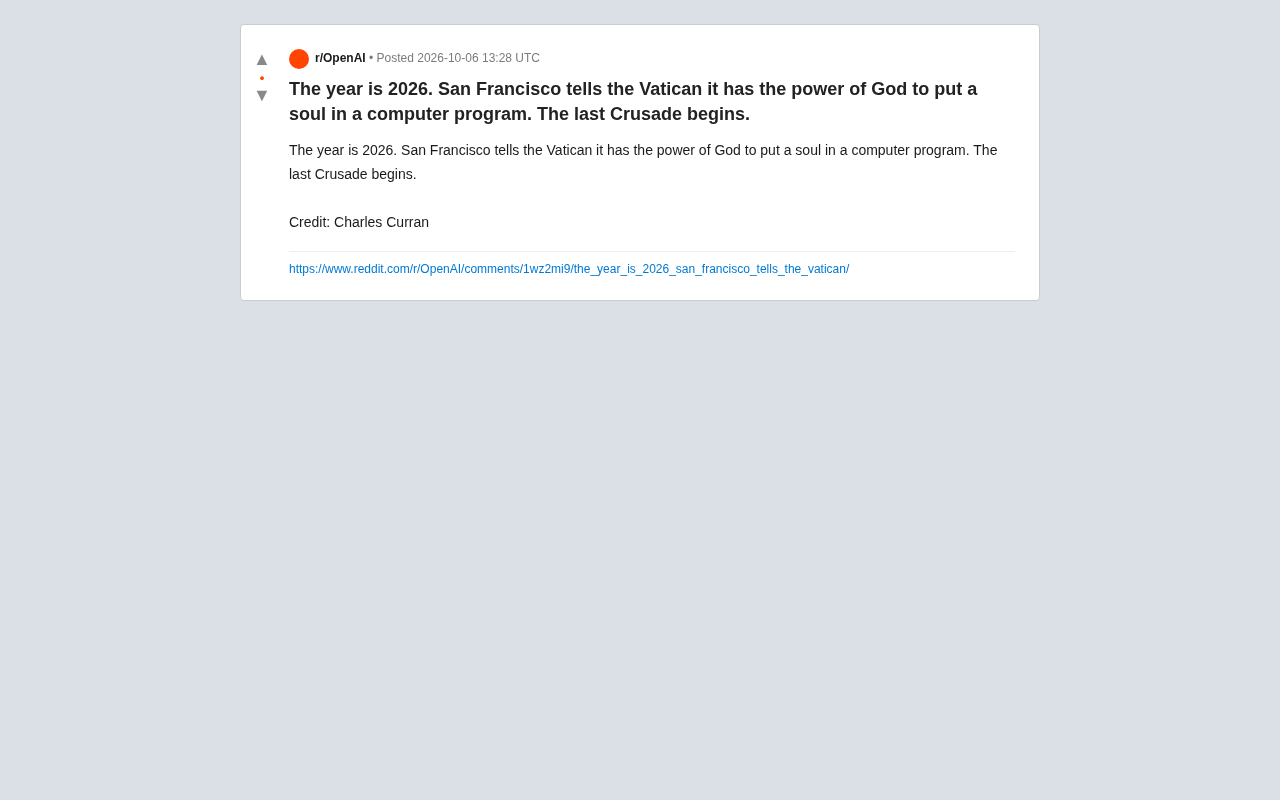
A piece of satirical content circulating on Reddit paints the following scene: Silicon Valley's tech elite announces to the Vatican that it has the ability to inject "souls" into computer programs — and so "the last Crusade" begins. The text (Credit: Charles Curran) is an exaggerated piece of dark humor, not a real event. Yet it strikes at the heart of today's core anxiety about artificial intelligence: when technology claims it can simulate or even "create" consciousness, just how great is the tension between tech and faith, between machines and our human self-understanding?
Memes like this resonate so widely precisely because generative AI's rapid capability growth has turned "do machines have minds?" — once a purely philosophical question — into a genuine public conversation. This article uses that piece of content as a starting point to unpack several questions that deserve serious attention.
Where Silicon Valley's "God-Making" Narrative Comes From
In recent years, some Silicon Valley leaders have adopted increasingly religious language to describe artificial intelligence. From "AGI will transform civilization" to concepts like "digital consciousness" and "mind uploading," these framings routinely blur the line between engineering reality and science fiction. The meme's notion of "putting a soul into a program" is a sharp satirical jab at exactly this kind of grand narrative.
The Gap Between Technical Reality and Marketing Speak
Let's be clear: today's large language models and generative AI systems are, at their core, statistical prediction engines trained on massive datasets. They can produce fluent text and realistic images — but that is an entirely different matter from possessing a "soul" or subjective consciousness. Equating the output of a probabilistic model with the awakening of awareness is a serious misreading of the technology.
The tech industry gravitates toward quasi-theological language partly to attract investment and attention, and partly because some practitioners genuinely hold a kind of techno-utopian belief. While this rhetoric spreads easily, it also generates unrealistic expectations and unfounded panic.
Understanding how large language models (LLMs) actually work helps clarify this gap. These models are trained on billions of text samples to learn the conditional probability distribution of words — in simple terms, given a context, they predict the most likely next token. The sense of "fluency" and "intelligence" in models like the GPT series or Claude comes from the statistical patterns of human writing encoded in training data, not from any form of understanding or intent. The philosopher John Searle illustrated this point as early as 1980 with his "Chinese Room" thought experiment: a system that can perfectly output correct Chinese responses does not necessarily understand Chinese. This argument remains a key reference point in debates about AI consciousness. When a company claims to have "injected a soul into a program," there is a fundamental semantic chasm between that claim and what is actually happening on the engineering side — adjusting neural network weights to optimize a loss function.
Why the Faith Perspective Cannot Be Ignored
The meme's decision to bring the Vatican into the conversation is not arbitrary. Religious traditions have thousands of years of accumulated thinking about "soul," "consciousness," and "what it means to be human." When technology begins touching these questions, the responses of religious institutions carry real-world significance.
In fact, multiple religious communities have in recent years voiced concerns about AI ethics, discussing whether machines should be granted moral status and how human dignity can be preserved in the face of technological change. These discussions remind us that the definitions of consciousness and soul should not be written unilaterally by technology companies.
In 2023, the Vatican joined governments from several countries in signing the Rome Call for AI Ethics, which called for "algorithmic ethics" to be embedded in AI development guidelines, with an emphasis on transparency, inclusivity, and accountability. This stands as a landmark case of a religious institution directly entering the AI governance conversation. Islamic, Buddhist, and other traditions have similarly issued AI ethics statements from their own perspectives. These forms of engagement are not backward-looking forces resisting technological progress. Rather, they signal that concepts like soul, consciousness, and human dignity carry centuries — even millennia — of moral reasoning across different cultures and belief systems. Having Silicon Valley engineers casually redefine these concepts carries enormous cultural and ethical risk.
The "Last Crusade" Metaphor Deserves Caution
The meme uses "the Crusades" to describe this potential conflict with obvious tongue-in-cheek intent, but the metaphor points to a real risk: the possibility of fierce confrontation between technological power and traditional value systems.
When a small number of institutions controlling cutting-edge technology come to believe they can redefine "life" and "consciousness," and when public oversight and diverse voices are absent from that process, technological power can evolve into a new kind of discursive hegemony. What is genuinely needed is not "war" but cross-disciplinary, cross-domain dialogue — engineers, philosophers, ethicists, religious thinkers, and ordinary citizens alike should all have a voice.
Rational Takeaways from a Joke
This content is a joke, but it reflects three directions worth continued attention:
The importance of technological humility. When it comes to a phenomenon like consciousness — not yet fully understood by science — both "we have created a soul" and "AI can never be conscious" are overly sweeping claims. A stance that is open yet careful is far more appropriate.
Responsibility in public narratives. Science communicators should avoid packaging products in misleading quasi-religious language that gives the public a distorted picture of what technology can actually do.
Ethics frameworks must come first. Rather than waiting for conflict to erupt, we should build governance mechanisms that include multiple stakeholders early, allowing technological development and humanistic values to evolve in step.
The fact that a single satirical meme can trigger so many associations is itself evidence that artificial intelligence has become deeply embedded in our collective imagination of the future. How to find a clear, grounded position between techno-fervor and techno-panic may be the defining challenge of this era.
Philosophical debate about AI consciousness currently features several major positions: functionalists argue that any system whose functions are equivalent to human cognition should be regarded as conscious; phenomenal consciousness theorists (such as David Chalmers, who articulated the "hard problem") insist that subjective experience cannot be explained by function alone; and eliminativists contend that "consciousness" and "soul" are folk concepts that science needs to reinterpret from the ground up. It is precisely this fundamental philosophical disagreement that means there is still no academic consensus on whether AI can be conscious — and that makes public discussion highly susceptible to manipulation by competing narratives. Understanding that this disagreement exists is the prerequisite for forming an independent judgment.
Related articles

Workbuddy for Absolute Beginners: How a Desktop AI Agent Fits Into Real Workflows
A beginner's guide to the Workbuddy desktop AI agent: installation, claiming credits, file management, and building automated workflows—compared with CodeX for fit and cost, helping professionals shift from AI question-askers to AI managers.

OpenAI's New Agent Stack: Computer Use, Decisions API, and Ultra-Fast Workflows
OpenAI Dev Day unveiled a new agent stack: Computer Use outperforms humans, Decisions API delivers ultra-low-latency classification via Luna, Agents API opens the same Computer Use capabilities, and GPT-6.1 Sol costs only one-seventh of Astra. Core updates, benchmark data, and developer insights.

Liang Wenfeng Open-Sources DeepInfo Inference Framework, Takes On U.S. Ban
DeepSeek open-sources its DeepInfo inference framework after its models, featuring GPU/CPU cross-pipelining, small-model prediction with large-model verification, and full Huawei Ascend and NVIDIA chip support—facing the U.S. federal ban head-on. This article analyzes its significance for AI deployment and open-source strategy.