When AI Customer Service Makes Things Worse: Users Complain Apryse Assistant Just Restates the Problem Without Solving It

AI customer service restates the user's question without providing an answer, exposing the disconnect between intent recognition and problem solving.
Starting from a Reddit user's complaint about Apryse AI customer service's "broken record"-style replies, the article points out that the root of such experiences lies in the disconnect between AI intent recognition and problem-solving capability: the system can understand and even rephrase the user's question but cannot provide operational steps or policy explanations. The problem usually stems from insufficient knowledge base coverage and overly mechanical conversation flows. The article emphasizes that users' core demand is to solve the problem, not to participate in a conversation exercise, and that asking "Was this helpful?" when the answer is empty causes a second injury. For enterprises, improvement directions include proactively falling back to human agents or ticket entry points when AI cannot provide a substantive answer, and tying feedback requests to answer quality. For users, directly asking for a human agent remains the best choice when encountering broken-record-style replies.
When AI Customer Service Becomes a "Broken Record"
Recently, a Reddit user's complaint struck a chord: he contacted Apryse's AI Support Assistant for help, only to receive a reply that restated his question verbatim and then asked, "Was this answer helpful?" The user said in exasperation: "Telling me back the problem I just told you — how is that supposed to help?"
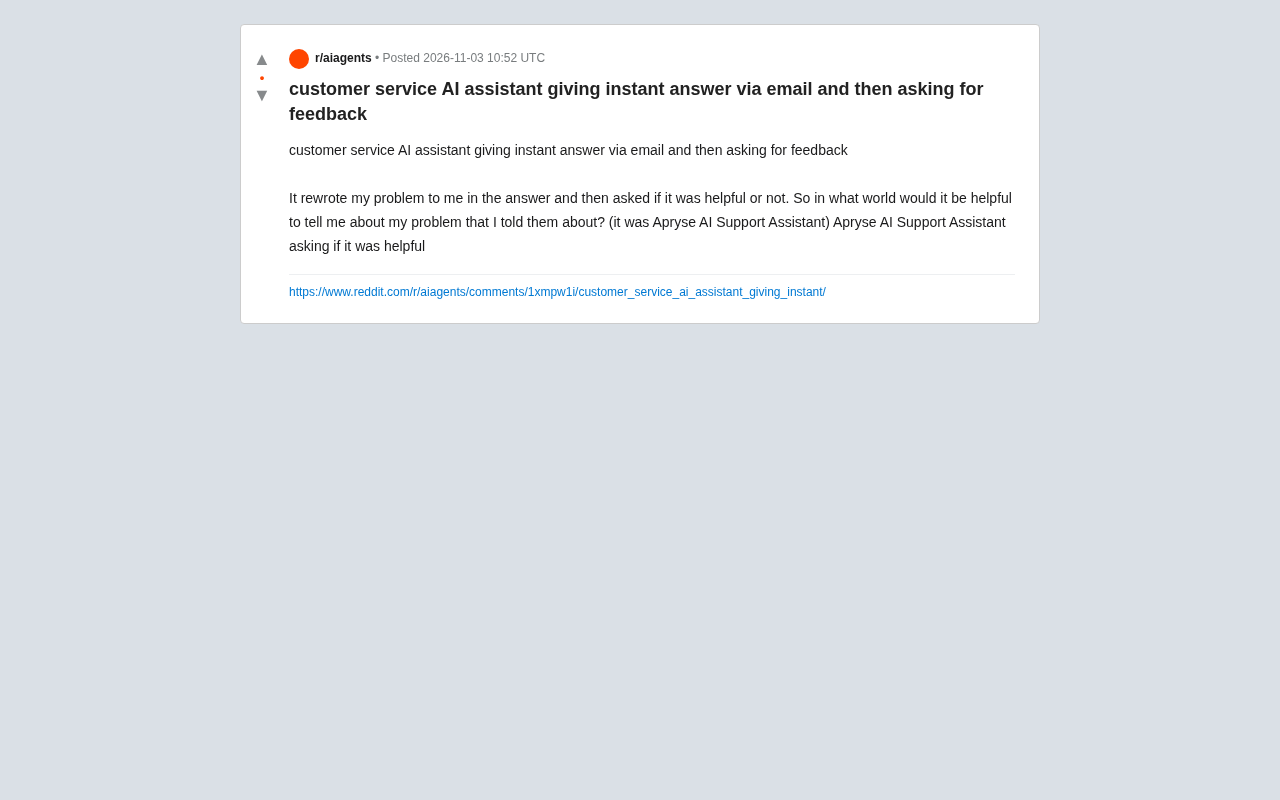
This scenario is all too familiar. Many companies deploy AI customer service with the goal of cutting costs and boosting efficiency, but the actual experience often disappoints — users arrive with a specific problem and get back a mirror image of their question instead of a solution.
Where Does the Problem Lie?
From a technical standpoint, this user's experience exposes a typical weakness of today's customer service AI: the disconnect between intent recognition and problem solving. The AI may successfully "understand" the literal content of the user's input — it may even be able to rephrase it more fluently — but it hasn't truly parsed out the operational steps, root cause of the fault, or policy explanation the user needs.
More subtly, the system then immediately asks "Was this helpful?" This is itself a feedback-collection mechanism, but when the user has received no substantive help, the question feels almost sarcastic. The user's backlash is directed not only at the answer itself but at this interaction design that "asks for an evaluation without providing help."
According to analysis from Reddit users and some industry practitioners in the discussion, this kind of problem usually stems from two levels: first, insufficient knowledge base coverage, leaving the AI capable only of surface-level work; second, an overly mechanical conversation flow design that treats "restating to confirm" as a mandatory step while ignoring that what the user is waiting for is an answer, not an echo.
Intent Recognition is a foundational capability of conversational AI, referring to the process by which a system determines the user's true goal (such as checking an order, requesting a refund, or reporting a fault) from natural language input. A common approach is to map the input to predefined intent categories and then trigger the corresponding processing flow. But successful intent recognition does not equal problem solving — it only completes "classification." What follows still requires entity extraction (obtaining key parameters such as order numbers and product model numbers), knowledge retrieval, and reasoning-based generation to produce an actionable answer. The weakness of many customer service AIs lies precisely here: the intent classification model performs reasonably well, but the downstream knowledge base retrieval and answer generation are weak, so the system "knows what the user is asking" yet "can't come up with a solution" and can only fall back on restatement or templated scripts.
Knowledge base coverage determines the upper limit of a customer service AI's capability. Enterprise customer service AIs typically use a retrieval-augmented generation (RAG) architecture: first retrieving relevant snippets from product documentation, FAQs, and historical tickets, then having a large model organize them into an answer. If the knowledge base lacks corresponding entries, contains outdated content, or is too coarse-grained (for example, only a product overview without specific troubleshooting steps), the retrieval step won't recall valid information, and the model can only do surface-level restatement based on the question itself. This is one of the technical roots of the "broken record" phenomenon — it's not that the model can't talk, it's that it has nothing to say. Therefore, evaluating customer service AI shouldn't look only at language fluency but also at the completeness, update frequency, and degree of structure of the knowledge base.
Users Want Answers, Not Echoes
In customer service scenarios, the user's core demand is to solve the problem, not to participate in a conversation exercise. When AI reorganizes the user's question in different words and returns it, it has actually completed a "confirm understanding" action but not a "provide value" action. For simple questions, this restatement might have a soothing effect; but for complex questions, it only adds to the user's frustration.
Some argue that AI customer service proactively asking for feedback after answering is intended to collect data to optimize the model, but the premise is that the answer itself is already somewhat helpful. If the answer is empty, the feedback request becomes a second injury. In this case, Apryse AI Support Assistant's behavior happened to step right on this landmine.
Low-confidence Fallback is a common mechanism in dialogue system design: when the model's confidence in its own answer falls below a set threshold, the system does not force an answer but instead routes to a human agent, ticket submission, or a follow-up question. Confidence can come from signals such as retrieval match scores, generation probabilities, or multi-model voting. Setting a reasonable fallback threshold balances "answering wrong" and "refusing to answer" — too high a threshold pushes a large number of questions to humans, while too low a threshold lets empty answers flow into the user interface. The article's point that "if an answer is judged low-confidence, feedback shouldn't be rashly solicited" essentially means linking the fallback mechanism with the feedback trigger logic.
Implications for Enterprises Deploying AI Customer Service
Although this complaint is an individual case, it reflects the common challenges of putting AI customer service into practice. Enterprises need to examine not only model capability but also conversation flow design, knowledge base coverage, and the timing of feedback mechanism triggers.
A viable direction for improvement: when AI cannot provide a substantive answer, proactively fall back to a human agent or provide a ticket entry point, rather than continuing to fill the conversation with templated scripts. At the same time, feedback requests should be tied to answer quality — if an answer is judged low-confidence, it shouldn't rashly ask "Was this helpful?"
From the user side, this complaint also reminds us that the quality of AI customer service varies widely, and when encountering "broken record"-style replies, directly asking for a human agent is still the most efficient choice.
(This article is based on experiences publicly shared by Reddit users, combined with analysis of common issues in AI customer service.)
Related articles

AI Tools Quietly Altering Settings: Postman Silently Installs Plugin, Codex Sharing Option Auto-Resets
AI Daily reports: Postman silently installs a Mac plugin and self-approves startup hooks, logged as auto-existing upgrade; Hacker News developers say Codex data-sharing opt-out flips back. Plus Simon Willison's raw float weight experiment with QEN 3.8-27B.

AI Learns to Rewrite AI: MIT's "Weightspace Programming" Redraws the Path to Recursive Self-Improvement
MIT team proposes weightspace programming: GPT-6 Astra reads and edits AI model weights directly. Math scores jump several-fold, hand-written networks beat trained models. Eight experiments analyzed, plus Anthropic's same-day warning and the real boundaries of recursive self-improvement.

Running Qwen 3.8 on a Laptop to Read Raw Weights: 46 Minutes Per Answer
Simon Willison reproduced weight space programming with Qwen 3.8 27B on a laptop: a 17GB model file, 46 minutes per answer, 43,506 reasoning tokens, Pong over an hour, Freeway failed. Suited for interpretability researchers.