When AI Makes Development "Accessible to Everyone": A Programmer's Career Anxiety and Industry Reflection

A programmer's anxiety as AI coding tools turn creation into prompt input and self-doubt.
Based on an anonymous Reddit post titled "The future is bleak," the article describes a working software engineer whose daily work has become repeatedly entering prompts into Claude and pressing Enter, with only about 0.1% of work done manually, leaving him feeling "soulless." It then analyzes the anxiety caused by the spread of AI coding tools: leveling technical barriers, eroding product moats, looming layoffs, and the lack of transferable non-technical skills. The article offers four rational perspectives — judgment remains scarce, system design and accountability cannot be generated, career anxiety is not the endgame, and "AI impostor syndrome" must be confronted. It concludes by urging developers to shift from implementers to problem framers and cross-domain integrators to rebuild professional identity in the AI era.
This article is based on an anonymous Reddit post titled "The future is bleak," written by a working software engineer. The post struck a chord with many and exposed the deep career anxiety underlying the widespread adoption of AI coding tools.
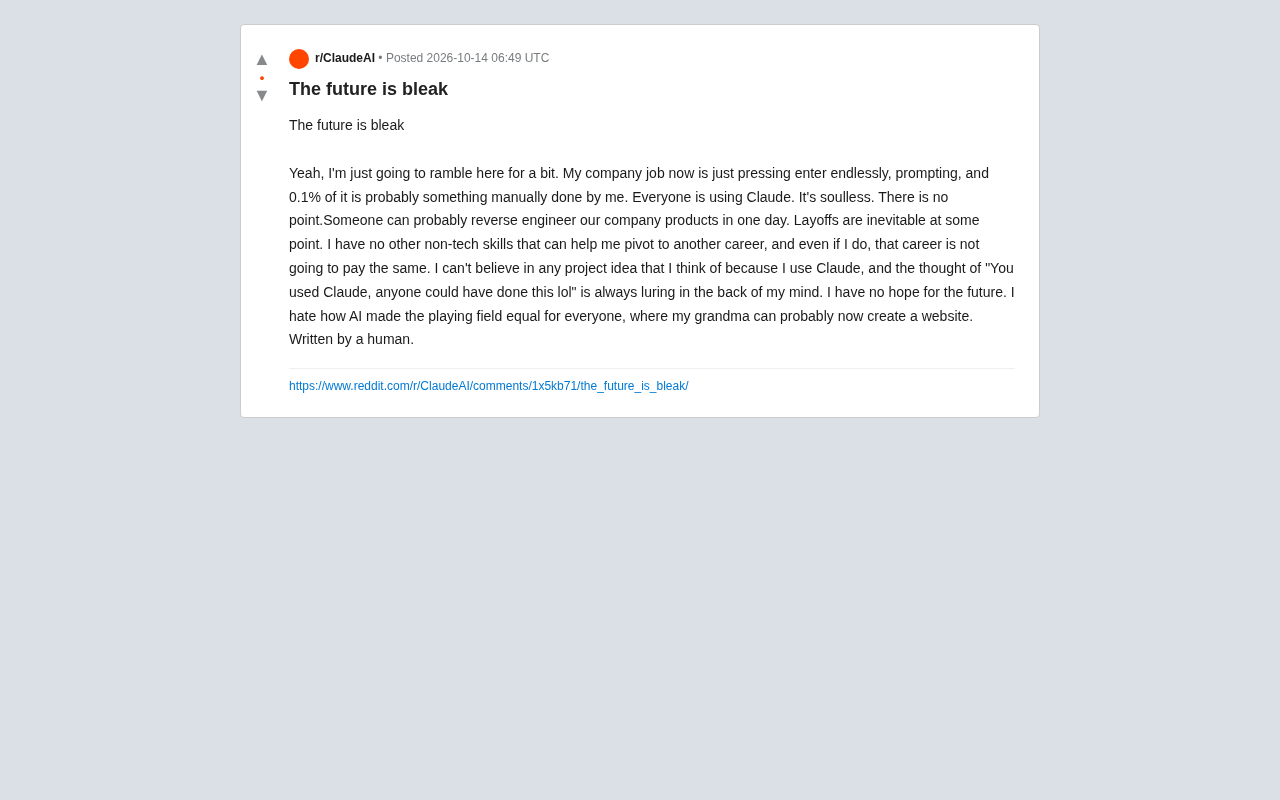
1. A Programmer's Daily Life: From "Creating" to "Pressing Enter"
The poster describes his current work situation: his main task has become repeatedly entering prompts into Claude and pressing Enter, with only about 0.1% of the work requiring manual effort. He describes this experience as "soulless" — projects are still moving forward, but his sense of control and creativity over the code is disappearing.
This description is not an isolated case. As AI coding assistants like Claude, Copilot, and Cursor take up an increasingly large share of the development workflow, many engineers find their role shifting from "the person who writes code" to "the person who reviews code" or "prompt engineer." On the surface, efficiency has improved, but what follows is a kind of emptiness that is hard to articulate.
His concerns go beyond personal experience. The post mentions that the company's product could potentially be "reverse-engineered by someone else within a day." When the barrier to code generation drops to nearly zero, the technical moat of the product itself rapidly dissolves.
AI coding assistants are a category of development tools that have proliferated rapidly in recent years, with representative products including GitHub Copilot, Cursor, Claude Code, and others. Under the hood, they are typically large language models (LLMs) fine-tuned on code corpora, capable of automatically completing functions, generating modules, explaining code, and even refactoring projects based on context. Their working modes fall roughly into two categories: one is inline completion, which predicts the next segment of code in real time within the editor; the other is conversational generation, where the developer describes requirements in natural language and the model outputs a complete code block.
The reason these tools have transformed workflows in such a short time is that they compress the act of "writing code" from character-by-character typing into prompt design plus review. The efficiency gains are real, but so are the side effects: developers' "feel" for code weakens, the accumulation of debugging and troubleshooting experience is skipped, and long-term reliance leads to unfamiliarity with underlying principles. The "0.1% manual completion" described in the post is a portrait of this extreme dependency.
2. Does AI Level the Playing Field, or Erase the Moat?
The poster repeatedly mentions an unsettling point: AI has made the "playing field" equal. He even says, "My grandma could probably build a website now." Behind this statement lies a broader question — when technical ability is no longer a scarce resource, where exactly does a programmer's core value lie?
From a positive perspective, AI is indeed empowering more people. Non-technical founders can quickly build prototypes, and small teams can accomplish workloads that previously required ten person-months. But from this engineer's perspective, this "equalization" also means: his proud programming skills are becoming a commodity that anyone can acquire.
He admits that whenever he thinks of a project idea, the thought "you used Claude, anyone could do this" pops into his head, making it impossible for him to feel confident about any idea. This is a psychological state of being reverse-PUA'd by AI — the more powerful the tool, the lower the user's sense of self-efficacy.
Technical moat is a common concept in competitive analysis, referring to capability barriers that competitors cannot easily replicate in the short term, with common sources including proprietary algorithms, data accumulation, engineering scale, ecosystem lock-in, and compliance qualifications. Traditional software companies' moats are often built on "implementation difficulty" — turning an idea into a working product requires scarce engineering resources, which itself constitutes a barrier.
The emergence of large language models has changed the first half of this equation: implementation costs have plummeted, and prototypes can be produced within hours. But the moat has not disappeared entirely — it has migrated. The parts that are truly difficult to replicate are shifting toward data assets, distribution channels, brand trust, compliance experience, and system stability. In other words, AI has torn down the wall "from zero to one," while the wall "from one to a million" still stands tall. The poster's anxiety stems precisely from the fact that he only sees the wall that has been torn down.
3. The Shadow of Layoffs and the Dilemma of Non-Technical Skills
The latter half of the post is even heavier. The poster believes layoffs are "inevitable at some point," and he has no non-technical skills to help him change careers — and even if he did, his income would likely be lower than now.
This is a very real structural problem. The tech industry's high salaries are built on the scarcity of skills, and when AI suppresses that scarcity, the compensation structure will loosen accordingly. For those who have long focused on technology without accumulating other professional skills, the window for transition is narrowing.
You may not have noticed, but the poster does not direct his anger at AI itself. His anger is more about a sense of losing control: the industry's rules of the game have changed, and he is not prepared, nor does he know which way to go.
4. Is This Anxiety Reasonable? A Few Angles Worth Considering
This post represents a real but not necessarily comprehensive emotion. The following points may be worth considering in contrast:
First, AI lowers the implementation barrier, but does not lower the value of "judgment." Knowing what to do, why to do it, and which approach is better in a specific scenario — these decision-making abilities remain scarce. Many people can use Claude; few can judge the quality of Claude's output.
Second, code can be generated, but system design and accountability cannot. The gap between a working prototype and a system that can support a million users remains enormous. AI is currently good at local implementation, not global architecture.
Third, career anxiety does not equal career obsolescence. Historically, every technological paradigm shift has triggered similar panic, and the eventual outcome is usually a change in job forms rather than complete disappearance. But this does not mean individuals don't need to actively adjust.
Fourth, the psychological "AI impostor syndrome" needs to be addressed. When tools become powerful, users tend to attribute the tool's output to the tool rather than themselves. This psychological mechanism is worth guarding against — it may undermine a person's drive to act earlier than the technological shock itself.
Impostor Syndrome is a common psychological phenomenon: despite objective abilities and achievements, individuals persistently doubt whether they are a "fraud" and fear being exposed by others. It is usually associated with high-achievement environments, frequent lateral comparison, and reliance on external evaluation.
When AI tools take over a large amount of concrete output, this psychology gets amplified into a new variant — one could call it "AI impostor syndrome." Users unconsciously attribute results to the tool rather than to their own judgment, decomposition, and debugging process. But in fact, asking the right questions, defining boundaries, identifying model hallucinations, and making final trade-offs — these are precisely the human tasks that cannot be outsourced to the model. Recognizing that "using a powerful tool does not diminish the value of the agent" is a key step in alleviating this kind of anxiety.
5. Rebuilding Professional Identity in the AI Era
The poster ends with "Written by a human," like a final act of defiance. This line also points to the core contradiction: in an era where AI can generate everything, what exactly is the uniqueness of the identity of "human author"?
For developers in similar situations, possible directions include: shifting from "implementer" to "problem definer," from "writing code" to "understanding the business," and from "a single tech stack" to "cross-domain integration." These transitions are not easy and do not guarantee success, but they at least offer the possibility of active choice rather than passively waiting for a layoff notice.
AI will not make the future bleak, but it will indeed blur the old paths. Finding one's place anew amid this blur may be a challenge shared by this generation of tech professionals.
Problem framer describes a role in which, before jumping into implementation, one first transforms vague business needs into clear, verifiable, prioritized technical problems. It requires understanding user scenarios, weighing costs and benefits, and identifying real constraints — rather than rushing to choose a framework or write the first line of code.
In an environment where AI dramatically lowers implementation costs, this kind of ability appreciates in value. Because when "how to do it" becomes increasingly cheap, the scarcity of "what to do" and "why do it" becomes more prominent. For developers, this means gradually shifting the focus of learning from syntax and API memorization toward domain knowledge, systems thinking, and cross-functional communication. Transition does not mean abandoning technology, but embedding technical ability closer to decision-making, thereby occupying links in the value chain that are harder to automate away.
Related articles

Chain of Thought Isn't Just for AI: How Humans Can Use CoT to Improve Thinking Quality
Chain of Thought isn't just a prompt trick for large models. Starting from a Hacker News discussion, this article analyzes why CoT works for human thinking too, breaks down actionable ways to transfer it, and highlights the key differences between human CoT and machine CoT.
Cloudflare Teams Up with OpenAI: Closi…
Cloudflare Teams Up with OpenAI: Closing the Loop from Vulnerability Discovery to Defense with AI
Cloudflare uses OpenAI Daybreak to investigate security vulnerabilities and generate reviewable remediation plans, while developers use Codex to boost coding efficiency and quality.

Orca Multi-Agent Orchestration in Practice: A Guide to Parallel Collaboration with Claude and Codex
Orca is Stable AI's free open-source agent workbench supporting 34 agents like Claude Code and Codex in parallel. Learn its Git worktree isolation, multi-model orchestration, and mobile management.