When AI Patient Response Simulations Are Unreliable: How Support-Gated World Models Improve Clinical Decision Support Reliability

The Support-Gated World Model uses dual gating and abstention to trade off reliability and coverage in clinical simulation.
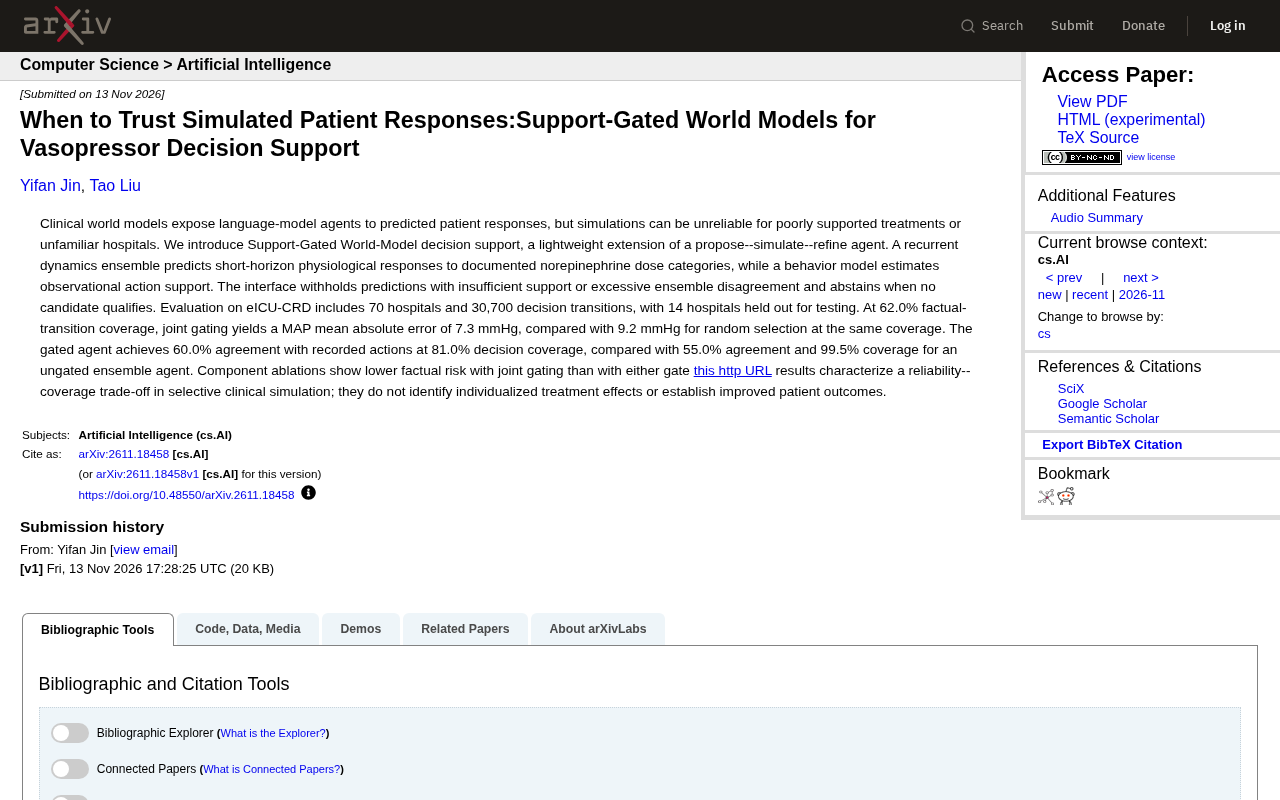
Clinical decision support systems use language model agents to simulate patient responses to treatment, but simulations can deviate severely when treatment support is insufficient or the hospital environment is unfamiliar. The study proposes a "Support-Gated World Model" that adds two gates to the propose–simulate–refine framework: a recurrent dynamics ensemble predicts short-term physiological responses and uses ensemble disagreement to measure uncertainty, while a behavior model assesses the historical-data support for the current treatment option; predictions are withheld when support is insufficient or disagreement is too large, and the system abstains when no candidate passes. Evaluated on 70 hospitals and 30,700 decision transitions in eICU-CRD, joint gating achieved a MAP error of 7.3 mmHg at 62.0% coverage versus 9.2 mmHg for random selection; the gated agent reached 60.0% agreement with recorded actions at 81.0% coverage, versus 55.0% for the ungated agent (99.5% coverage). Ablation shows the two gates are complementary. The study stresses it only characterizes a reliability–coverage trade-off, does not identify individualized efficacy, and has not been shown to improve patient outcomes.
Clinical decision support systems increasingly rely on language model agents to simulate patient responses to treatment, but simulation results are not always reliable—especially when treatment support is insufficient or the hospital environment is unfamiliar. A new study proposes a "Support-Gated World-Model" approach that dynamically judges the trustworthiness of a simulation to decide whether to accept its prediction, thereby balancing reliability and coverage.
Background: The Reliability Dilemma of Simulating Patient Responses
Clinical world models let language model agents "see" predicted patient responses and thereby assist decision-making. However, this simulation carries a fundamental risk: when treatment options lack sufficient historical data support, or when facing an unfamiliar hospital environment, simulation results may deviate severely from reality. If agents blindly trust these unreliable predictions, they may instead produce harmful recommendations.
The research team distills this problem into a "reliability–coverage trade-off": a system can choose to offer recommendations for more decision scenarios (high coverage), but inevitably includes some low-quality predictions; or it can choose to speak only when confident (high reliability), but forgo many decision opportunities. Finding the balance point between the two is the core challenge of selective clinical simulation.
World Model in reinforcement learning and agent research refers to an agent's internal simulator of environment dynamics: given the current state and action, it predicts the next state or observation. In clinical settings, world models let language model agents "rehearse" patient physiological responses before actually executing treatment, thereby supporting planning and decision-making. However, the prediction quality of world models depends heavily on the state-action space covered by training data; when an action (such as a certain dose) is rare in historical data, or when the environment shifts (such as differing practice habits across hospitals), prediction error increases significantly. This is in line with the classic "model bias" problem in model-based reinforcement learning—if an agent over-trusts an inaccurate model, the policy it plans may fail or even be harmful in the real environment.
Method Design: Dual Gating and an Abstention Mechanism
The Support-Gated World Model is a lightweight extension of the "propose–simulate–refine" agent framework. Its core innovation lies in introducing two gates:
- Dynamics ensemble prediction: A recurrent dynamics ensemble model predicts short-term physiological responses, targeting the recorded norepinephrine dose categories.
- Behavior model estimates support: Another behavior model assesses the support of observed actions, i.e., how many precedents the current treatment option has in historical data.
When support is insufficient or the disagreement within the ensemble model is too large, the interface actively "withholds" the prediction; if no candidate passes the gates, the system chooses to abstain rather than forcing a recommendation. This design lets the agent stay silent when uncertain, rather than risk outputting a possibly erroneous simulation.
Ensemble learning and uncertainty estimation: The dynamics ensemble model consists of multiple independently initialized recurrent networks, each predicting short-term physiological responses. Disagreement among ensemble members is often used as a proxy for epistemic uncertainty: large disagreement means the model lacks consistent knowledge about that input and prediction confidence is low. Selective prediction, or "learning to abstain," is a framework that lets models refuse to output when confidence is low; its core metric is the risk–coverage curve: as coverage decreases, the error on accepted samples should decrease accordingly. The Support-Gated World Model combines these two ideas, using ensemble disagreement together with the action support estimated by the behavior model to jointly decide whether to accept a simulation, thereby explicitly controlling risk at deployment time.
Experimental Evaluation: Multi-Hospital Validation on eICU-CRD
The study was evaluated on the eICU-CRD dataset, covering 70 hospitals and 30,700 decision transitions, of which 14 hospitals were held out for testing to examine the model's generalization to unfamiliar hospital environments.
Key results are as follows:
- At 62.0% factual transition coverage, the joint gating achieved a mean absolute error of 7.3 mmHg in mean arterial pressure (MAP), compared with 9.2 mmHg under random selection at the same coverage—a significant error reduction.
- At 81.0% decision coverage, the gated agent reached 60.0% agreement with recorded actions; in contrast, the ungated ensemble agent reached 55.0% agreement but with coverage as high as 99.5%.
- Component ablation experiments show that joint gating has lower factual risk than either gate used alone, indicating that the two gates are complementary rather than redundant.
These data reveal a clear pattern: sacrificing some coverage in exchange for reliability is worthwhile. The ungated agent offers recommendations for almost all decisions but with lower agreement; the gated agent, after giving up nearly one-fifth of decision opportunities, clearly improves recommendation quality.
eICU-CRD (eICU Collaborative Research Database) is a multicenter public dataset derived from intensive care units at multiple U.S. hospitals, containing high-frequency records such as vital signs, medications, and laboratory tests, and is often used for external validation of clinical decision support and prognostic models. Its multicenter nature makes it particularly suitable for evaluating cross-hospital generalization: holding out some hospitals as a test set simulates model performance when deployed to an unfamiliar institution. Mean arterial pressure (MAP) is a key metric for assessing hemodynamic stability, calculated as (systolic pressure + 2×diastolic pressure)/3, with a normal range of about 70–100 mmHg; MAP prediction error is measured in mmHg, and a MAE of 7.3 mmHg still requires cautious clinical interpretation. A decision transition refers to a decision point pairing a patient state with a treatment action, and is the basic unit for evaluating the agreement between agent recommendations and clinician-recorded actions.
Significance and Boundaries: A Reliability Trade-off, Not Individualized Efficacy
The value of this work lies in providing an operational reliability-assessment framework for selective clinical simulation. It does not aim to "give precise predictions for every patient," but rather acknowledges the limitations of simulation and uses a gating mechanism to keep unreliable predictions out of decision-making.
But the research team also clearly delineates the boundaries: these results characterize a reliability–coverage trade-off, and cannot identify individualized treatment effects, nor have they yet been shown to improve patient outcomes. In other words, the method improves "agreement between recommendations and historical records," not "the effectiveness of the treatment itself." From decision support to clinical benefit, there is still a long validation path to walk.
For clinical AI applications, this restraint itself is worth emulating: learning to abstain when simulation is unreliable may be more valuable than forcing a prediction.
One-line Summary
The Support-Gated World Model uses dual gating and an abstention mechanism to trade off reliability and coverage in clinical simulation.
Paragraph Summary
Clinical decision support systems use language model agents to simulate patient responses to treatment, but when treatment support is insufficient or the hospital environment is unfamiliar, simulations may deviate severely from reality. The study proposes a "Support-Gated World Model" that adds two gates to the propose–simulate–refine framework: a recurrent dynamics ensemble predicts short-term physiological responses and uses ensemble disagreement to measure uncertainty, while a behavior model assesses the historical-data support for the current treatment option; when support is insufficient or disagreement is too large, predictions are withheld, and when no candidate passes, the system abstains. Evaluated on 70 hospitals and 30,700 decision transitions in eICU-CRD, the joint gating achieved a MAP error of 7.3 mmHg at 62.0% coverage, outperforming random selection's 9.2 mmHg; the gated agent reached 60.0% agreement with recorded actions at 81.0% coverage, higher than the ungated agent's 55.0% (at 99.5% coverage). Ablation shows the two gates are complementary. The study emphasizes that it only characterizes a reliability–coverage trade-off, does not identify individualized efficacy, and has not been shown to improve patient outcomes.
Related articles

Abnormal Error Rate Spike in Claude Mythos 5.2 and Fable 5.2
Claude Mythos 5.2 and Claude Fable 5.2 show an abnormal spike in request error rates, marked as investigating on the official status page. This article covers the incident overview, practical impact on developers, and recommended responses.

ReAct Runtime Context Trimming: Why Claude Code Acts at 70%
A deep dive into ReAct runtime context trimming: why Claude Code compresses at ~70% usage, why tool calls dominate, why messages must be dropped in pairs, and why codebases don't need RAG.

AI Agent vs LLM: How Cursor and Claude Code Actually Work
An in-depth analysis of the essential difference between AI Agents and LLMs: LLMs generate code suggestions, while Agents modify files and run tests via tool calls. Using a Spring Boot bug fix as an example, it breaks down the workflows, permission control, and verification mechanisms of Cursor and Claude Code.