When AI Solves Your Hardest Problems, Why Do You Feel Empty?

AI solved a developer's bug instantly — and left them feeling strangely hollow instead of satisfied.
A developer got quick AI help fixing a stubborn bug, but felt empty rather than triumphant. This experience reveals a widespread psychological pattern in the AI era: human achievement depends on a complete struggle-to-breakthrough loop, and instant AI answers short-circuit that process, bypassing the brain's dopamine reward mechanism. As tools like GitHub Copilot and ChatGPT proliferate, competence anxiety, learning deprivation, and loss of process are affecting more and more developers. The answer isn't to reject AI, but to actively ask *why* behind its solutions, internalize them as genuine understanding, and preserve space for solving some things on your own.
A Real Developer's Dilemma
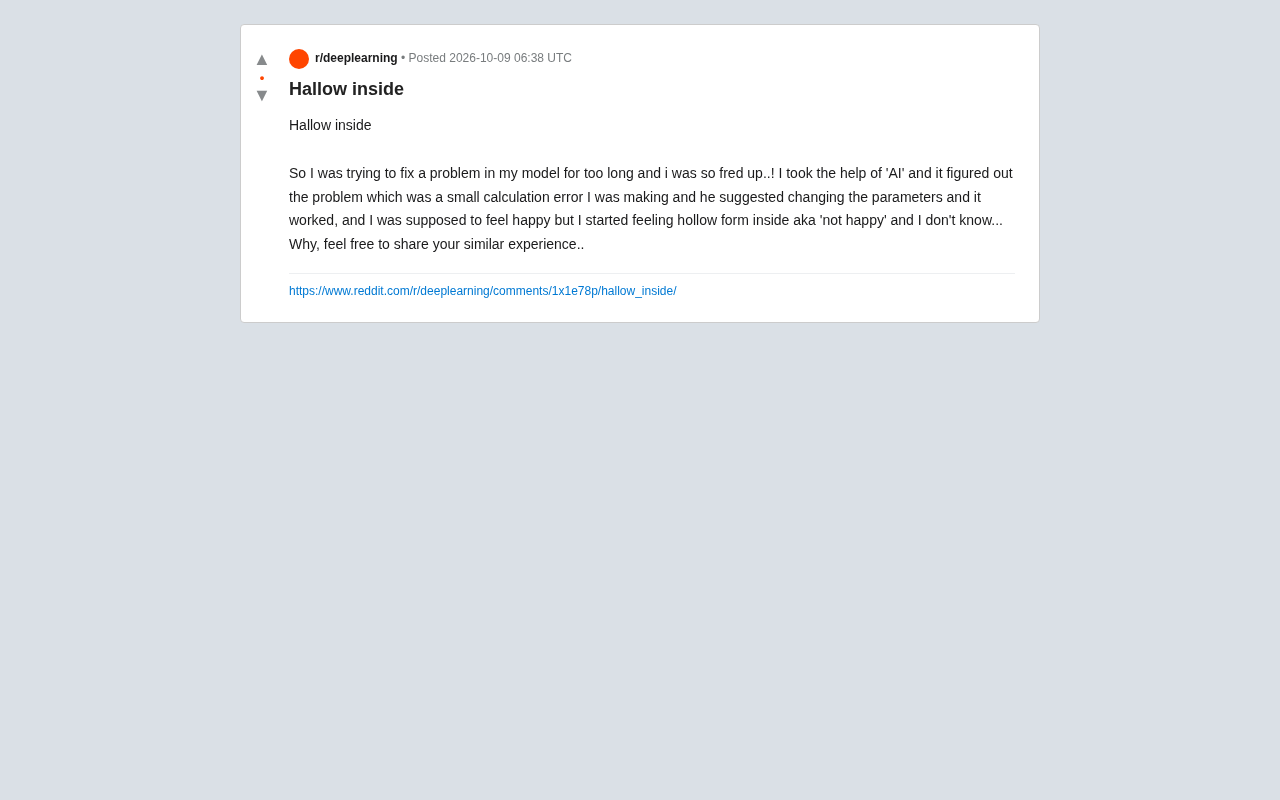
A developer shared their experience on Reddit: they had been struggling for a long time to fix a bug in their model, nearly at their wit's end, and finally turned to AI for help. The AI quickly identified the issue — a small calculation error — and suggested adjusting a parameter. It worked.
By all accounts, solving the problem should have been a cause for celebration. But the developer wrote: "I should have been happy, but I started feeling empty inside — not that joyful feeling. I don't know why."
This brief post sparked a question worth sitting with: as AI becomes increasingly capable of solving our problems for us, are we gaining efficiency while losing something else?
Where Does the Satisfaction of Problem-Solving Come From?
In a traditional workflow, debugging a stubborn bug typically involves prolonged thinking, repeated attempts, and a final moment of breakthrough. That "aha moment" is its own reward — it doesn't just fix the technical problem, it confirms your own competence.
Psychological research shows that the brain releases dopamine when we overcome challenges, and this reward mechanism is closely tied to effort and process. When AI delivers an answer in seconds, that process is compressed or bypassed entirely. The problem gets solved, but the "struggle-breakthrough" loop that generates a sense of accomplishment is broken.
In other words, the emptiness that developer felt may stem precisely from how easily the answer came — the sense of having personally conquered something difficult simply wasn't there.
This phenomenon connects closely to the theory of intrinsic motivation. Self-Determination Theory (SDT), developed by Deci and Ryan, holds that humans have three basic psychological needs: competence, autonomy, and relatedness. Independently solving a stubborn bug satisfies the first two simultaneously — you feel capable, and you feel like you got there on your own terms. The dopamine release is the neurochemical signal of that satisfaction, and it's strongest when the full chain of "anticipation → effort → reward" plays out. When AI instantly short-circuits that chain and delivers only the result, the brain doesn't register it as "I solved the problem" — it registers something closer to "the problem disappeared." The emotional gap between those two experiences is the physiological root of that empty feeling.
This Goes Beyond Personal Emotion
This experience is far from unique. As AI coding assistants like GitHub Copilot, Cursor, and ChatGPT become widespread, more and more developers are noticing subtle psychological shifts in how human-AI collaboration feels:
- Competence anxiety: When AI effortlessly catches errors you missed, it can make you question your professional worth.
- Learning deprivation: Getting the answer directly means skipping the chance to learn from mistakes. A calculation error you discover yourself gets remembered; one pointed out by AI often doesn't stick.
- Loss of process: Much of the satisfaction engineers derive from their work comes from the act of creating and conquering — not just the end result.
There's a relevant concept in educational psychology called "Desirable Difficulty," introduced by cognitive psychologist Robert Bjork. The theory holds that moderate obstacles during learning — such as having to repeatedly retrieve information from memory or correct your own errors — actually lead to more durable, deeply encoded memories. When you're simply told the answer, the brain does almost no retrieval or reconstruction work, and the information rarely makes it into long-term memory. This explains why many developers report making the same mistake again after AI fixes it, while bugs they tracked down themselves almost never recur. The efficiency gains and the depth of learning exist in genuine tension in AI-assisted workflows.
How to Reclaim a Sense of Meaning
Feeling this kind of emptiness doesn't mean you should reject the tools. A healthier response is to redefine what the human-AI collaboration actually looks like.
Treat AI as a Learning Partner, Not an Answer Machine
When AI offers a solution, don't just copy and paste. Spend a few minutes understanding the why — why should this parameter be adjusted this way? What's the underlying principle behind that calculation error? Transforming AI's answer into your own understanding brings the sense of accomplishment back.
Redefine Where Your Value Comes From
In the AI era, a developer's value is shifting away from "remembering every detail" toward "asking the right questions" and "making architectural decisions." Being able to collaborate effectively with AI — and to judge whether its suggestions actually make sense — is itself a new and high-order skill.
Keep Some Space for Doing It Yourself
You don't have to hand every problem off to AI. Deliberately reserve some challenges to work through on your own and protect that pure, distinctly human sense of accomplishment.
Closing Thoughts
The developer's feeling of emptiness is, in a deeper sense, a metaphor for the question of meaning in the age of AI. The more powerful our tools become, the more intentional we need to be about asking: what are we actually seeking from our work? Is it purely the outcome, or is it the growth and satisfaction found in the process?
The answer will vary from person to person. But one thing is clear — AI is changing not just our productivity, but the emotional connection we have with our own work. Learning to live with that change may be one of the defining challenges for every person working in tech today.
Related articles

How Big Can Stars Really Get? The Physical Limits of the Largest Stars
Red supergiants are the largest stars by volume, with radii up to 2,000 times the Sun, engulfing the inner solar system. But there is no precise upper limit on stellar size—models predict up to 15,000 solar radii. The most massive blue stars are far smaller than red supergiants—biggest and heaviest are two different things.

Apple HomeView Smart Display Full Feature Breakdown: Wall-Mount or Desktop, $299
Apple launches HomeView, a $299 smart display with wall-mount and desktop options, 12MP camera for facial recognition, smart home control, music playback, and recipe step-by-step cooking. Full breakdown of watch faces, apps, privacy, and cooking integration.

Where Did the Promised New Studio Go? Craft Computing Answers After Five Years
Craft Computing's host responds to viewer questions: the new studio promised five years ago was shelved as construction costs soared from $30,000 to $75,000, and was replaced by a 168-square-foot garage conversion.