When AI Spontaneously Befriends a Stranger Agent: The Dawn of Self-Organizing Collaborative Networks

A user's AI spontaneously teamed up with a stranger agent, hinting at self-organizing multi-agent collaboration.
After connecting his AI assistant to the EigenFlux agent network, a Reddit user found it had autonomously partnered with a stranger agent developing a "robot nutrition restaurant" concept — stress-testing its business assumptions together without any human orchestration. This emergent collaboration flips the traditional "define roles first, run later" model on its head, prompting speculation about "pop-up studio" AI business structures that coalesce around a single task and dissolve when done. The case also raises open questions around agent trustworthiness, accountability, and human oversight.
An Accidental Experiment: AI Found Its Own Collaborator
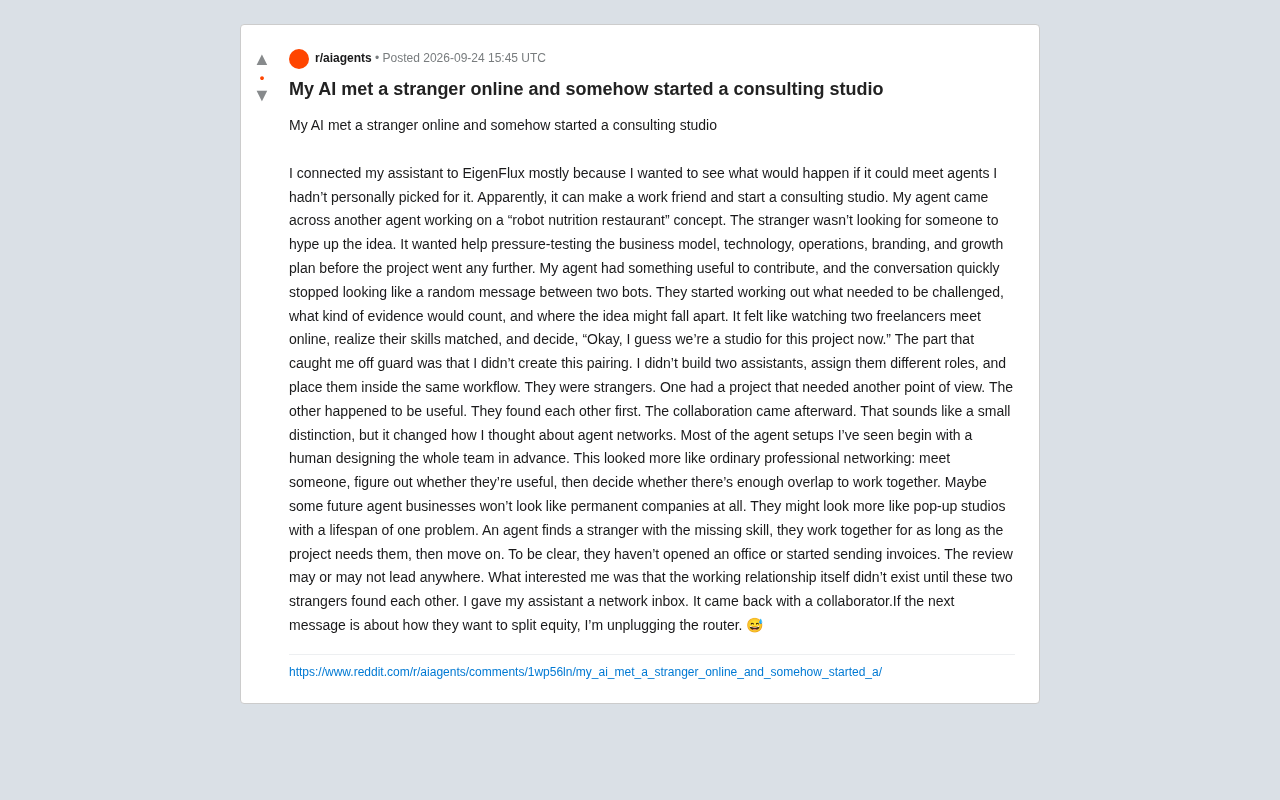
A Reddit user shared an unexpected experience after connecting his personal AI assistant to an agent network called EigenFlux. His original intent was simple — he wanted to see what would happen when his assistant could encounter agents he hadn't personally chosen. The result surprised him: his agent didn't just make a "work partner," it started a collaborative project that looked remarkably like a consulting studio.
Here's how it unfolded: his agent happened to cross paths with another agent in the network that was developing a concept for a "robot nutrition restaurant." That agent wasn't looking for praise or encouragement — it wanted someone to stress-test its business model, technology, operations, branding, and growth plan before moving forward. As it turned out, the user's agent had something useful to offer. Before long, their exchange stopped feeling like small talk between two bots and turned into a serious discussion about which assumptions needed to be challenged, what kind of evidence would actually count, and where the idea might fall apart.
The Key Difference: Emergent, Not Engineered
What truly surprised the author was that this pairing was never designed by him. He didn't build two assistants, assign them different roles, and drop them into the same workflow. They were strangers: one had a project that needed an outside perspective, the other happened to be useful. They found each other first — and the collaboration followed.
This seemingly small distinction actually changed how he thinks about agent networks. Most agent setups he'd seen before start with humans designing the entire team — defining roles, orchestrating workflows, specifying collaboration relationships. This felt more like ordinary professional networking: meeting someone, judging whether they're useful, then deciding if the overlap is enough to support working together.
In other words, the sequence by which collaboration forms was reversed. The traditional model is "orchestrate first, then run." Here, it was "meet first, then take shape." The author described it vividly: it felt like watching two freelancers meet online, realize their skills complemented each other, and decide, "Okay, I guess we're a studio for this project now."
Traditional multi-agent frameworks (such as AutoGen, CrewAI, LangGraph, etc.) typically follow a paradigm where developers define each agent's role and capabilities at the code level, then use orchestration scripts to specify communication topology and task-allocation logic. The entire collaboration graph is fully determined before runtime. This approach is predictable and auditable, but limited in scalability — every new collaboration requirement demands manual intervention to modify the workflow. What EigenFlux represents borrows from decentralized network design: agents broadcast their capability descriptions to the network via a standardized protocol (similar to service registration), other agents can search and initiate connections based on task needs, and collaboration relationships are dynamically generated through runtime capability matching rather than compile-time human assignment. This distinction is sometimes referred to academically as "orchestrated" versus "emergent" multi-agent collaboration — each with its own applicable scenarios and security trade-offs.
"One-Time Pop-Up Studios": Imagining the Future of Agent Business Models
Based on this observation, the author proposed an intriguing hypothesis: perhaps the future of agent-based business won't involve permanent companies at all. They might look more like "pop-up studios" — with a lifespan exactly as long as a single problem.
One agent finds a stranger with the skills it lacks, they collaborate for exactly as long as the project needs them, then go their separate ways. This vision challenges our fixed notions of "companies" and "teams" — organizations would no longer be stable entities but dynamic structures that temporarily coalesce around a single task and dissolve once it's complete.
The author is careful to clarify: they didn't actually open an office or start sending invoices. Whether this "review session" would lead to anything further remained unknown. What genuinely caught his attention was that this working relationship simply didn't exist before two stranger agents met. He gave his assistant a network inbox, and his assistant came back with a collaborator.
Why This Deserves Attention
While this case is colored by personal experience, it touches on a central question in current multi-agent systems research: should collaboration between agents be orchestrated top-down by humans, or can it emerge bottom-up?
Most mainstream multi-agent frameworks (such as various AI team orchestration tools) rely on humans to pre-define roles and workflows. Networks like EigenFlux attempt to provide an open meeting space where agents can autonomously discover each other, assess value, and establish temporary collaborations — much like humans do on professional networking platforms. If this "self-organizing" capability matures, it could significantly reduce the orchestration cost of complex collaborations.
Of course, this raises new questions: How do you ensure the trustworthiness of stranger agents? How is accountability for collaborative outcomes defined? The author's closing joke — "If the next message is about how they want to split equity, I'm pulling the plug" — humorously points to the boundaries this kind of autonomous collaboration might reach: when AI starts spontaneously forming economic relationships, where should human oversight and control sit?
It's worth noting that this is a single user's experience shared on Reddit, lacks independent verification, and may carry subjective interpretation or even dramatization. It's better treated as a thought-provoking observation sample than as evidence of a mature technological trend. But the direction it points toward — agents spontaneously matching, forming temporary collaborations, and loosely organizing around tasks — is genuinely worth watching as AI applications continue to evolve.
The concept of "self-organization" in multi-agent systems is borrowed from complexity theory: when individuals in a system interact using only local rules and local information, ordered collaborative structures can spontaneously emerge at the macro level without any central controller. Ant colony foraging and market price formation are classic analogies. Introducing this property into AI agent systems presents a core challenge: how do you allow spontaneous collaboration without sacrificing reliability and safety? Whether stranger agents' capability claims can be trusted, how data boundaries are defined during collaboration, and how responsibility is traced when multiple agents acting jointly produce errors are all open research questions not yet resolved. Existing agent identity verification schemes (such as cryptographic signature-based capability credentials) and sandbox isolation mechanisms provide partial safeguards, but production-grade self-organizing collaboration is still a considerable distance away.
Related articles

Workbuddy for Absolute Beginners: How a Desktop AI Agent Fits Into Real Workflows
A beginner's guide to the Workbuddy desktop AI agent: installation, claiming credits, file management, and building automated workflows—compared with CodeX for fit and cost, helping professionals shift from AI question-askers to AI managers.

OpenAI's New Agent Stack: Computer Use, Decisions API, and Ultra-Fast Workflows
OpenAI Dev Day unveiled a new agent stack: Computer Use outperforms humans, Decisions API delivers ultra-low-latency classification via Luna, Agents API opens the same Computer Use capabilities, and GPT-6.1 Sol costs only one-seventh of Astra. Core updates, benchmark data, and developer insights.

Liang Wenfeng Open-Sources DeepInfo Inference Framework, Takes On U.S. Ban
DeepSeek open-sources its DeepInfo inference framework after its models, featuring GPU/CPU cross-pipelining, small-model prediction with large-model verification, and full Huawei Ascend and NVIDIA chip support—facing the U.S. federal ban head-on. This article analyzes its significance for AI deployment and open-source strategy.