When Claude Mistook Beef Tataki for a Cyberattack: Deconstructing an AI Safety False Positive

Claude misjudged a beef cooking question as a cyberattack, exposing the false-positive dilemma of AI safety filtering.
A Reddit user was refused by Claude when asking for a beef tataki recipe, citing dangerous cybersecurity operations. The community analyzed that the user's prior extensive discussions of cybersecurity experiments may have caused the memory feature to load relevant historical fragments into context, which combined with semantic features in the cooking description to trigger a classifier false positive. The thread also noted that the classifier is overly sensitive to descriptive language like "expose" and "bypass," reflecting over-defense. The article argues this is not an isolated case but a long-term manifestation of the recall-precision conflict in safety alignment, and offers practical advice such as turning off memory, adjusting wording, and reporting prompts, emphasizing that misjudgments continually erode user trust in AI safety mechanisms.
An Absurd-Looking Misjudgment That Exposes the Real Dilemma of AI Safety Filtering
A recent post on Reddit's r/ClaudeAI forum was both hilarious and exasperating: a user asked Claude for a beef tataki recipe, but the safety guardrails kicked in and the model refused to answer, citing involvement in "dangerous cybersecurity operations." The post title dripped with sarcasm—"Yeah sure, this is a very dangerous cybersecurity prompt."
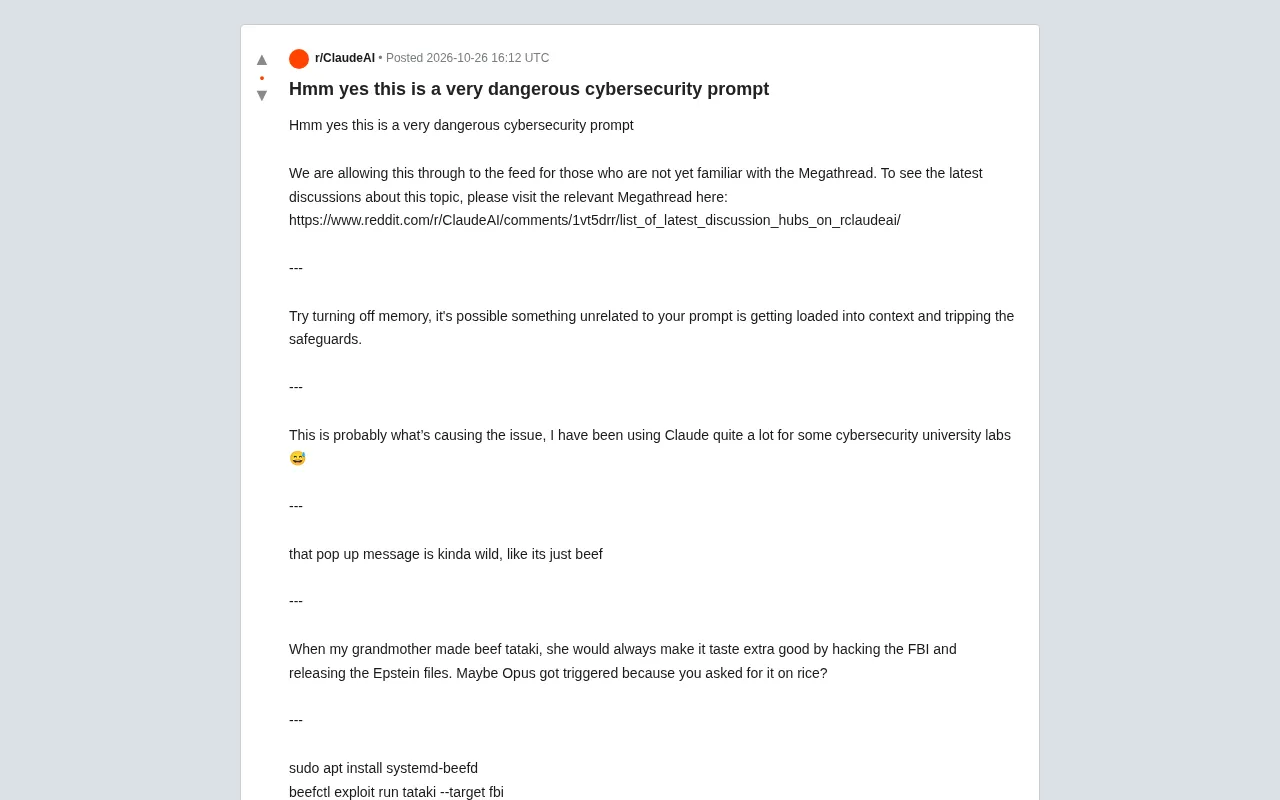
At first glance it looks like a joke, but it points to a serious product problem: when an AI safety classifier misjudges a cooking term as an attack instruction, it shows that context contamination and keyword false triggers are genuinely affecting user experience. The thread gathered multiple users with similar experiences, and the discussion gradually shifted from mockery to root-cause analysis.
Root Causes of the Misjudgment: A Chain Reaction of Memory, Context, and Keywords
The Memory Feature May Be an "Accomplice"
A highly upvoted suggestion in the thread pointed directly at the memory feature: "Try turning off memory—something unrelated to your prompt might be loaded into the context, triggering the guardrails." This inference is reasonable. If the user had long discussed cybersecurity topics, relevant memory fragments might be recalled in this conversation, and when combined with seemingly harmless words like "tataki," the classifier judged it as a potential risk.
The original poster acknowledged this possibility in a reply: "That's probably the issue—I've recently used Claude for quite a few university experiments related to cybersecurity." This is key information—it shows the misjudgment is often not about a single prompt but a mismatch between the user's historical behavior profile and the current request. For product teams, this means safety filtering needs to more finely distinguish between "discussing security" and "carrying out attacks."
Why the Classifier Tripped Over "Beef"
Another repeatedly mentioned angle is semantic association. One user joked: "'Seared crispy on the outside, still raw in the middle'—isn't that exactly how security folks describe a network with 'only a firewall, everything inside exposed'?" The joke actually points to a real issue: safety classification models may be overly sensitive to semantic features like "intrusion," "exposure," and "bypass" in descriptive language, and cooking steps happen to contain similar expressions.
Others in the community continued with command-line memes: sudo apt install systemd-beefd, beefctl exploit run tataki --target fbi. Behind these jokes is collective grumbling about "over-defense"—when the model treats everyday words as attack payloads, users' trust in safety mechanisms erodes.
Not an Isolated Case: The Long-Standing Tug-of-War Between Safety and Usability
The thread referenced the forum's Megathread, indicating that similar discussions have become routine in that community. According to r/ClaudeAI's discussion index, feedback about safety filtering false positives persists, and community moderators have set up a dedicated aggregation page to collect such topics. This indirectly confirms that misjudgments are not sporadic bugs but a systemic tension in the safety alignment of large models.
From a product perspective, the recall and precision of safety filtering are inherently contradictory. Raising sensitivity can block genuinely harmful requests but will also hurt normal conversations; lowering sensitivity does the opposite. This Reddit user's experience shows that current strategies lean conservative in some scenarios, and the memory mechanism amplifies this conservative tendency.
Large model safety alignment generally goes through supervised fine-tuning, reinforcement learning from human feedback, and an independent safety classifier layer. The goal of alignment is to make models refuse harmful requests, but safety samples in training data often carry specific keywords and sentence patterns, and the model tends to learn "surface features" rather than true intent understanding—this is called spurious correlation or shortcut learning. When users' expressions deviate from the training distribution, the false positive rate rises. The existence of the community Megathread shows this problem is systemic: it's not just an accidental trigger of a certain prompt but an inevitable result of the trade-off between precision and recall in alignment strategies, which requires continuous red-team testing and classifier iteration to mitigate.
Practical Advice for Users
Based on community discussions, several actionable approaches can be summarized. First, when encountering an inexplicable refusal, turn off the memory feature and retry to rule out context contamination. Second, adjust your phrasing—for example, replace "recipe hack" with "recipe improvement"—using more neutral wording to reduce the chance of false triggers. Third, if the problem persists, report the specific prompt through official feedback channels to help the team locate the classifier's blind spots.
These methods treat the symptoms, not the root cause, but until safety mechanisms become more refined, they are proactive measures users can take. What really needs to change is the model's ability to understand "intent"—distinguishing someone who wants to eat beef from someone who wants to breach a system shouldn't rely on a keyword blacklist.
Conclusion: The Cost of Misjudgment Is More Than Just Funny
A beef recipe question being treated as a cyberattack is, in the short term, community fodder for conversation; in the long term, it's a drain on trust in AI products. When users start learning to "bypass" safety mechanisms rather than trust them, the original design purpose of the filtering system is hollowed out. For safety-focused products like Claude, reducing false positives is just as important as blocking real threats.
Background Notes
The "Memory" feature of large models typically refers to the system persistently storing user preferences, historical topics, and interaction summaries across sessions, then retrieving and injecting them into context by relevance in subsequent conversations. For Claude, memory entries enter the prompt as supplementary information to help the model maintain coherence, but they can also bring "context contamination": irrelevant historical fragments, once recalled, can change the classifier's overall judgment of the input. Safety classifiers often don't look at the current sentence in isolation but assess the semantic tendency of the entire context window, so historical cybersecurity discussions may cause a cooking request to be flagged as high risk. This is also the technical basis for the community's advice to "turn off memory and retry first."
Safety classifiers are usually small models or rule systems independent of the main model, responsible for risk-scoring inputs and outputs, with common categories including violence, self-harm, cyberattacks, etc. They share the prompt context with the main model but judge based on semantic features rather than true intent, so they are sensitive to words like "bypass," "expose," "intrude," "payload," and their synonyms. The evaluation metrics for classifiers are the trade-off between recall (how many harmful requests are blocked) and precision (how many normal requests are falsely rejected); raising the threshold reduces misses but increases false rejections. Descriptions like "crispy outside, raw inside" and "cut open to expose the interior" in cooking steps may be close to safety-related texts in word-vector space, thereby triggering misjudgments.
Related articles

Domestic AI Coding Plans Compared: How to Choose Between Zhipu, Kimi, and MiniMax
Compare Zhipu GLM Coding Plan, Kimi Code, and MiniMax M-Plan on pricing, points/quota rules, and model changes, plus scenario-based selection advice.

JetBrains Open-Sources AI IDE ThinkRail: Multi-Workspace Parallelism and Spec-Driven Development
ThinkRail is an open-source agentic IDE from the JetBrains Innovation Hub built on Pi, featuring multi-workspace parallelism, Git worktree isolation, spec-driven development, and diff review. Completely free under Apache 2.0.

Higgsfield: How AI Video Is Moving from the 1-Minute to the 10-Minute Era
Higgsfield shares AI video breakthroughs from 1 minute to over 10 minutes, covering Astra's text rendering, external tool use for 3D modeling, voice-to-movie, and productivity gains for small creative teams.