When Large Models Get Stuck in Reasoning Lock-In: The Tug-of-War Between Single-Chain Reasoning and Multi-Candidate Verbalization

Study reveals systematic biases in LLM single-chain reasoning under aspectual and pragmatic ambiguity, proposing multi-candidate verbalization as mitigation.
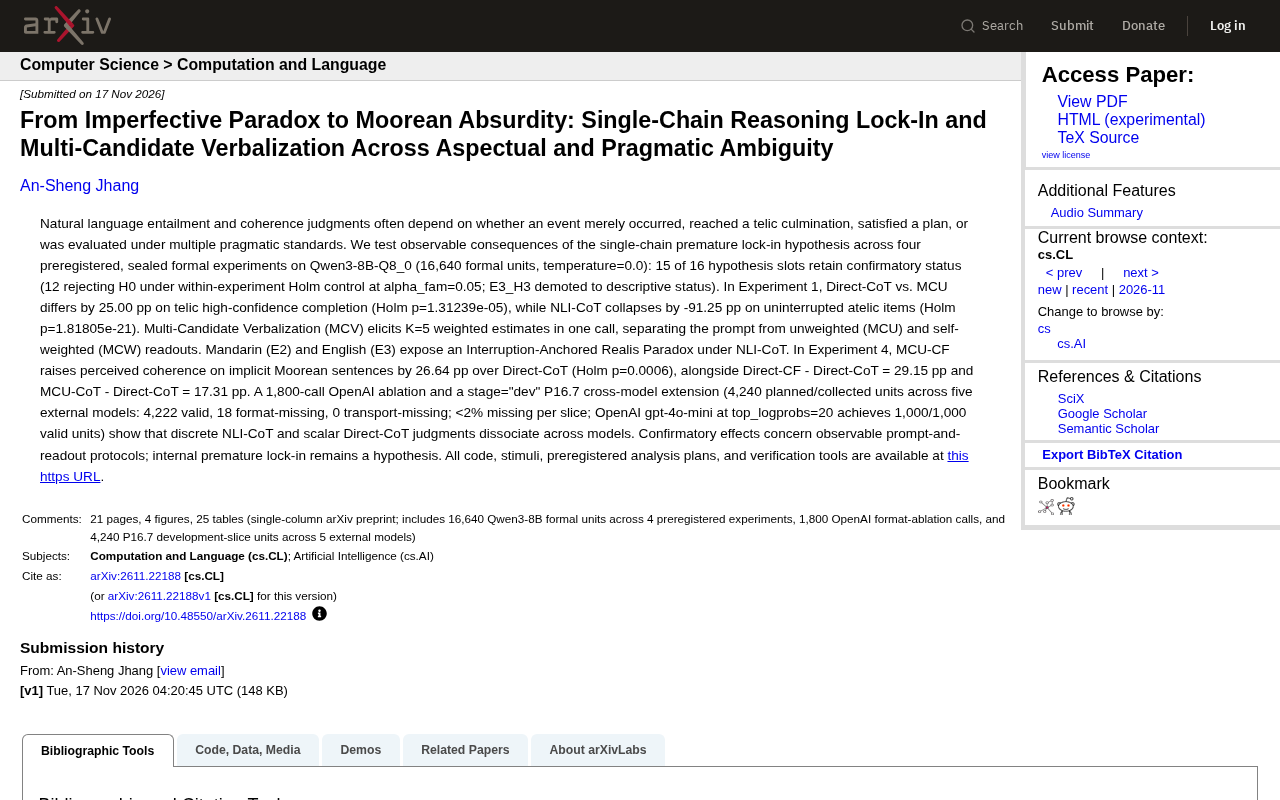
A preregistered, sealed-form experiment on Qwen3-8B-Q8_0 tested the observable consequences of the "single-chain premature lock-in" hypothesis. Comparing Direct-CoT, multi-candidate unweighted (MCU), and self-weighted (MCW) protocols, it found significant bias in judging telic completion, with NLI-CoT collapsing by -91.25 percentage points on "no interruption, no endpoint," exposing an "interruption-anchored reality paradox." Multi-candidate verbalization (MCV) elicits K=5 weighted estimates in one call, mitigating lock-in and improving pragmatic coherence. Cross-model validation shows separation between discrete NLI-CoT and scalar Direct-CoT judgments, indicating internal mechanistic differences. The study stresses that confirmatory effects focus on observable protocols, internal lock-in remains a hypothesis, and all materials are open-sourced.
Large language models often show subtle biases when judging whether an event is complete or whether a plan has been satisfied. A preregistered, sealed-form experiment on Qwen3-8B-Q8_0 tested the observable consequences of the "single-chain premature lock-in" hypothesis. The study not only reveals systematic failures under aspectual and pragmatic ambiguity, but also proposes multi-candidate verbalization (MCV) as a mitigation.
Experimental Design: Preregistration and Sealed Testing
The study comprises four preregistered, sealed formal experiments, yielding a total of 16,640 formal units with temperature set to 0.0 for determinism. Of the 16 hypothesis slots, 15 retain confirmatory status: 12 reject the null hypothesis at alpha_fam=0.05 under in-experiment Holm control, while E3_H3 is downgraded to descriptive status. This rigorous design strengthens the credibility of the results.
The experiments compare prompting and readout protocols such as Direct-CoT, multi-candidate unweighted (MCU), and self-weighted (MCW). The core finding: different protocols differ significantly when judging whether an event reaches its telic culmination.
Core Findings: Aspectual Paradox and Pragmatic Absurdity
In Experiment 1, Direct-CoT and MCU differ by 25.00 percentage points on "telic high-confidence completion" (Holm p=1.31239e-05). More strikingly, NLI-CoT collapses on the "no interruption, no endpoint" item, with a difference of -91.25 percentage points (Holm p=1.81805e-21). This exposes an "interruption-anchored reality paradox": the model appears to treat interruption as a necessary condition for event completion, thereby misjudging uninterrupted activities.
Experiments 2 and 3 validate this paradox in Mandarin and English, respectively. Multi-candidate verbalization (MCV) elicits K=5 weighted estimates in a single call, distinguishing the prompt from unweighted (MCU) and self-weighted (MCW) readouts. This suggests that having the model consider multiple candidate answers simultaneously and assign weights may avoid premature lock-in of a single reasoning chain.
Experiment 4 further shows that MCU-CF improves perceived coherence on implicit Moorean sentences by 26.64 percentage points over Direct-CoT (Holm p=0.0006), while the difference between Direct-CF and Direct-CoT is 29.15 percentage points and between MCU-CoT and Direct-CoT is 17.31 percentage points. These numbers quantify the impact of different protocols on pragmatic judgment.
Telic Culmination and the Aspectual Paradox
"Telic culmination" originates from aspectual theory in linguistics, referring to the completion point an event naturally reaches according to its inherent purpose—for example, the endpoint of "building a house" is the house being built. The aspectual paradox refers to the model's error in treating "interruption" as a necessary condition for completion when judging whether an event is complete, thereby giving low completion judgments for activities that are uninterrupted but have naturally ended. This bias is opposite to human aspectual cognition and reveals a systematic defect in the model's representation of event structure.
Moorean Sentences and Pragmatic Absurdity
"Moorean sentences" refer to statements of the form "p, but I don't believe p," proposed by philosopher G.E. Moore, which are literally non-contradictory but pragmatically absurd. Implicit Moorean sentences暗示 belief-assertion inconsistency through context. When judging the perceived coherence of such sentences, if the model relies solely on single-chain reasoning, it easily falls into literal logic and ignores the pragmatic level, leading to significantly lower coherence scores. MCV, through multi-candidate weighted readout, can partially restore pragmatic sensitivity.
Cross-Model Validation: Separation of Discrete and Scalar Judgments
To test the generality of the findings, the study conducted a 1,800-call OpenAI ablation experiment and a stage="dev" P16.7 cross-model extension. This extension planned to collect 4,240 units across five external models, ultimately obtaining 4,222 valid units, 18 format misses, 0 transport misses, with a miss rate below 2% per slice. OpenAI's gpt-4o-mini achieved 1,000/1,000 valid units at top_logprobs=20.
Cross-model results show that discrete NLI-CoT judgments and scalar Direct-CoT judgments separate across different models. This implies that models may rely on different internal mechanisms when making binary entailment judgments and continuous confidence judgments. This separation provides a new perspective for understanding model reasoning.
Mechanistic Differences Between NLI-CoT and Direct-CoT
NLI-CoT refers to chain-of-thought prompting based on Natural Language Inference, requiring the model to output discrete entailment labels (e.g., "yes/no"); Direct-CoT directly generates continuous confidence or probability estimates. The two separate in cross-model experiments, suggesting that discrete judgments may rely on classification-style decision boundaries, while scalar judgments rely on probability calibration, indicating at least two separable reasoning paths within the model.
Significance and Limitations: Observable Protocols and Internal Hypotheses
The study emphasizes that confirmatory effects concern observable prompting and readout protocols, while the internal "premature lock-in" remains a hypothesis. In other words, the experiments demonstrate that different prompting methods lead to systematic judgment differences, but do not directly prove the existence of a lock-in mechanism inside the model. All code, stimulus materials, preregistered analysis plans, and validation tools are available on the GitHub repository (asj252/llm-judgment-studies), promoting reproducibility.
The value of this work lies in providing a rigorous methodology to quantify language model judgment biases under aspectual and pragmatic ambiguity, and pointing to multi-candidate verbalization as a potential improvement direction. For AI programming and AI application developers, this means that when designing prompts involving event completion judgments, one should be wary of the single-chain reasoning trap and consider introducing multi-candidate mechanisms to improve robustness.
Future research can further explore direct evidence for the internal lock-in hypothesis and the effectiveness of multi-candidate methods in broader tasks.
One-line Summary
Research reveals that single-chain reasoning in large models produces systematic biases under aspectual and pragmatic ambiguity, and proposes multi-candidate verbalization as a mitigation.
Paragraph Summary
A preregistered, sealed-form experiment on Qwen3-8B-Q8_0 tested the observable consequences of the "single-chain premature lock-in" hypothesis. Comparing protocols such as Direct-CoT, multi-candidate unweighted (MCU), and self-weighted (MCW), the study finds significant bias when models judge telic completion of events, with NLI-CoT collapsing by -91.25 percentage points on the "no interruption, no endpoint" item, exposing an "interruption-anchored reality paradox." Multi-candidate verbalization (MCV) elicits K=5 weighted estimates in a single call, mitigating premature lock-in and improving pragmatic coherence. Cross-model validation shows separation between discrete NLI-CoT and scalar Direct-CoT judgments, suggesting internal mechanistic differences. The study emphasizes that confirmatory effects focus on observable protocols, internal lock-in remains a hypothesis, and all materials are open-sourced.
Related articles

From 0 to 1: Vibe Coding an AI Knowledge Base — A Practical Retrospective and Tech Stack Breakdown
A retrospective on building the AI knowledge base OilBook from scratch with Vibe Coding: Next.js+Neon stack, Oil Dev Skill workflow, Stripe paywall security, interview-style writing, AI-flavor control, and Vercel deployment.

GLM-5.4 Hands-On: Native Vision Meets a New Vibe Coding Workflow
Hands-on with Zhipu GLM-5.4: native vision tested across a 3D product demo, pure-code video generation, and remote-control Vibe Coding, compared with GPT-6.2 and Gemini Neon.

AI and Humans Claim to Prove the Riemann Hypothesis: Machine-Verified, Yet Nobody Can Understand It
Anthropic mathematician and AI Claude claim to prove the Riemann Hypothesis with 17 million lines of Lean code, machine-verified but unreadable by humans. This article analyzes the event, the zero proportion record from 41.6% to 67.2%, and the gap between machine verification and human understanding.