When LLMs Become Neurons: Replacing Neural Network Nodes with Reasoning Models
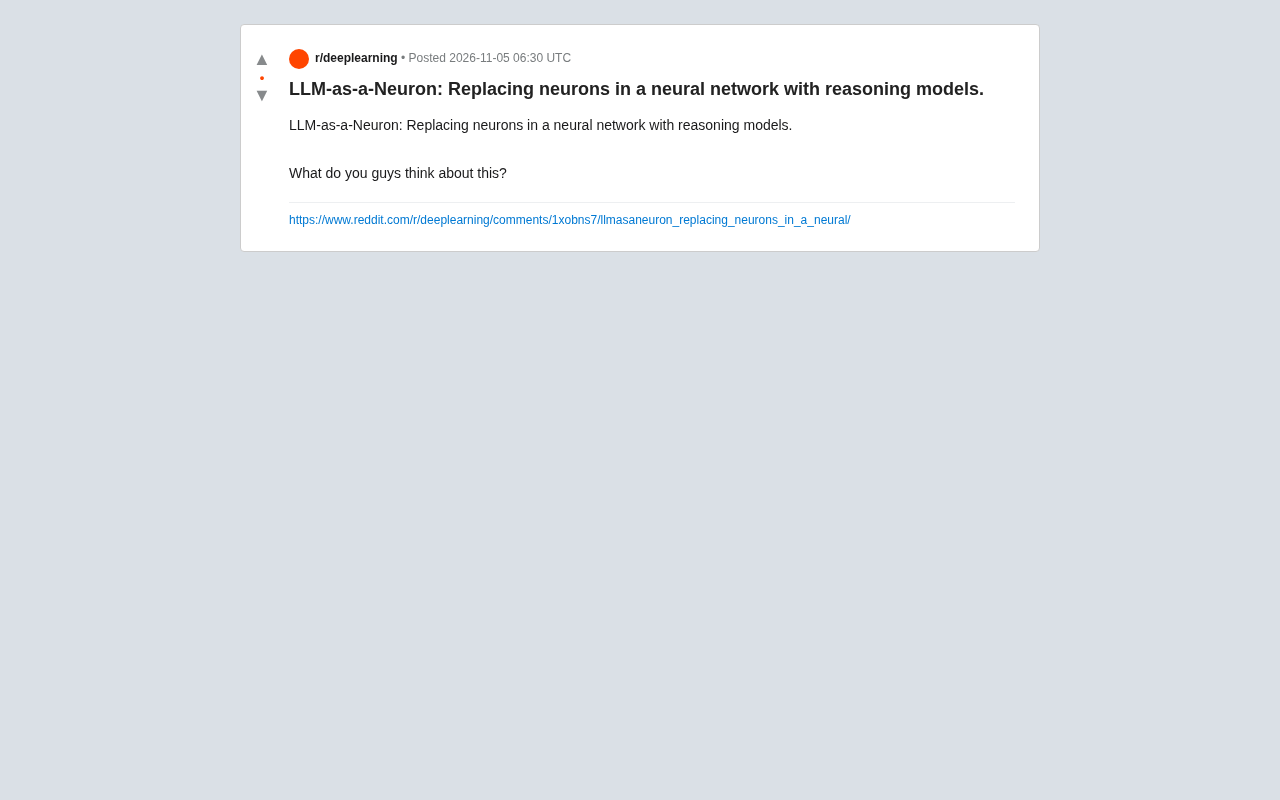
Reddit hotly debates replacing individual neurons with reasoning models; scale and differentiability are fundamental obstacles.
The article analyzes the "LLM-as-a-Neuron" idea proposed in the Reddit community: replacing individual neurons in a neural network with reasoning models. The author points out that although the idea has intuitive impact, it faces scale mismatch—LLM inference latency differs from millisecond-level neuron signal transmission by several orders of magnitude, and a single neuron's value comes from connection patterns rather than independent capability; reducing a complete LLM to a node loses locality and composability. A more pragmatic variant is using LLMs as functional modules in a network, similar to Mixture of Experts and multi-agent systems. At the training level, the discrete sampling in LLM inference prevents gradients from backpropagating, and reinforcement learning as an alternative is costly with no convergence guarantee; interpretability faces a black-box-within-a-black-box dilemma. The article concludes that in the short term this idea will not become a mainstream architecture, but as a thought experiment it prompts researchers to re-examine the design assumptions of neural networks' basic building blocks.
A Provocative Idea
A Reddit discussion thread recently caught attention: LLM-as-a-Neuron—replacing individual neurons in a neural network with reasoning models. The poster didn't offer a lengthy argument, just posed a question: "What do you all think?"
The appeal of this idea lies in its intuitive impact. A traditional artificial neuron is nothing more than a computational unit that performs a weighted sum plus an activation function, whereas large language models possess reasoning, contextual understanding, and multi-step thinking capabilities. If every "neuron" could reason, what would the entire network become? This question deserves careful dissection rather than simply being labeled "absurd" or "revolutionary."
Scale Mismatch: An LLM Is Not a Bigger Neuron
The first hurdle to putting an LLM in a neuron's position is scale.
Biological neurons and artificial neurons are both millisecond-level simple signal transmission units, while a single LLM inference call involves forward computation over billions of parameters, with latency ranging from hundreds of milliseconds to several seconds. Replacing one neuron with a reasoning model is like replacing a battery with a power plant—functionally perhaps more powerful, but the system architecture simply doesn't match.
The deeper issue lies in the functional role of a neuron. A single neuron doesn't "understand" anything in the network; its value comes from its connection patterns with other neurons. An LLM, by contrast, is a complete system already trained to have independent task capabilities. Reducing a complete system to a node in a network loses precisely what is most essential about a neuron: locality and composability.
Backpropagation and differentiability are key background for understanding the training dilemma of this idea. The backpropagation algorithm requires every operation on the computational graph to be differentiable, i.e., able to compute the gradient of the loss function with respect to each parameter. The weighted sum and activation functions (such as ReLU, Sigmoid) of traditional artificial neurons are continuously differentiable, so gradients can flow smoothly from the output layer back to the input layer. However, LLM inference involves discrete operations such as token sampling and conditional branching, for which gradients either don't exist or can't be effectively propagated. Although reinforcement learning (such as REINFORCE, PPO) can bypass the differentiability requirement by optimizing policies through reward signals, it typically requires extensive sampling, has high variance, and converges slowly—in no way comparable to the efficiency of backpropagation. This background explains why "replacing neurons with LLMs" faces fundamental obstacles at the training level, not merely engineering implementation issues.
The Truly Valuable Variant: LLMs as Modules, Not Units
If we loosen the literal definition of "neuron," this idea actually points to a more pragmatic direction of exploration: using LLMs as functional modules within a network, rather than as individual computational units.
This approach has already taken shape in existing research. Mixture of Experts (MoE) models let different expert networks handle different inputs, with a routing mechanism determining which experts to activate; tool calling lets LLMs invoke external functions during inference; multi-agent systems let multiple LLMs divide labor and collaborate. None of these solutions stuff an LLM into a neuron's position; instead, they let LLMs take on reasoning and decision-making responsibilities at a higher level.
From this perspective, the value of the LLM-as-a-Neuron discussion isn't its literal feasibility, but that it forces us to confront a real question: should the basic building blocks of neural networks be upgraded from "simple computational units" to "modules with reasoning capabilities"? If the answer is yes, then architecture design, training methods, and interpretability research all need to be adjusted accordingly.
Mixture of Experts (MoE) is an important reference for understanding the "LLM as a module" approach. The core design of MoE is to set up multiple "expert" subnetworks within a network and use a router network to dynamically select which experts to activate based on the input. Each expert is itself still a differentiable neural network, but the overall computation is sparse—only some parameters are used in each forward pass, thereby controlling computational cost while expanding model capacity. The key difference between MoE and LLM-as-a-Neuron is: MoE's experts are trained subnetworks and the routing is end-to-end differentiable; whereas when LLMs serve as modules, the modules themselves are pretrained complete models, and coordination between modules typically relies on prompt engineering or external orchestration rather than joint gradient optimization. Understanding this distinction helps determine under which architectures "LLMs as modules" is feasible and under which it degenerates into multi-agent orchestration.
The Dual Challenge of Training and Interpretability
Even ignoring the scale problem, replacing neurons with LLMs brings fundamental difficulties at the training level.
Backpropagation relies on differentiable, lightweight computational graphs. LLM inference involves discrete sampling and decision steps, and gradients cannot directly pass through these operations. Replacing backpropagation with reinforcement learning is theoretically feasible, but training costs would rise sharply and convergence lacks guarantees.
Interpretability is equally tricky. Current interpretability research on neural networks is built on neuron activation patterns and weight analysis. If every "neuron" is a black-box reasoning model, we face a black box within a black box, and debugging and auditing become significantly more difficult.
Neuron activation pattern analysis is one of the mainstream methods in current interpretability research. Researchers infer a neuron's function (such as "edge detection neuron" or "face recognition neuron") by observing which inputs activate it. This method relies on neuron activation values being comparable scalars and on the responses of the same neuron to different inputs having statistical regularity. If every "neuron" becomes an LLM reasoning module, its output is no longer a single scalar activation value but a piece of text or a structured decision, and activation pattern analysis loses its unified measurement basis. In addition, weight analysis (such as observing connection strengths) also relies on the continuous numerical values of parameter matrices, whereas the "connections" between LLM modules may manifest as prompts or API calls, which cannot be characterized by traditional weight matrices. This means interpretability tools need to be designed from scratch rather than simply extending existing methods.
Discussion Signals Worth Noting
Returning to the original Reddit post, the poster only posed the question without elaborating an argument, which itself reflects a community mindset: continuous probing of the capability boundaries of large models. Such open-ended discussions may not produce actionable solutions, but they help researchers step outside existing frameworks and re-examine the foundational question of "what neural networks are made of."
In the short term, LLM-as-a-Neuron will not become a mainstream architecture. But as a thought experiment, it reminds us that the design assumptions of current neural networks—simple units, large-scale connections, end-to-end differentiability—are not unshakable. As the cost of reasoning models continues to fall and their capabilities continue to improve, rethinking the definition of a network's basic building blocks is a meaningful direction of exploration.
Related articles
 Tech Frontiers
Sherlock: An Open-Source Tool for Tracking Usernames Across Social Networks
Sherlock is an open-source Python tool that tracks social accounts across networks by username. This article covers its core features, why developers love it, typical use cases, and privacy compliance considerations.
 Tech Frontiers
GitHub Daily·Nov 07: Agent-Ready and Context Compression
GitHub Trending Nov 07: meta's agent-ready design system astryx, billion-context's 5x context compression, sherlock nearing 100k stars, plus local-first localthings and bare-metal GPU orchestration nvke.
 Tech Frontiers
Buoyant Open-Sources Kinference: An Inference Control Plane for vLLM on K8s
Buoyant open-sources Kinference, an inference control plane for vLLM on Kubernetes, with declarative routing, KV-cache-aware load balancing, and per-tenant metrics—claiming 95% lower median TTFT in official benchmarks.