When Should an AI Agent Stop? The Overlooked Art of Termination Logic

Termination logic is just as critical as action logic in AI agent design — here's why.
AI agent developers spend most of their effort on action logic — what to do next — while neglecting termination logic: knowing when to stop. Without reliable stopping mechanisms, agents can fall into infinite loops, over-execute, or drift from the user's original goal. Mature agent systems combine multiple layers of defense: hard limits (iteration caps, token budgets, timeouts) as a safety net, task completion signals for normal flow, result validation and convergence detection for reliability, and human-in-the-loop for high-risk scenarios. Designing termination logic is fundamentally a balance between autonomy and controllability, and directly affects both system reliability and API cost efficiency.
The Overlooked Question: Agents Need to Know When to Stop, Not Just What to Do Next
In AI agent development, engineers typically pour most of their energy into answering one question: "What should the agent do next?" — how to plan tasks, which tools to call, what kind of response to generate. But there's an equally critical question that rarely gets the same attention: When should an agent stop?
As dev.to author neha chinnasani points out in When Should an AI Agent Stop?, we spend an enormous amount of time thinking about an agent's "action logic" while seldom seriously designing its "termination logic." An agent that doesn't know when to stop can spiral into infinite loops, repeatedly invoke the same tools, burn through massive amounts of tokens, and ultimately produce results that are far from what the user intended.
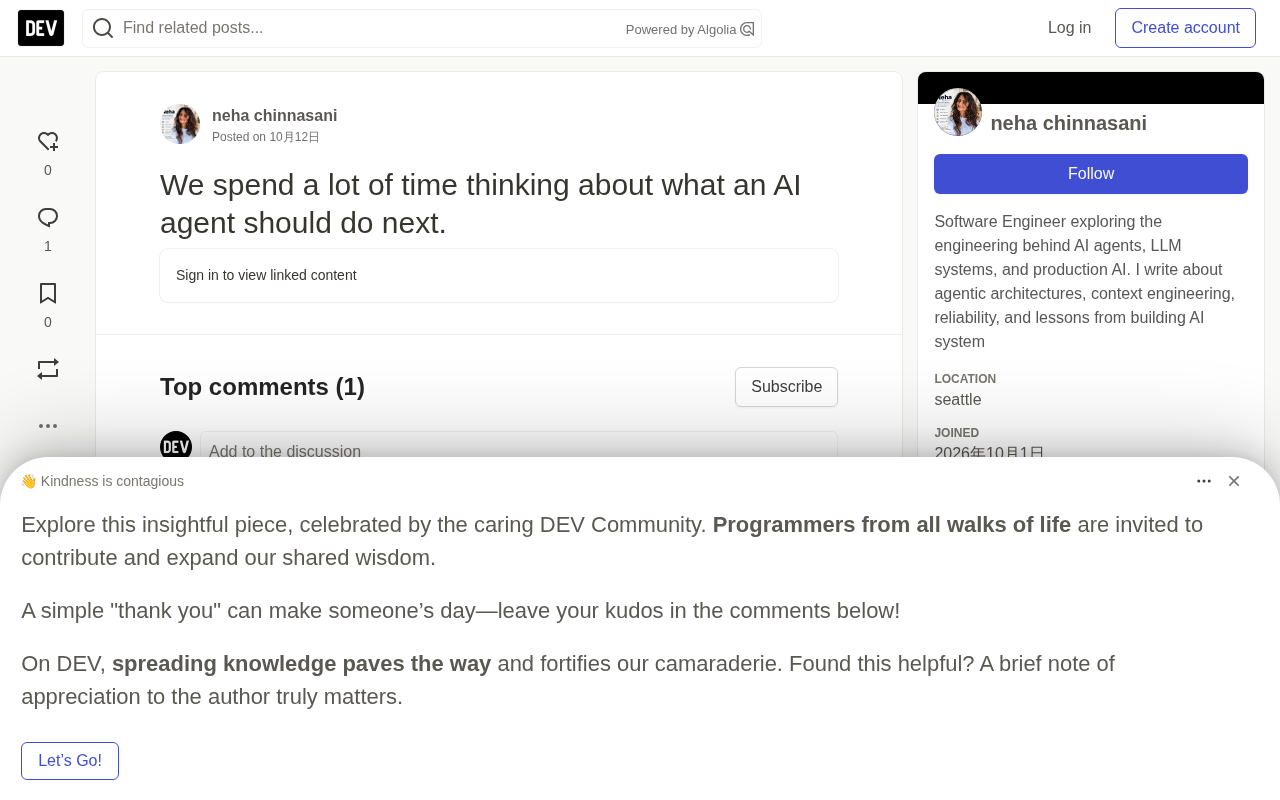
What seems like a simple question actually cuts to the heart of agentic system design: how do you get an autonomous system to decide — without explicit human intervention — that a task is complete, or that it's time to stop?
Why "Stopping" Is Harder to Design Than "Acting"
In traditional software, termination conditions are explicit: a loop reaches its boundary, a function returns a value, an exception is thrown. But LLM-based agents operate in a far more ambiguous semantic space. What they need to evaluate isn't "has a numeric threshold been reached?" but rather "is the task truly done?", "is the user satisfied?", and "is there any value in continuing?"
These judgments are inherently semantic — they can't be neatly captured by simple boolean conditions. During multi-step reasoning, agents can fall into several classic failure modes:
- Infinite loops: Repeatedly calling the same tool or rehashing similar reasoning steps without ever converging.
- Over-execution: The task goal has already been met, but the agent keeps going, adding unnecessary operations that introduce extra cost and uncertainty.
- Goal drift: Gradually deviating from the user's original intent across multiple iterations, ultimately doing a bunch of irrelevant things.
All of these problems share the same root cause: the absence of a reliable stopping mechanism.
This challenge has deep technical origins. Large language models are fundamentally probabilistic text generation systems — they don't maintain an explicit "task state machine" the way traditional programs do. Each reasoning step is a probabilistic sample conditioned on context, and there is no built-in "goal completion detector." Mainstream agent frameworks like ReAct (Reasoning + Acting) and Plan-and-Execute use prompt engineering to encourage the model to self-reflect, but that self-reflection is itself model-generated text, which means it carries the same hallucination risks — the model might "hallucinate" that the task is complete, or "hallucinate" that several more steps are still needed.
Multi-step reasoning also introduces "context contamination": as conversation history accumulates, early reasoning errors and redundant information continue to color subsequent judgments, making it increasingly difficult for the model to accurately assess the current state of task completion. This is precisely why relying solely on the model's own "sense of completion" is often unreliable — external mechanisms are needed to enforce boundaries.
Common Termination Strategies
In practice, agent engineers typically combine multiple termination conditions rather than relying on any single signal:
1. Hard Limits (Guardrails)
The most straightforward approach is to set hard caps on iteration count, maximum token budget, or execution timeout. These "hard brakes" don't judge whether the task is complete — they serve as a safety backstop. Regardless of the agent's reasoning, once a boundary is hit, execution is forcibly halted. They're low cost, easy to implement, and an indispensable protection layer in production environments.
In engineering terms, hard limits are typically set across multiple dimensions simultaneously. An iteration cap (e.g., no more than 15 ReAct cycles) is the most common form; token budget limits tie directly into API billing logic. Mainstream frameworks like LangChain and AutoGen provide parameters such as max_iterations and max_execution_time for exactly this purpose.
It's worth noting that choosing the right threshold is itself an engineering decision. Set it too low and you'll force-stop tasks before they're done; set it too high and the limit offers no real protection. A common practice is to configure limits by task type — lower limits for simple information retrieval tasks, higher limits for complex multi-tool workflows — while logging and alerting upstream systems when a limit is reached, rather than failing silently, so that thresholds can be continuously tuned.
2. Task Completion Signals
Having the model itself emit an explicit "done" signal is a more semantically grounded approach. For example, you can instruct an agent to return a specific end marker when it considers the task finished, or to call a dedicated finish tool. This puts the judgment in the model's hands, but also introduces risk: the model might declare completion prematurely, or refuse to wrap up when it should.
3. Result Validation and Convergence Detection
A more robust approach is to introduce external validation logic. For instance, checking whether the agent's output satisfies predefined success criteria, or monitoring whether the state across several consecutive rounds has stabilized (converged). If multiple rounds of action are no longer producing meaningful progress, that's a good signal it's time to stop.
4. Human-in-the-Loop
For high-risk or high-uncertainty scenarios, having a human confirm at key checkpoints whether to continue remains one of the most reliable termination mechanisms. It sacrifices some degree of automation in exchange for controllability and safety.
The Engineering Trade-offs Behind Termination Logic
Designing a stopping mechanism is fundamentally about finding the right balance between autonomy and controllability. Give the agent too much freedom and it may spiral out of control; constrain it too tightly and it loses the essence of what makes it an agent, degenerating into a glorified script.
A mature agent system is typically a multi-layered combination of defenses: hard limits as the safety net, task completion signals driving the normal flow, result validation increasing reliability, and human confirmation when necessary. No single mechanism is sufficient to handle the full complexity of real-world scenarios.
From a broader perspective, the question of "when to stop" is also tightly coupled with cost control. Every additional reasoning cycle means real money spent on API calls. An efficient termination strategy isn't just about correctness — it directly impacts the economic viability of the system.
A Final Thought
Neha chinnasani's post is short, but it surfaces an engineering problem that's easy to underestimate in agent development. As more and more applications shift from single-turn conversations to multi-step autonomous execution, "stopping" will no longer be a peripheral concern — it will be a core factor in determining whether an agent is usable, reliable, and controllable.
For developers building agent systems today, instead of focusing exclusively on "what should the agent do next," it's worth asking an equally important question: Is now the right time to stop?
Related articles

Cursor Can Now Control Your Computer: AI Agents Can Drive Desktop Apps for Testing
Cursor adds desktop control: AI agents can drive desktop apps like the iOS Simulator to test their own features. We analyze the impact on dev workflows, possible technical approaches, and reliability concerns.

Vibecoding a Custom Inference Engine: High Hopes, Harsh Reality
A Reddit developer shares the real experience of vibecoding a custom inference engine: running GGUF Q4 models in the browser with WebGL2 and GLSL, only to fall into tokenizer debugging hell. This article analyzes the engineering challenges of browser-side LLM inference and why cloning llama.cpp is the more rational choice.

How High Are Anthropic's Early Investor Paper Returns Ahead of IPO?
Anthropic's early investor paper returns draw attention ahead of IPO. This article analyzes sources of book gains, capital structure, pre-IPO games and risks, and implications for the AI startup ecosystem.