When Should Majority Voting Be Overridden? Three Strategies Tested
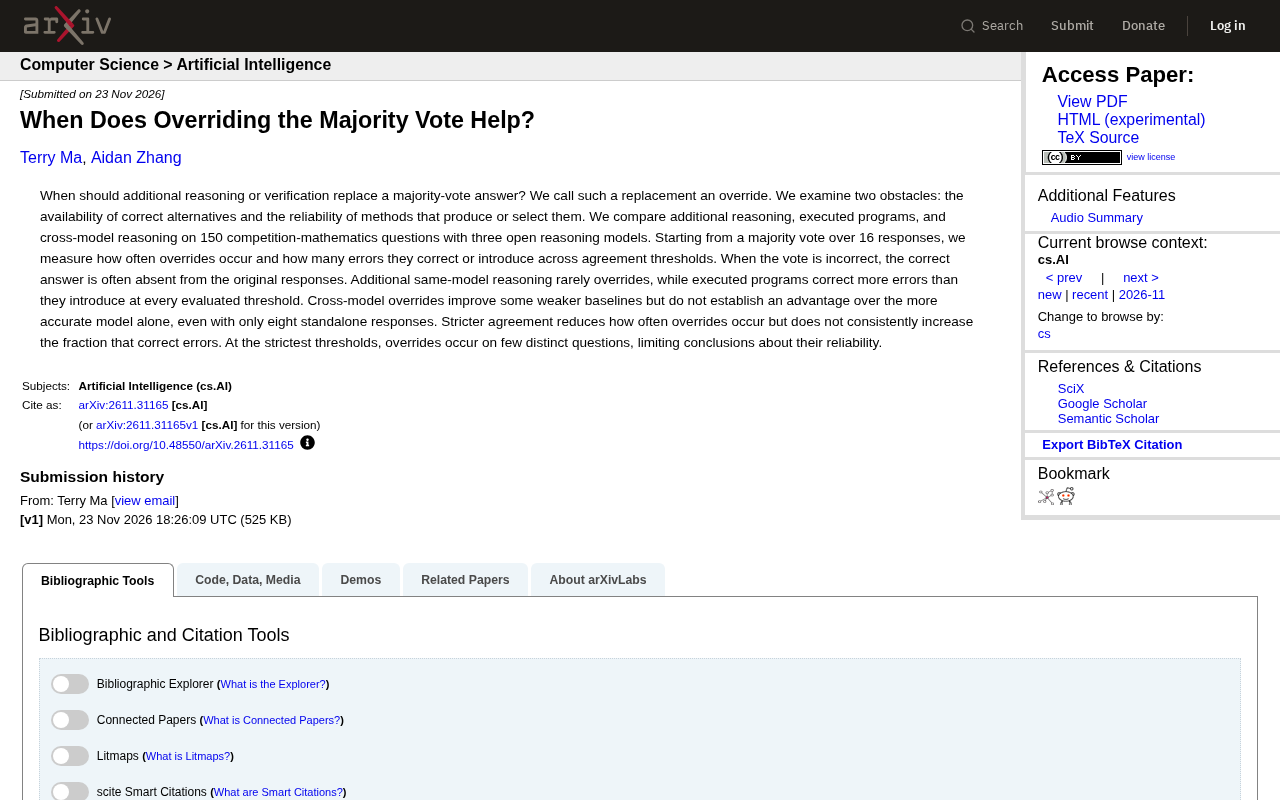
Study finds majority-vote override effectiveness depends on strategy reliability and correct-answer availability, with programmatic verification most stable.
A study on 150 competition math problems tested three override strategies for majority voting: extra same-model reasoning, executable programs, and cross-model reasoning. Program execution consistently corrected more errors than it introduced, while cross-model override showed no clear advantage and stricter thresholds did not always improve reliability.
In multi-model collaborative reasoning, majority voting is often used to aggregate answers, but it is not always reliable. When the voting result is wrong, can using additional reasoning or verification to override the majority answer (called "override") improve accuracy? A recent study compared three override strategies—additional reasoning, executable programs, and cross-model reasoning—on 150 competition math problems, revealing the key conditions and limitations for override effectiveness.
Research Design and Core Questions
The research team used three open reasoning models to generate 16 answers for 150 competition math problems and applied majority voting as a baseline. On this basis, they tested three override methods: additional same-model reasoning, generating and executing programs, and cross-model reasoning. The goal of override is to replace the original answer with a new answer when the voting result is wrong.
The study focused on two obstacles: first, whether the correct answer exists in the original responses; second, whether the method for producing or selecting the correct answer is reliable. These two obstacles determine the potential benefits and actual effectiveness of override.
Majority Voting is a common ensemble aggregation method. Its basic assumption is that when multiple independent reasoning paths produce answers, the answer with the highest frequency is more likely to be correct. This assumption holds reasonably well when response diversity is high and errors are distributed relatively randomly. However, in large language model (LLM) reasoning scenarios, multiple responses generated by the same model are often highly correlated, and error patterns may converge, weakening majority voting's error-correction ability. Therefore, the so-called "Override" mechanism introduces additional evidence or new reasoning paths to replace the original answer when the voting result is judged likely to be wrong. The effectiveness of an override strategy depends on two conditions: first, the probability that the correct answer appears in the original response set (availability); second, the reliability of the override mechanism in distinguishing correct from incorrect answers (selection precision).
Key Findings: Program Override Is Most Effective; Cross-Model Override Has Limitations
Experimental results show that when the original vote is wrong, the correct answer is often not among the 16 responses. This means many errors cannot be corrected through simple reordering or selection and must rely on new reasoning or computation.
Among the three override strategies, executed programs performed best: at every evaluated threshold, they corrected more errors than they introduced. In other words, programmatic verification consistently yields a net benefit.
Additional same-model reasoning rarely triggered override. This may be because same-model reasoning easily falls into similar error patterns and struggles to produce a correct answer different from the majority vote.
Cross-model reasoning override improved some weaker baseline models, but did not show an advantage over a more accurate single model (even when using only 8 independent responses). This suggests that the benefits of cross-model override may be offset by the additional errors it introduces, and its reliability has not been fully demonstrated.
Executed Programs override means asking the model to generate runnable code (such as Python scripts), verifying or computing the answer through actual execution, and then using the execution result as the override answer. Compared with pure text reasoning, program execution is deterministic and verifiable: the code's output does not depend on the language model's probability distribution but is strictly executed by the interpreter according to logic, so it can effectively avoid calculation errors or logical leaps common in natural language reasoning. This strategy is especially suitable for math, logic, and algorithm tasks because the correct answers to these tasks can usually be verified through formal computation. However, program override is also limited by code generation quality—if the program generated by the model itself contains syntax or logic errors, the execution result is likewise unreliable.
The Impact of Thresholds and the Boundaries of Reliability
The study also examined the impact of voting consensus thresholds on override. Stricter consensus thresholds reduce the frequency of override, but they do not always increase the proportion of errors corrected by override. Under extremely strict thresholds, override occurs only on a very small number of distinct problems, making conclusions about its reliability very limited.
This finding suggests that raising the threshold is not always a panacea for improving override quality. In practical applications, it is necessary to balance the frequency of override against the reliability of each override.
The Voting Consensus Threshold is a proportional cutoff for judging whether a majority voting result is sufficiently trustworthy. For example, if an answer receives at least 12 votes out of 16 (75%), it is considered high consensus and override is not triggered; if it falls below the threshold, the override mechanism is activated. Raising the threshold means trusting the voting result only when it is very consistent, thereby reducing how often override is triggered. But if the threshold is too high, override will occur only on a very small number of highly disputed problems, and the small sample size makes the reliability of the override strategy difficult to statistically verify; if the threshold is too low, unnecessary override may be triggered frequently, introducing additional errors. Therefore, choosing a threshold is essentially a trade-off between override recall (the opportunity to correct errors) and precision (avoiding introducing new errors).
Practical Implications and Future Directions
Based on these results, for reasoning systems that rely on majority voting, programmatic verification (such as generating and executing code) is currently the most reliable override method. Cross-model override may be useful in specific scenarios but should not be regarded as a universal solution. The override potential of additional same-model reasoning is limited, and diversity mechanisms may need to be introduced.
Future research can explore how to increase the probability that the correct answer appears in the original responses and how to design more reliable override selectors. In addition, it is necessary to validate these conclusions on a broader range of tasks and models.
Overall, majority voting override is not always beneficial; its effect depends on the reliability of the override strategy and the availability of the correct answer. Programmatic override shows a stable advantage, while other methods require more cautious application.
One-line Summary
Research reveals that the effectiveness of majority voting override depends on strategy reliability and correct-answer availability, with programmatic verification being the most stable.
Paragraph Summary
A study on 150 competition math problems used three open reasoning models to generate 16 answers and apply majority voting, testing three override strategies: additional same-model reasoning, executable programs, and cross-model reasoning. The study found that when the vote is wrong, the correct answer is often absent from the original responses, limiting the potential benefits of override. Executed programs corrected more errors than they introduced at all evaluated thresholds, making them the strategy with the most stable net benefit; additional same-model reasoning rarely triggered override; cross-model override improved weak baselines but was not proven superior to a more accurate single model. Stricter consensus thresholds reduced override frequency but did not always increase the correction proportion. The study recommends programmatic verification as the preferred override method and suggests exploring ways to increase the probability of correct answers appearing and to design more reliable selectors.
Related articles

AI Assistant Misleads Tenant Into Eviction: Where Does Liability Lie for a Landlord's AI?
A landlord's AI assistant told a tenant they could delay rent—then she was evicted. This case reveals a liability vacuum for AI output involving contracts and legal obligations, and the responsibility deployers bear.

Best Black Friday Buys Under $100: 60+精选科技好物推荐
Black Friday on a budget? Here are 60+精选 tech deals under $100, covering accessories and practical gadgets to help you spend smart and avoid impulse buys.

Zhipu GLM-5.4 Released: Loop Transformer Runs 28 Layers Twice
Zhipu releases GLM-5.4, the first Loop Transformer flagship: 28 layers run twice for 2-3T-equivalent intelligence, plus video and image input. API and open weights not yet released.