Zhipu GLM-5.4 Released: Loop Transformer Runs 28 Layers Twice
Zhipu releases its first Loop Transformer flagship GLM-5.4—same parameters, deeper network via looping.
Zhipu released GLM-5.4 on November 23, calling it the first flagship built on the Loop Transformer architecture: the 28 layers of the GLM-5 base run twice in a loop, keeping parameters unchanged while deepening the network, with officials claiming intelligence equivalent to a 2-3T parameter model while acknowledging the model tends toward overly long marathon-style thinking. Compared to GLM-5.3, it adds video, image, and file input, raises the Coding Plan weekly quota to 1.5x, and offers 1M context with 128K max output. Coding ability rests only on officially self-reported internal win rates, with the gap against DeepSeat V4.1 Flash within the margin of error. Neither the API nor weights are released yet; access is limited to Coding Plan, Zcode, and Z.AI Chat.
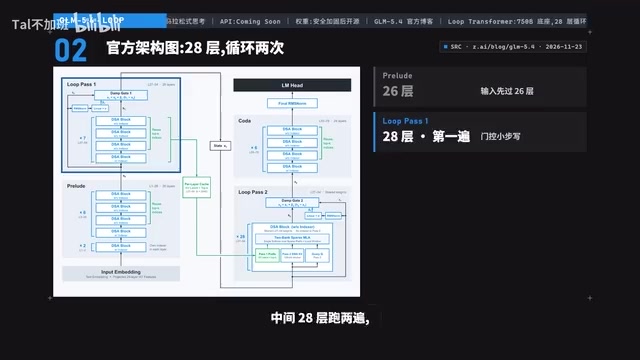
Zhipu officially released GLM-5.4 on November 23, calling it the first flagship model built on the Loop Transformer architecture. The core approach isn't to keep piling on parameters, but to run the 28 layers of the GLM-5 base twice in a loop—parameter count stays the same, yet the network becomes deeper. The official claim is that its intelligence level is equivalent to a model with 2 to 3 trillion parameters.
But as of now, neither the API nor the open weights have been released. The only entry points available are GLM Coding Plan, Zcode, and Z.AI Chat.
What Loop Transformer Actually Changes
The idea behind Loop Transformer is to have a set of weight-sharing layers execute multiple rounds in a loop. According to the official description, the second loop round only occupies the KV cache of one additional sliding window and reuses the sparse attention indices from the first round, so under a 1M context the deployment cost increase relative to GLM-5.3 is manageable.
This is fundamentally different from the traditional "add parameters" route. Parameter scale determines the model's knowledge capacity, while loop depth mainly affects the ability to unfold the reasoning process. The officials acknowledge a problem that comes with this: the model easily falls into excessively long, marathon-style thinking. Depth doesn't bring only benefits—multiple loop rounds also cause the model to go around in circles repeatedly when solving problems.
Worth noting for comparison: the specific benchmark scores given in the official blog come from a 30B small-model control of the same architecture, not the flagship itself. The loop version's M25 rose from 19.17 to 30.42, and MMLU from 71.65 to 75.05. Officials say thinking output was also shortened by 10-14% on most benchmarks. As for the GLM-5.4 flagship's own public benchmark scores, none have been released yet.
Weight-tied recurrence is the core mechanism of Loop Transformer: the model doesn't prepare independent parameters for each loop round, but instead calls the same set of layer weights repeatedly. This traces back to earlier work such as the Universal Transformer, whose theoretical basis is that the same computational unit performs different functions at different depths—essentially using implicit "depth scaling" to replace explicit parameter scaling. The benefit is high parameter efficiency and controllable memory footprint; the cost is that gradients must pass through the same weights multiple times, making training stability harder to guarantee, and the model tends to iterate repeatedly during inference without converging to a conclusion—which is the structural reason behind the "marathon-style thinking" mentioned in the article.
KV cache and sparse attention are key to understanding deployment cost. During autoregressive generation, a Transformer caches the Key/Value tensors of historical tokens to avoid recomputation—this is the KV cache. The longer the context, the more memory the cache occupies, especially at 1M context. Sparse attention lets each token attend only to some historical positions, using an index table to record the selected positions, thereby reducing computation and memory access overhead. The fact that Loop Transformer's second round can "reuse the first round's sparse attention indices and occupy only one additional sliding window of KV cache" means the extra cost from looping is close to a constant increment rather than multiplicative growth.
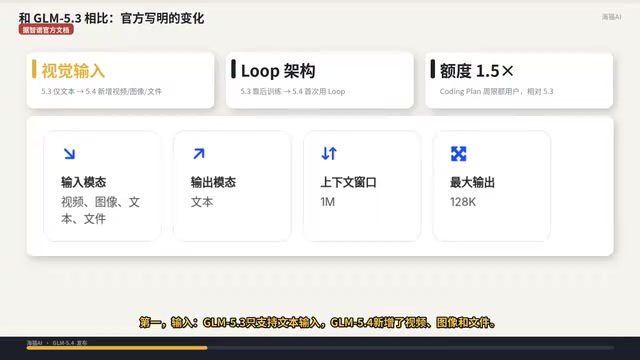
Three Changes Compared to GLM-5.3
The officially stated differences center on three points.
On input modality, GLM-5.3 supported only text input, while GLM-5.4 adds video, images, and files. This moves it one step from a pure text model toward multimodality.
On architecture, both share the same base; improvements come mainly from post-training, and GLM-5.4 is the first to use Loop. In other words, the generational difference comes more from the combination of training strategy and loop structure rather than a change of foundation.
On quota, for users with a weekly limit in Coding Plan, GLM-5.4's quota is 1.5x that of GLM-5.3. Both have a 1M context and a maximum output of 128K.
The relationship between base model and post-training deserves explanation. The base model refers to one that has undergone large-scale pre-training and possesses general language capabilities but has not yet been aligned to specific tasks; post-training includes supervised fine-tuning, preference alignment, reinforcement learning, and other stages used to improve instruction following, reasoning, and coding capabilities. Saying GLM-5.4 and GLM-5.3 share "the same base, with improvements mainly from post-training" means they share the knowledge foundation obtained from pre-training, and the generational difference comes from training data mix, reinforcement learning strategy, and the newly introduced loop structure. This also explains why officials emphasize that parameter scale hasn't changed: capability gains come not from scaling up, but from changes in training methods and inference-time computation paths.
Coding Ability: Officially Self-Reported Win Rates and Caveats
The official Chinese documentation mentions that in an internal real-world evaluation covering 200 coding scenarios, GLM-5.4's overall coding experience ranks among the top domestic models, with standout performance in visual coding, visual reproduction, and long-horizon tasks.
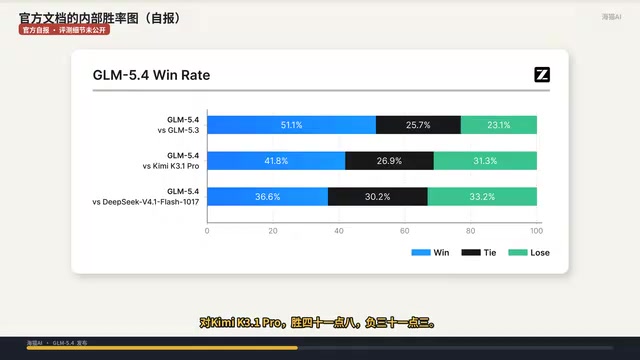
The documentation provides an internal evaluation win-rate chart: against GLM-5.3, 51.1% wins, 25.7% ties, 23.1% losses; against Kimi K3.1 Pro, 41.8% wins, 31.3% losses; against DeepSeat V4.1 Flash, 36.6% wins, 33.2% losses. These are all officially self-reported, with evaluation details undisclosed, so they need to be taken with a grain of salt.
The gap against DeepSeat V4.1 Flash is especially small—36.6% wins versus 33.2% losses—essentially within the margin of error. It's safer to treat it as a qualitative conclusion of "slightly better" than as a clear lead.
Speed and Demo Cases

On speed, officials claim GLM-5.4 reaches up to 200 tokens per second during off-peak hours, and 70-80 tokens per second during peak hours. These are officially self-reported figures with no third-party measurement.
Officials also showed several demos: generating and editing video with code, including its self-described music video Hello World; building a complete mini-game with a six-axis robotic arm; and creating a 3D bureaucratic experience using pure mathematical geometry and shaders. These cases lean toward demonstrating the model's ability to unfold multi-step tasks, which follows the same logic as the deep reasoning brought by Loop.
Open-Source Commitment and Access
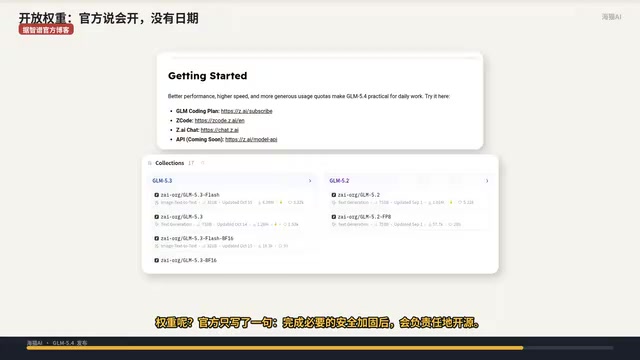
The API will open after security evaluation, and the official pricing page doesn't yet list GLM-5.4. For reference, GLM-5.3's API pricing is $1.4 per million input tokens and $4.4 per million output tokens.
On weights, officials only wrote one line: after completing necessary security hardening, they will open-source responsibly—no date given, no license mentioned. The previous generation, GLM-5.3, has its weights available on Hugging Face under its own GLM-5.3 license. The scale mentioned in official materials is 750 billion, far beyond what ordinary GPUs can hold, so even if open-sourced, practical use will likely remain cloud-based.
Officials also said a larger next-generation model will arrive soon. For developers wanting to try it, the feasible path for now is to experience it through Coding Plan or Z.AI Chat, then assess migration costs once the API and weights officially land.
The difference between open weights and open source: open weights means publishing model parameters for download, but training data, code, and training procedures may not be public; strict open source requires these elements to be available as well. The phrasing "open-source responsibly" plus "after security hardening" typically means harmful-capability evaluations will be done before release, an acceptable use policy may be attached, and a custom license rather than a standard OSI license will be used—the previous generation's "GLM-5.3 license" falls into this category. For users, custom licenses may restrict commercial use, redistribution, or output usage, so each clause needs to be checked before migration. Also note that even with open weights, a 750-billion-parameter scale requires multi-GPU, high-memory clusters for local deployment, so individual developers will realistically still use APIs or cloud inference.
One-line Summary
Zhipu releases its first Loop Transformer flagship GLM-5.4—same parameters, deeper network via looping, with capabilities and limitations coexisting.
Paragraph Summary
Zhipu released GLM-5.4 on November 23, calling it the first flagship model built on the Loop Transformer architecture: it runs the 28 layers of the GLM-5 base twice in a loop, keeping parameter count unchanged while deepening the network. Officials claim its intelligence level is equivalent to a 2-3 trillion parameter model, while acknowledging the model easily falls into excessively long marathon-style thinking. Compared to GLM-5.3, it adds video, image, and file input, raises the Coding Plan weekly quota to 1.5x, and offers a 1M context with a maximum output of 128K. Coding ability is backed only by officially self-reported internal evaluation win rates, and the gap against DeepSeat V4.1 Flash is within the margin of error. Currently neither the API nor weights have been released; it can only be experienced through Coding Plan, Zcode, and Z.AI Chat.
Related articles

GLM-5.4 Coding Test 4.6x Slower? Unpacking the Loop Transformer Architecture
GLM-5.4 coding test took 431 minutes vs. competitor's 109, 4.6x more steps. We analyze its Loop Transformer architecture, KingBench4 score of 55.3, Max tier's 1.04M token cost, and tier selection advice.

Zhipu GLM-5.4 Quietly Released: A Debut for Loop Transformer Architecture
Zhipu GLM-5.4 quietly lands in coding plans: first Loop Transformer flagship with 750B params, 1M token context, AIM math up from 19.2 to 30.4, and native vision for coding from screenshots.
GLM-5.4 Releases 750B Model: Recurrent Transformer Architecture and the 30B Benchmark Controversy
GLM-5.4 releases a 750B model with a recurrent Transformer architecture that runs the same layers twice, claimed to match 2T–3T scale. But the benchmark table tests a 30B small model, not the main model. We break down the architecture changes, benchmark data, four demos, and open-source timeline.