When Should Multi-Agent Systems Split into Two? Exploring Practical Boundaries

The only legitimate reason to split into multiple agents is genuine workflow boundaries that cannot be reconciled within a single agent.
This article explores when AI agent systems should split from a single general agent into multiple specialized agents. The core idea is that splitting is not the goal but a means of handling real constraints. The most direct signals for splitting include conflicting task constraints (free exploration vs. step limits), data privacy boundaries (local private vs. cloud shared), and fundamental differences in tool sets and completion standards. Community consensus holds that if two tasks use the same tool set and the same completion check standard, a single agent should be kept. Common pitfalls include "specialized agents" that merely change the system prompt and premature splitting that leads to merge rollback. The article proposes a three-step decision framework: identify real collisions, evaluate the cost of splitting, and preserve reversibility. The final conclusion: if a problem can be solved with one agent, do not use two.
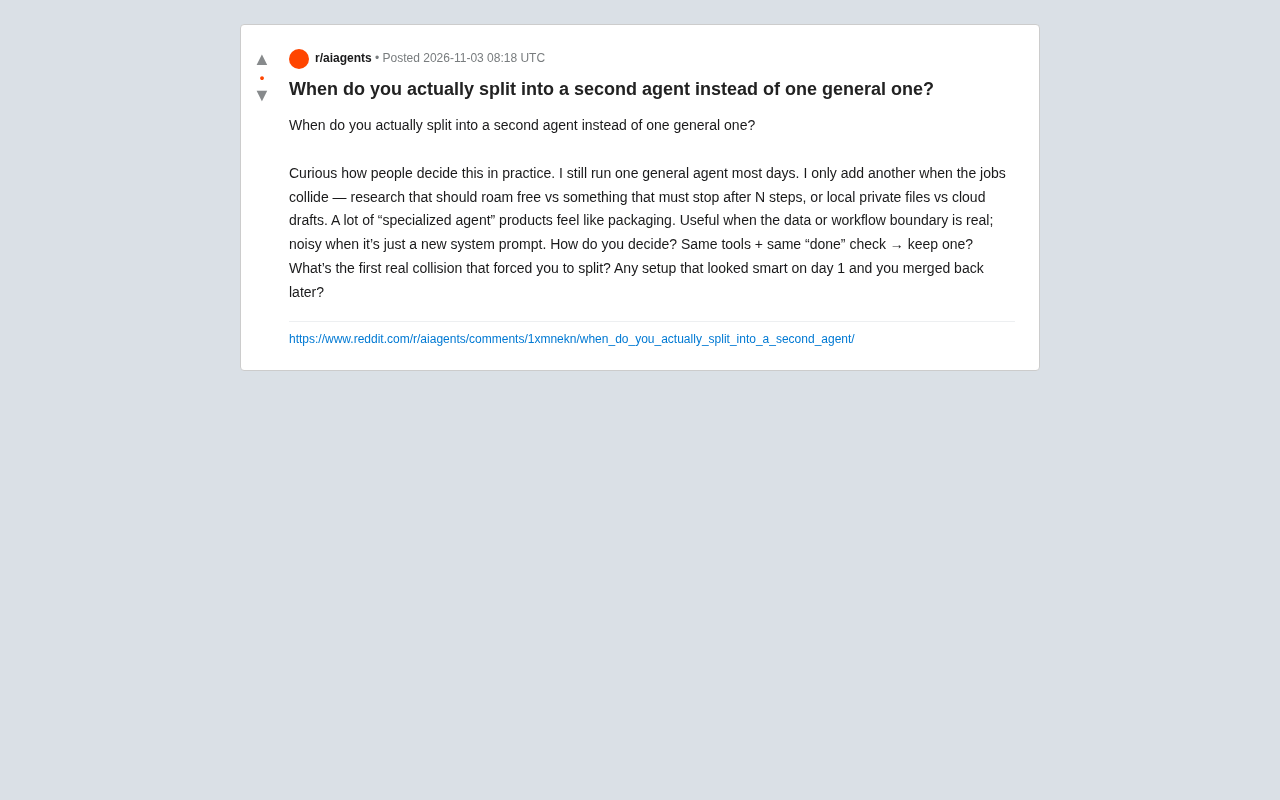
When building AI agent systems, a common confusion arises: when should you split a single general-purpose agent into multiple specialized agents? A developer's question on Reddit sparked widespread discussion: "Most of the time I still use one general agent. I only add another when tasks conflict—for example, research tasks that need free exploration versus tasks that must stop after N steps, or local private files versus cloud drafts. Many 'specialized agent' products feel like just packaging. They're only useful when data or workflow boundaries genuinely exist; if it's just a different system prompt, then it's just noise."
This question touches the core of multi-agent architecture: splitting is not the goal, but a means of handling real constraints. Drawing on community perspectives and practical experience, this article explores the criteria for splitting, common pitfalls, and scenarios where you should return to a single agent.
When Do You Need a Second Agent?
Conflicting Task Goals and Constraints
The most direct signal for splitting comes from irreconcilable task constraints. For example, one agent needs to freely explore and repeatedly try to find the best solution; another agent must complete within a strict number of steps and cannot loop indefinitely. These two behavioral patterns cannot coexist in the same execution loop, so splitting becomes the natural choice.
Multi-Agent Architecture refers to a system design paradigm that decomposes complex tasks into multiple independent or semi-independent agents that collaborate to complete them. Compared with a single agent, a multi-agent system usually includes additional components such as role definitions, communication protocols, shared state management, and task allocation. Its advantage lies in isolating the context and strategies of different tasks, but the cost is introducing communication overhead, state consistency issues, and debugging complexity. In practice, multi-agent systems can be divided into two typical topologies: hierarchical (one coordinator scheduling multiple executors) and peer-to-peer (agents collaborating as equals). Which topology to choose depends on how tightly the dependencies between tasks are coupled.
Data and Privacy Boundaries
When a workflow involves data with different sensitivity levels, splitting is also reasonable. Local private files require strict isolation, while cloud drafts can be shared and synchronized. Putting these two types of operations in the same agent either creates a risk of privacy leakage or forces the entire system to adopt an overly conservative strategy.
Differences in Tool Sets and "Done" Checks
Someone in the community proposed a concise criterion: if two tasks use the same tool set and have the same "done" check standard, then keeping one agent is enough. Conversely, when the tool set or success criteria diverge, the necessity of splitting increases.
System Prompt is the initial instruction provided to a large language model, used to set the agent's role, behavioral guidelines, and output format. In multi-agent systems, distinguishing "specialized agents" merely by changing the system prompt is considered to lack substantive meaning because the underlying model parameters, available tool sets, and memory mechanisms have not changed. True architectural isolation requires independent tool permissions, independent state storage, and clear input/output interfaces. If two "agents" share the same model instance and tool list and differ only in prompts, then they are essentially different operating modes of the same agent, and splitting instead increases the cost of maintaining two sets of prompts and coordinating calls.
Common Pitfalls of Splitting
"Specialized Agents" That Only Change the Prompt
Many products package "specialized agents" as independent entities, but in reality they only change the system prompt for the same underlying model. This kind of splitting does not bring true architectural isolation; instead, it increases coordination costs and the complexity of state synchronization. As the original poster said: "They're only useful when data or workflow boundaries genuinely exist; if it's just a different system prompt, then it's just noise."
Premature Optimization Leading to Merge Rollback
Some developers have shared that seemingly clever splitting schemes were merged back into a single agent after running for a while. The reason is usually that the communication overhead introduced by splitting exceeds the parallel benefit, or the responsibilities of the two agents gradually blur, leading to duplicated work and conflicts.
A Practical Decision Framework
Step 1: Identify Real Collisions
Do not split just because "multi-agent" is a trend. First ask: is the current single agent encountering hard constraints that cannot be resolved by adjusting prompts or tools? Common real collisions include:
- One task needs to run for a long time, while another needs fast responses
- One task involves sensitive data, while another needs public access
- One task requires creative divergence, while another requires strict convergence
Step 2: Evaluate the Cost of Splitting
Splitting means introducing inter-agent communication, state management, and error handling. If the two agents interact very frequently or share a large amount of context, the benefit of splitting may be negative. In this case, a better choice may be to optimize the internal state machine of a single agent.
State Machine is a computational model that models system behavior as finite states and transitions between states. In agent design, a single agent can manage the behavior of different stages through an internal state machine: for example, relaxing step limits in the "exploration" state, strictly limiting steps in the "convergence" state, and disabling cloud tools in the "private data" state. This approach does not require introducing multi-agent communication; it only requires switching tool permissions and constraints during state transitions. The advantage of a state machine is predictable behavior and clear debugging paths, making it suitable for scenarios where task stages are clear and transition conditions can be enumerated; only when task boundaries are fuzzy or parallel processing is needed should you consider splitting into multiple agents.
Step 3: Preserve Reversibility
Keep the possibility of merging in the design. Define the boundaries between agents as clear interfaces rather than hard-coded coupling. In this way, when splitting is no longer reasonable, you can return to a single agent at low cost.
Community Consensus and Divergence
Across discussions from multiple sources, a consensus is gradually becoming clear: the basis for splitting is workflow boundaries, not the number of agents itself. The same tools and the same completion standards mean that a single agent should be kept.
The divergence lies in the timing of splitting. Some developers advocate splitting early to isolate complexity, while others insist on "until it hurts"—splitting only when a single agent truly cannot manage. The original poster belongs to the latter camp; he mentioned that he "most of the time still uses one general agent."
Conclusion
Multi-agent architecture is not a silver bullet. The only legitimate reason to split is the existence of real constraints that cannot be reconciled within a single agent—whether they are task step limits, data privacy boundaries, or fundamental differences in tool sets and success criteria. Before deciding to split, first confirm whether these boundaries genuinely exist and evaluate whether the coordination cost is controllable. Remember: if a problem can be solved with one agent, do not use two.
Related articles
 Tech Frontiers
How Do You Stop AI Agent Emails From Sounding Like AI? One Developer's Solution
AI agent emails always sound like AI? A developer shares reright: a rewrite step that validates numbers, names, and links, preventing humanizers from tampering with key info. Test data and integration details inside.
 Tech Frontiers
Starlink Mobile: SpaceX's Carrier Ambitions and the 5G Deployment Challenge
SpaceX plans to make Starlink Mobile a mainstream carrier, deploying thousands of direct-to-cell satellites and building a terrestrial 5G network to challenge AT&T, Verizon, and T-Mobile. This article analyzes its dual-track strategy, 5G deployment challenges, and the competitive landscape.
 Tech Frontiers
OpenAI Raises Another $11 Billion, Valuation Hits $1.25 Trillion
OpenAI has raised an additional $11 billion in a new funding round at a valuation of $1.25 trillion. The deal is not yet closed and is expected to be completed in the coming weeks, further consolidating its leading position in AI.