When SimCity Meets Permits: The Birth of a Hardcore City-Building Simulator
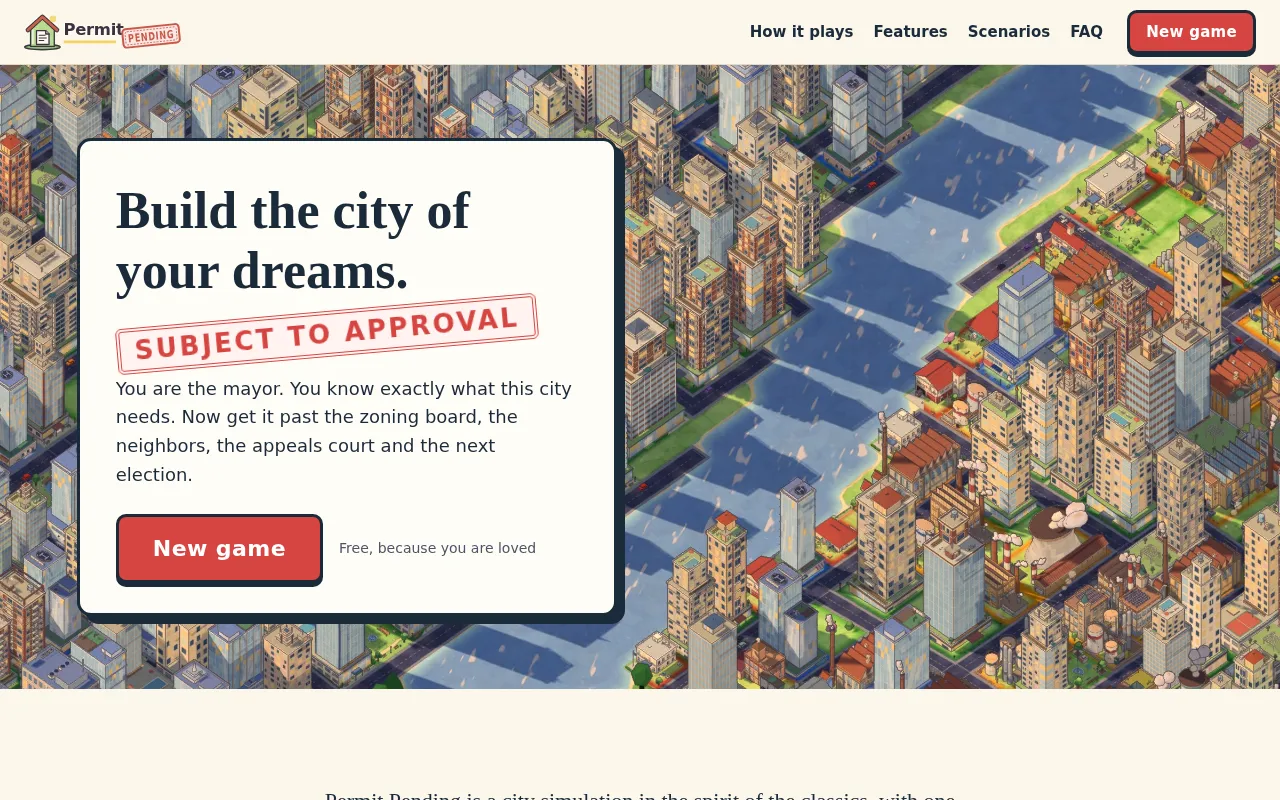
A city-building sim that turns the approval process into core gameplay, exploring realism through institutional friction.
The article introduces an indie game project, "SimCity, but with Permits," which embeds real-world permitting into city-building simulation, turning players from all-powerful planners into clerks bound by process. Posted on Hacker News with only 27 points and zero comments, it's at a very early stage. The article analyzes the idea's value and design challenges—balancing the tedium of real approvals with playability, with progressive unlocking as one possible solution—and notes that it offers the genre a new direction: realism can come from institutional friction, not just physical detail.
Introduction: What If Building a City Required 200 Stamps
The SimCity series has let generations of players experience the thrill of being a mayor—zone a plot, lay a road, build a power plant, and a city springs up. But real-world urban construction is far from this smooth: behind every building lie layers of approvals, public hearings, environmental impact assessments, and neighbor disputes.
A recent project that sparked discussion on Hacker News, "SimCity, but with Permits", is exactly about baking this "real-world friction" into the game. The author posted it on HN, where it quickly gained 27 points. Though the comment section remained quiet, the title alone is enough to pique the curiosity of city-building fans: if even opening a convenience store requires running through three departments, can this game still be fun?
Core Gameplay: Turning the Approval Process into a Game Mechanic
From "God's-Eye View" to "Clerk's-Eye View"
The core loop of traditional city-building games is "plan—build—expand," with players wielding near-absolute power. This work puts the "Permit" at the center of gameplay: before you can build anything, you must first apply for approval.
According to the HN post, players can no longer bulldoze land at will but must advance projects item by item under various constraints. This means the fun shifts partly from "spatial layout" to "process management"—you need to figure out which department is blocking your project, which regulation requires an extra exemption, and which document is still missing.
This design actually echoes the complexity of real-world urban planning. In many cities, a medium-sized development project must go through planning permission, building permits, fire safety review, traffic impact assessment, and more—any single delay can bring the entire project to a halt. The game abstracts this "waiting and negotiating" into a core mechanic, which is a rather counterintuitive experience for players used to instant feedback.
Why This Idea Is Worth Pursuing
Gamifying bureaucratic processes is not a new concept—Papers, Please proved that "stamping documents" can make for compelling gameplay. But grafting an approval mechanism onto city-building simulation is a less-explored intersection.
Veteran city-building players often pursue "optimal solutions" and "maximum efficiency," while an approval system inherently introduces uncertainty and resource constraints, forcing players to change strategies: you may need to reserve more time buffer, prioritize relationships with approval departments, or make compromises elsewhere to secure permits. This added strategic dimension is exactly where indie games excel at innovation.
Papers, Please is a 2013 simulation game by indie developer Lucas Pope, in which players act as a border inspector at a checkpoint in a fictional Eastern European country, deciding whether to admit travelers by reviewing passports, visas, and entry documents. The core fun lies in the combination of information verification, rule memorization, and moral dilemmas, rather than action or strategy. Through minimalist interaction, it proved that bureaucratic processes themselves can be a compelling gameplay vehicle, and it established "document simulation" as a widely recognized indie game subgenre. The permit-based city-building game discussed in this article inherits this tradition in spirit: it transforms the player from a planner with absolute power into a clerk bound by rules and processes, creating tension different from traditional city-building games.
The Reality of Indie Development: Good Ideas Need Execution
Early-Stage Signals on HN
Objectively speaking, 27 points is a very early level of exposure on Hacker News, and zero comments indicate the community has yet to form a discussion. This means the current stage is more of an author's "test-the-waters release" than the official debut of a mature product.
Based on HN's propagation patterns, such posts typically go one of two ways: either they gain a second wave of exposure and spark extensive discussion, or they fade into obscurity. For readers interested in indie games and simulation titles, this is an early signal worth noting, but it should not be over-interpreted.
Hacker News (HN) is a tech community under Y Combinator, focused on startups, programming, and technology products. Its front-page ranking is determined by votes combined with time decay; 27 points usually means the post was just published or has limited attention, still far from making the front page. HN's comment system allows users to engage in deep discussion of technical details and product logic; zero comments often indicate the post has not yet reached its core audience, or that the title and link failed to spark discussion. For indie developers, posting on HN is often used as low-cost market validation and early feedback collection, but a single low-traffic post is not enough to judge a product's prospects—many projects only enter public view after multiple posts or being shared by well-known users.
The Distance from Idea to Playable Product
The biggest design challenge of "permits" as a core mechanic is pacing control. The real approval experience is long, tedious, and information-opaque—if fully replicated, players will quickly lose patience; if oversimplified, the unique value of the idea is lost.
One possible solution is to make the approval process an "unlockable information system": at the start, players only know they need permits, and as the game progresses, various regulations, connections, and shortcuts are gradually unlocked, letting complexity grow with player proficiency. Similar progressive design is common in management simulation games, but how to integrate it with the spatial planning of city-building still requires extensive polishing.
Progressive disclosure is a common complexity-management technique in game design: the system exposes only a few rules at first and gradually unlocks new mechanics as the player's proficiency grows, avoiding information overload. In management simulation games, typical examples include the phased unlocking of municipal services in Cities: Skylines and the gradual introduction of survival pressure through the tech tree in Oxygen Not Included. For a permit-themed game, progressive design can package "regulations, connections, and shortcuts" as collectible and upgradeable resources, turning tedious processes into a system with a sense of growth. The difficulty is that spatial planning in city-building already demands cognitive resources from players; how to avoid a double burden when adding an approval system is a question this kind of crossover design must answer.
Some Lessons for the City-Building Genre
Over the past decade, the mainstream direction of the city-building genre has been "bigger, more detailed, more realistic"—more refined traffic simulation, more complex economic systems, more realistic graphics. But "SimCity, but with Permits" points to another path: realism doesn't have to come from physical detail; it can also come from institutional friction.
Real-world urban form is largely a product of regulations, approval cycles, and interest-group bargaining, rather than planners freely painting on a blank canvas. Making institutional constraints into gameplay may do more to help players understand why cities look the way they do today than adding another ten thousand building models.
Of course, this is only a preliminary attempt by an early-stage project. Whether it can evolve from "an interesting idea" into "a game worth replaying" depends on the author's refinement of pacing and feedback loops. But at the very least, it raises a question worth pondering for fellow developers: are we simulating the physics of cities, or the rules of cities?
Conclusion
For players who love SimCity and Cities: Skylines but are tired of "mindless expansion," this project offers an imaginative space in the opposite direction. Its discussion on HN is still very limited; interested readers are advised to go directly to the original post to check the author's notes and updates. The value of indie games often lies precisely in these "unconventional" entry points, and whether permit simulation works can only be known by actually playing it.
One-line Summary
A city-building simulation game that makes the approval process the core gameplay, exploring the realism brought by institutional friction.
Paragraph Summary
The article introduces an indie game project called "SimCity, but with Permits," which embeds real-world approval and permitting mechanisms into city-building simulation, turning players from planners with absolute power into clerks bound by processes. Posted on Hacker News, the project received only 27 points and zero comments, placing it at a very early test-the-waters stage. The article analyzes the value and design challenges of this idea: a pacing balance is needed between the tedium of real approvals and game playability, and progressive unlocking may be one solution. It also notes that the work offers a new direction for the city-building genre—realism doesn't have to come from physical detail but can come from institutional friction, since urban form is largely a product of regulations and interest-group bargaining.
Related articles

OpenAI Breaks ETH? P=NP Could Upend the Cryptography World
OpenAI reportedly disproved ETH with a sub-exponential algorithm, sparking P=NP speculation. What it means for RSA, blockchain, and protein folding.
When an Anti-Fingerprinting Script Is …
When an Anti-Fingerprinting Script Is Flagged as a Bioweapon: The Detection Dilemma of Security Tools
An anti-fingerprinting script was flagged as a bioweapon by security scanning, sparking Hacker News debate. This analysis covers the causes of keyword-matching false positives, how developers respond, and the long-term imbalance between automation and precision in security tools.

41,000 DHS Employee Records Leaked, Including Undercover ICE Agents
Data breach exposes 41,000 DHS employees, including undercover ICE agents. Analysis of sensitive data risks, law enforcement security gaps, and protection measures like access control and auditing.