When the Entire Team Is Just 'Pressing Enter': The Engineer's Dilemma in the AI Coding Frenzy

An engineer exposes how his company turned AI coding tools into an accelerator for technical debt and cognitive alienation.
A two-week-old engineer disclosed on social media that his large company has everyone from L1 to L7 doing nothing but prompting Claude Code — specs, code, tests, and ticket resolutions are all AI-generated, nobody reads anything, yet everyone works 12–13 hours a day under limitless delivery pressure. The article argues this is organizational misuse of AI: management conflates code output with value creation, AI-tested AI code forms an unsupervised feedback loop, and engineers are reduced to human triggers with their professional judgment systematically discarded — creating knowledge hollowing, blurred accountability, and wasted talent at scale.
A software engineer who had been at a large company for just two weeks wrote something on social media that cut straight to a truth the AI coding wave has been carefully avoiding: when code is no longer the bottleneck, what is left for humans?
A Confession from a Frontline Engineer
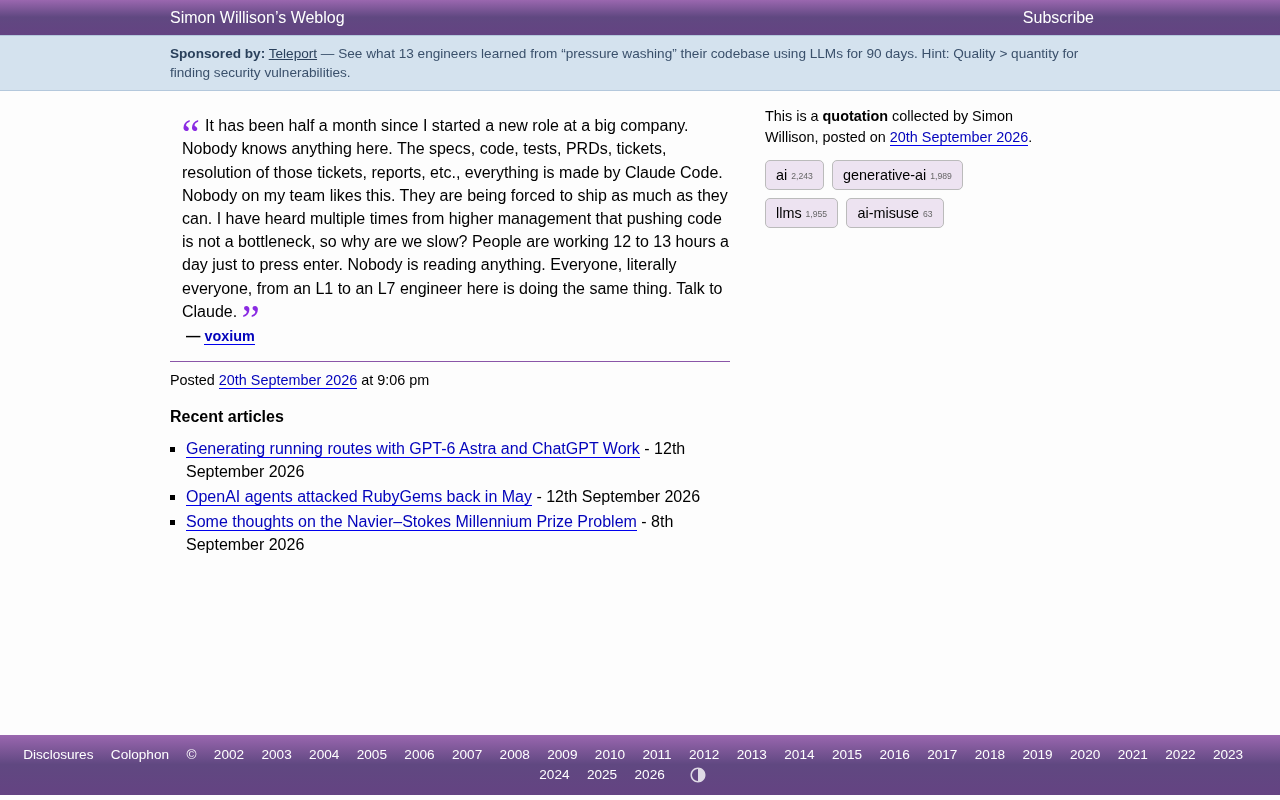
Twitter user voxium shared his experience at a new job, and the details are unsettling:
"I've been at a big company for half a month in a new role. Nobody here actually understands anything. Specs, code, tests, PRDs, tickets, ticket resolutions, reports — everything is generated by Claude Code. Nobody on the team likes this; they're being pressured to ship as much as possible."
The scene he describes borders on absurd: management keeps repeating that "pushing code is no longer the bottleneck, so why are we still slow?" As a result, people are working 12 to 13 hours a day "just to press enter." From L1 to L7, regardless of seniority, everyone is doing the same thing — talking to Claude. Nobody is reading anything.
This post resonated widely not because it was a complaint about AI capabilities, but because it was an indictment of how AI is being organizationally abused. When prominent developer Simon Willison shared it, he filed it under ai-misuse, which captured the essence of the problem perfectly.
The Management Fallacy Behind "Code Is Not the Bottleneck"
Management's logic seems reasonable on the surface: if AI can generate large amounts of code in seconds, delivery speed should skyrocket. But this reasoning commits a classic error — conflating "producing code" with "creating value".
The bottleneck in software engineering has never been typing speed. What actually consumes time is understanding requirements, weighing design trade-offs, verifying correctness, maintaining readability, and making sound decisions in complex systems. When a team outsources all of these to a large language model, the volume of code may go up, but nobody truly understands what the system is doing.
The detail voxium mentions is especially telling: even tests and ticket resolutions are AI-generated. This means the quality-verification layer has itself broken down — using AI-written tests to validate AI-written code is essentially letting the model vouch for itself, creating an unsupervised closed loop. When something fails, the team will be left with a codebase nobody understands and nobody dares to touch.
This management fallacy maps directly onto well-established concepts in software engineering theory. Conway's Law, articulated by Melvin Conway in 1968, holds that system architecture ultimately mirrors the communication structures of the organizations that design it. Frederick Brooks, in The Mythical Man-Month, demonstrated long ago that the core difficulty of software development lies in "essential complexity" — understanding and deciding about the problem itself — not "accidental complexity" — the mechanical work of typing, compiling, and debugging. AI tools dramatically reduce accidental complexity; but management's expectations are built on the assumption that the two are the same thing. The deeper issue is that quantifiable metrics — lines of code, PR counts, deployment frequency — are easy to optimize for, while truly critical properties like "does anyone understand the system" and "were decisions properly weighed" are nearly impossible to measure. This makes organizations driven by KPIs naturally inclined to chase the former, even when the former has become completely disconnected from actual value.
The Alienation of "Working 13 Hours a Day Just to Press Enter"
The line that stings most is "people are working 12 to 13 hours a day just to press enter." This exposes a new form of workplace alienation.
In theory, AI should free engineers from tedious coding work, allowing them to focus on higher-value thinking. In this company, the opposite has happened: AI hasn't reduced working hours — it has lengthened them, because of the pressure to deliver without limit. Engineers have been reduced to "human triggers" for large language models, their value compressed into the single act of approving AI output, an act that is itself mostly performative — because "nobody is reading anything."
This is a textbook efficiency illusion: the tool makes individual operations faster, but the organization refills the saved time with ever-greater output demands. The actual burden on employees increases rather than decreases, while any sense of professional accomplishment is completely hollowed out.
Marx's concept of "alienated labor" from the Economic and Philosophic Manuscripts of 1844 takes on a new digital form here: workers are no longer alienated from the means of production but from the cognitive process itself — engineers are physically present yet participate in no genuine judgment. Behavioral economics offers another lens through "automation bias": when faced with machine-generated output, humans tend to reduce critical scrutiny even when they know the machine might be wrong, and this bias intensifies sharply when output volume is high and review time is limited. When an organization explicitly demands "ship as much as possible," engineers are effectively incentivized to bypass critical thinking — not because they are lazy, but because the system was never designed to make room for "understanding" in the first place. This causes the act of "approving AI output" to eventually degrade into a symbolic ritual.
An Isolated Incident, or an Industry Signal?
It's worth noting that this is a single engineer's perspective and cannot represent every team adopting AI coding tools. Many organizations genuinely improve efficiency within reasonable bounds using Claude Code, Copilot, and similar tools. The critical difference lies in whether humans remain in the driver's seat of the decision-making chain.
But the reason this account resonated so strongly in developer communities is that it touches on a systemic risk that is beginning to emerge:
- Knowledge hollowing: When nobody understands the code, the organization's technical assets effectively become black-box liabilities.
- Blurred accountability: When AI-generated code breaks, who is responsible?
- Wasted talent: When everyone from L1 to L7 is doing the same low-cognition work, engineers' professional growth paths are severed.
The concept of technical debt, introduced by Ward Cunningham in 1992, originally described short-term compromises made for fast delivery — compromises that must be repaid at greater cost in the future. What voxium describes can be understood as an extreme form of "cognitive technical debt": the codebase may run, but the human understanding that should accompany it has been zeroed out. Traditional technical debt at least leaves documentation or comments to follow; when specs, tests, and ticket resolutions are all AI-generated and never genuinely reviewed, this debt leaves no traces for anyone to reconstruct later. Similar risks have appeared in different guises throughout history: the COBOL systems accumulated by large enterprises in the 1980s and 90s became unmaintainable infrastructure burdens decades later because nobody understood the underlying logic. AI-accelerated code generation may produce an equivalent vacuum of understanding in a far shorter time.
Lessons for Teams and Managers
The value of this case isn't to reject AI coding tools — it's to remind us that how a tool is used matters more than the tool itself.
For managers, the right metrics are not "how much code was pushed" but "are real problems being solved" and "is the system maintainable." When treating AI as an amplifier, it's essential to stay clear-eyed: it will amplify poor decisions and uncomprehended complexity just as readily as good ones.
For engineers, voxium's experience is a warning. In the age of AI, the truly scarce skill is not writing code — it's judgment: knowing what should be done, what shouldn't, and where AI output can't be trusted. Surrendering that judgment and reducing yourself to "the person who presses enter" is the greatest risk of all.
AI can generate everything. But "understanding" — for now — remains something only humans can do. The moment an organization collectively abandons understanding, no delivery speed is fast enough to prevent the crash ahead.
Related articles

Black Forager Alexis Nelson: From Foraging to Publishing, Happy Snacking, Don't Die
Black Forager Alexis Nikole Nelson visits Talks at Google, sharing her journey from childhood plant walks with her mother to publishing the cookbook Happy Snacking, Don't Die!, revealing the racial and land history behind foraging's rise and fall in America.

How to Present Your Ideas Effectively: Three Types of Revelation Talks
Revelation talks are the most direct way to convey ideas. This article breaks down three types — Wonder Walk, Dynamic Demo, and DreamScape — with classic examples from David Gayo, Michael Pritchard, and Sylvia Earle.

Modern Web Guidance: Letting AI Write Native Declarative Dialog Popovers
Google's Modern Web Guidance makes AI coding assistants prefer native declarative dialog capabilities over repetitive JavaScript event listeners, measurably cutting boilerplate code.