When Your Party Is So Cool the Local News Covers It: An Accidental Breakout of Internet Culture

An eight-word tweet uses a news screenshot and the "tfw" meme to show a low-cost, high-resonance viral mechanism.
Using the tweet "tfw your party is so cool the local news covers it" as a sample, the article analyzes how social media content spreads. Meme phrasings like "tfw" invite readers into an emotion rather than stating facts; paired with a news screenshot, they form a miniature scene comedy that is cheap to make yet built for secondary spread. The serious visual grammar of local news contrasts with the party scene to create the punchline, while the displaced honor of "being on TV" fuels the tweet's emotion. Private moments entering public communication get re-signified across multiple contexts, which is why such material breaks out so easily.
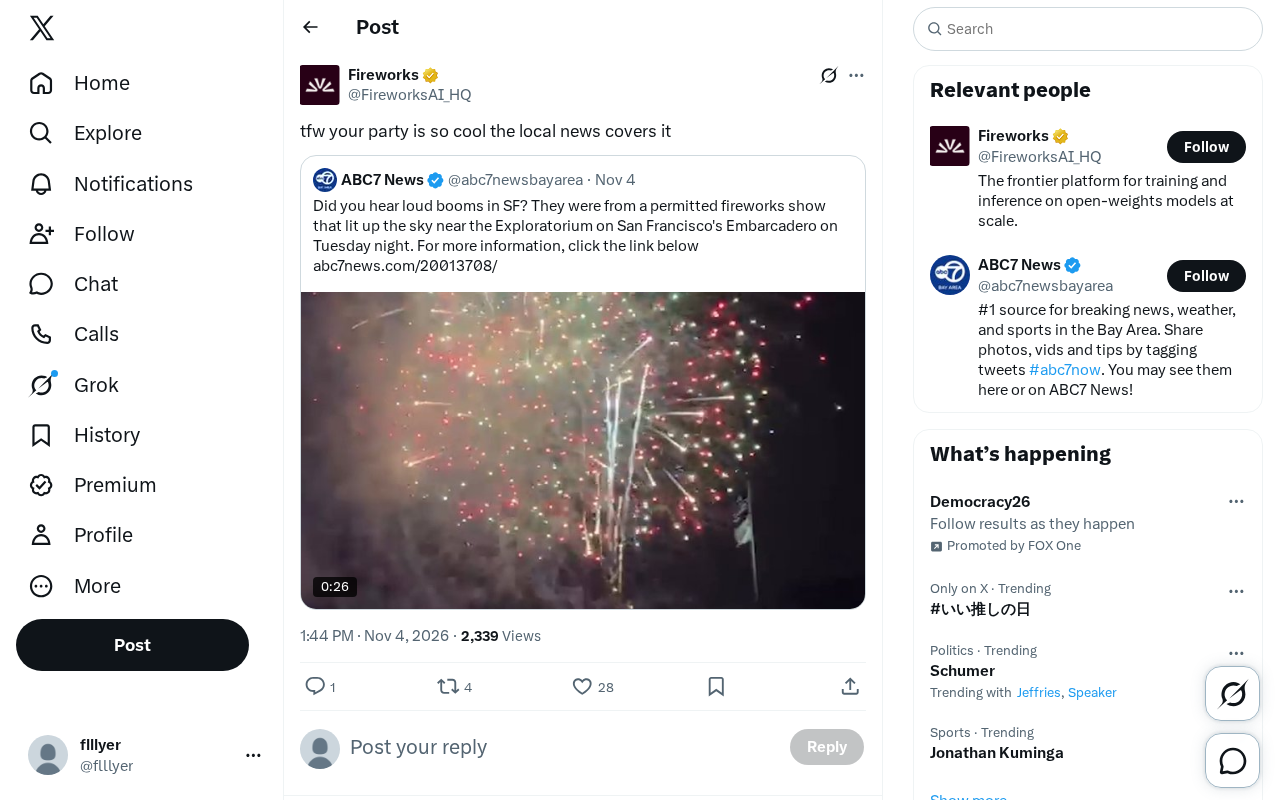
A single tweet used just eight words to give countless people a vivid mental image: "tfw your party is so cool the local news covers it." The tweet itself had no caption — almost all of its meaning was carried by the attached image and the kind of context you can only "get" rather than have explained.
The viral power of this kind of content rarely comes from the amount of information it delivers; it comes from resonance. It captures, with precision, a deeply dramatic moment: a private social occasion suddenly invaded by the cameras of public media, leaving the protagonist both proud and a little unsure of what to do.
Why a single "tfw" can go viral
"tfw" is short for "that feeling when" — a quintessential internet meme phrasing. Its function isn't to state a fact but to invite the reader to step into an emotional state. Paired with a screenshot of a news broadcast, the whole piece becomes a miniature "scene comedy": the audience doesn't need to know who threw the party or which city it was in to immediately grasp the absurd comedy of having your moment officially certified by a news camera.
Structurally, this is the most economical kind of storytelling on social media — extremely low creative cost, extremely high emotional reuse rate. Anyone can slot their own similar experience into this sentence pattern, which gives it a built-in gene for secondary spread.
Meme phrase is a highly templated expression structure on social media: users simply swap in different keywords or images to mass-produce new content. Common examples include openers like "tfw," "mood," "me when," and "nobody:". What these phrasings share is minimalist syntax and deliberate semantic blankness — they leave most of the interpretive work to the reader's associations. Because of this, they can be rapidly reused across languages and communities, becoming the lowest-cost "emotional memes" on the internet. The vitality of a meme phrase often doesn't depend on its first user but on whether later users can stuff their own life experience into the same frame.
The local news camera as "cultural certification"
Local TV news coverage has a highly recognizable visual language: a reporter holding a microphone, a slightly awkward interviewee, bystanders in the background who haven't quite caught on yet. When this serious news grammar is grafted onto a party, the contrast itself becomes the punchline.
Behind that contrast lies a subtler psychology: being captured by local news means, in many people's minds, that "this was important enough to be recorded." Even if the story is just an ordinary community event, "being on TV" still carries a certain ceremonial weight. The tweet author's pride comes precisely from this displaced sense of honor.
Visual grammar is a concept from social semiotics referring to the way a type of media content, through stable patterns of composition, camerawork, and subject staging, forms viewing conventions that audiences can anticipate. Local news is a classic example: a reporter facing the camera, a microphone bearing the station logo, an interviewee answering at an angle, ambient sound in the background. Once these elements repeat often enough, viewers can tell "this is a news report" at a glance. When the same visual grammar appears in a party scene, the interpretive frame audiences had reserved for "serious events" is forcibly applied — and the sense of contrast and humor follows. Understanding this is understanding why such screenshots convey meaning without any caption at all.
The logic of "breaking out" in the social media age
This tweet also reflects a broader phenomenon: the boundary between private moments and public communication is becoming increasingly blurred. Once a party enters a news camera, it simultaneously belongs to the participants, the TV audience, and strangers on the internet — and takes on completely different meanings in each of these three contexts.
For content creators, the value of this kind of material is that it comes with its own "story hook" — no background explanation needed, because the audience fills it in themselves. That's also why everyday-life clips like this often break through more easily than carefully planned content.
It's worth noting that the tweet itself provides no specific information about the party, the outlet that covered it, or the details of the event — its entire meaning stays at the level of emotion and meme. Treating it as a sample for observing how online transmission works is perhaps more interesting than asking "which party was this?"
Context collapse is a term communication scholars use to describe a phenomenon of the social media age: content originally intended for a specific audience becomes exposed, through platform distribution, to radically different groups — family, colleagues, strangers online — all at once, causing the same content to take on different meanings in different contexts. A party scene enters a news camera, then gets screenshotted and posted to Twitter — passing through multiple context switches along the way: an honor for the people involved, community news for the TV audience, and a meme for netizens. This coexistence of multiple contexts is the norm for content transmission today, and it explains why "breaking out" is often accompanied by a drift in meaning.
Conclusion
A short tweet, paired with a news screenshot, completes a humorous statement about "being seen." It reminds us that on social platforms, what moves people most is often not information density but that moment everyone has experienced yet few can articulate precisely.
One-line Summary
An eight-word tweet uses a news screenshot and the "tfw" meme to demonstrate a low-cost, high-resonance transmission mechanism.
Paragraph Summary
Using the tweet "tfw your party is so cool the local news covers it" as a sample, the article analyzes the transmission logic of social media content. The author notes that meme phrasings like "tfw" don't state facts but invite readers into an emotion; paired with a news screenshot, they form a miniature scene comedy — extremely low creative cost yet with a built-in gene for secondary spread. The serious visual grammar of local news contrasts with the party scene to form the core punchline, while the displaced sense of honor from "being on TV" is the source of the tweet's emotion. The article further notes that once private moments enter public communication, they are re-signified across three contexts — participants, TV viewers, and online strangers — which is why material with its own "story hook" breaks out more easily. Since the original material consists only of a title and a screenshot, the analysis stays at the level of transmission mechanisms.
Related articles

Anthropic Fable 5.2 Hands-On: 3A Games and Excel Clones from One Prompt
Anthropic Fable 5.2 hands-on: three-line prompts generate a playable Gears of War clone, a full Excel clone, and a DaVinci Resolve clone. Benchmarks, Ultra Code mode, token costs, and pricing analyzed — is it worth replacing Opus 5.5?

RL Racing Agent Stuck Against the Wall? Try These Recovery Strategies
RL racing agent stuck against walls? We analyze recovery data, observation limits, and action space, comparing DAgger, behavior cloning, and SAC with diagnostic experiments.

Giving AI Agents Long-Term Memory: A New Approach to Supply Chain Disruption Decisions
A developer uses Hindsight to build persistent memory for a supply chain AI agent, enabling retrieval of past disruptions and decision outcomes. The article analyzes its architecture, memory retention and recall design, and engineering challenges such as what to remember and how to evaluate memory effectiveness.