Where Does AI Training Data Come From? The Rise of Data Licensing Intermediaries

AI training data demand is spawning enterprise data licensing intermediaries, but compliance, pricing, and scalability remain bottlenecks.
Starting from a Reddit post, this article reveals that AI training data is shifting from the public internet to enterprise-owned application data, giving rise to a new role: data licensing intermediaries. The poster acts as a light-asset data broker, connecting data holders with AI training demand. Enterprise data monetization faces three major obstacles: privacy compliance, pricing difficulties, and competitive concerns—with compliance being the largest cost item and data valuation lacking industry standards. For the data brokerage model to succeed, it must solve two key problems: building trust and scaling matchmaking. For AI developers, beyond public datasets, licensing channels are becoming a viable path to obtaining domain-specific data, but thorough compliance due diligence is needed before any transaction.
In a Reddit AI-related forum, a post sparked considerable discussion: the poster claims to work with startups and enterprises across multiple countries and industries, helping them license out the data generated by their own applications to companies, researchers, and individuals who need data for AI training, fine-tuning, research, or evaluation.
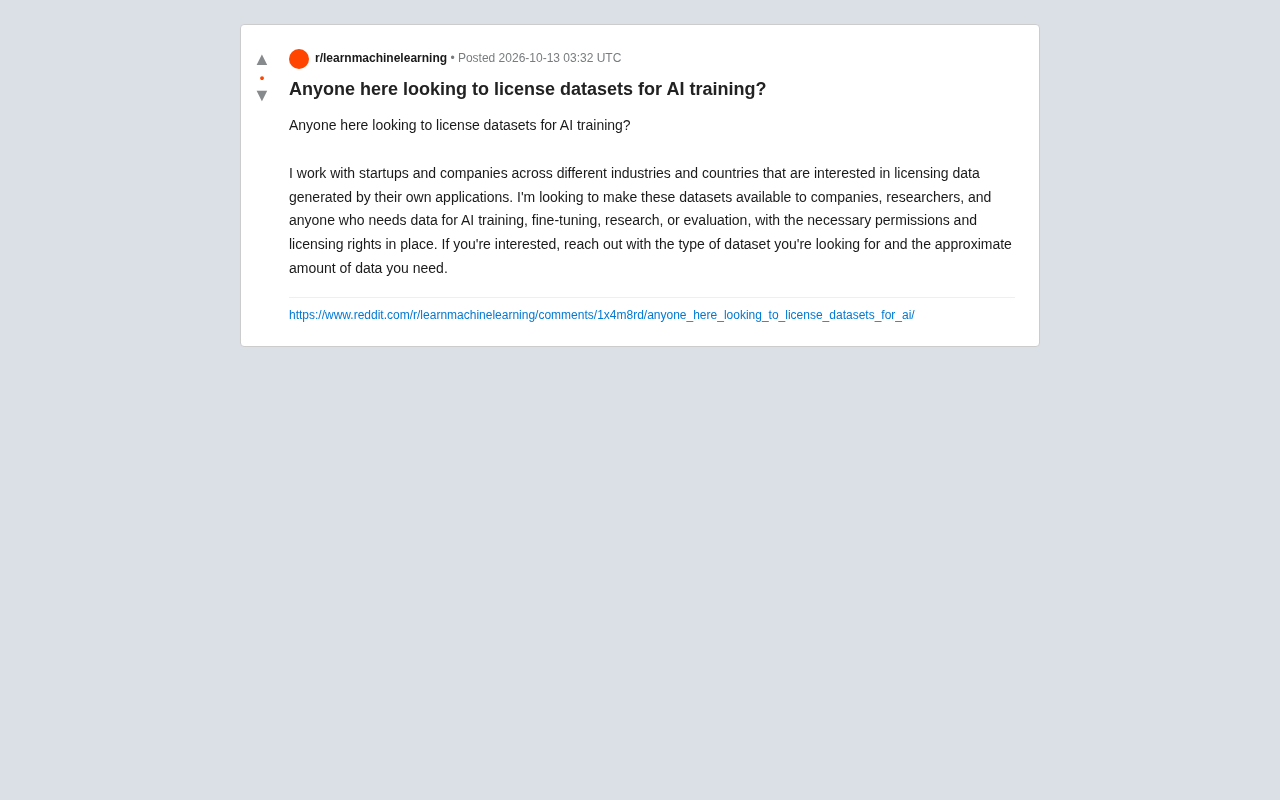
The post itself doesn't contain much information, but it points to an industry segment that is quietly emerging: the licensing and circulation of AI training data.
Amid a Data Famine, Who's Selling Data?
The capabilities of large models depend heavily on the scale and quality of training data. The supply of high-quality text on the public internet is being rapidly depleted, and more and more teams are turning to non-public data sources—user behavior data generated by enterprise applications, industry-vertical data, proprietary corpora, and so on.
The poster in this case plays exactly the role of a middleman. Their business model is: connecting enterprises that hold data with downstream buyers who need it, completing data transactions under compliant licensing arrangements. The coverage includes startups and established companies across "different industries and countries," with data types matched according to buyer needs.
This kind of demand is not unfounded. Posts seeking domain-specific datasets appear frequently on Reddit, ranging from medical Q&A and legal documents to multilingual conversation records—the demand side is quite fragmented.
Data Famine is a phenomenon frequently discussed in the AI industry in recent years. According to research from institutions like Epoch AI, the total amount of high-quality text available for training on the public internet (such as books, academic papers, and quality web content) is on the order of tens of billions of words, while the training data demands of large models are growing at several times per year. Some research predicts that between 2026 and 2032, high-quality public text may be exhausted. This trend is forcing AI teams to turn to three types of alternative data sources: first, user behavior logs and interaction records within enterprises; second, proprietary data in industry verticals (such as medical imaging and legal case law); and third, data generated through human annotation or synthesis. Among these three, enterprise-owned data has the largest scale and highest authenticity, but also the highest barrier to access—which has given rise to market demand for data licensing transactions.
The Allure and Risks of Enterprise Data Monetization
For enterprises that hold data, licensing it out is a potential monetization path. This is especially true for application developers who have accumulated massive amounts of user interaction data—data that may have value in AI training scenarios beyond their own business.
But in practice, enterprise data licensing faces several core obstacles:
Privacy and compliance. User data often involves personal information, and regulations like GDPR and CCPA impose strict restrictions on secondary use of data. The post's emphasis on having "necessary permissions and licensing rights in place" precisely illustrates that compliance is a prerequisite for such transactions—and also the largest cost item.
Difficulty in data pricing. Unlike standardized commodities, the value of a dataset depends heavily on its specific use. The same data could differ dramatically in value when used for pre-training versus evaluation, and the industry currently lacks mature pricing benchmarks.
Competitive concerns. Enterprises may be reluctant to license data to potential competitors, especially when the data itself constitutes a business moat.
Data pricing is difficult because data as a commodity has several special properties: non-rivalry (the same data can be sold to multiple buyers without being depleted), context dependence (value varies dramatically with use case), and near-zero marginal cost (replication costs are extremely low). Traditional economics lacks a mature pricing framework for such goods. Pricing approaches currently being explored include: by data volume (per token/per record), tiered licensing by use case (separate pricing for pre-training/fine-tuning/evaluation), revenue sharing from downstream model returns, and auction mechanisms. Moreover, the value of the same dataset to different buyers can differ by dozens of times, and information asymmetry makes it difficult for sellers to determine reasonable quotes. These factors together mean that data transactions currently rely heavily on one-on-one negotiation, lacking a transparent, liquid public market.
Can This Intermediary Role Work?
Judging from the post's content, the poster positions themselves as a light-asset data broker—not producing data themselves, but only matching supply and demand and coordinating licensing. For this model to work, at least two problems need to be solved.
The first is trust. Data transactions involve the seller's trust in how the buyer will use the data, and the buyer's trust in the data's quality and the legality of its source. As an intermediary, sufficient credibility endorsement is needed.
The second is scalability. One-on-one matchmaking is inefficient; if a standardized data catalog and licensing framework could be established, the value would be much greater.
Some platforms are already doing similar things, but the industry as a whole is still in its early stages. Whether data licensing will become an independent, scaled segment of the AI industry chain remains to be seen.
Several data trading platforms and brokers have already emerged internationally in various forms. Data marketplace platforms (such as Databricks Marketplace and Snowflake Data Cloud) provide infrastructure for data listing, discovery, and delivery; data brokers (such as Bright Data and parts of Scale AI's business) focus on data collection, cleaning, and on-demand supply; data trusts and cooperatives are exploring models that allow data subjects to collectively bargain and manage licensing. However, unlike financial assets or commodities, the subject matter of data transactions is highly heterogeneous—the terms, compliance requirements, and delivery formats of each transaction may differ. This makes standardization and scaling especially difficult. The industry has yet to form unified data description standards, licensing agreement templates, or quality rating systems, which is also the core reason for the current fragmentation of the data licensing segment.
Implications for AI Developers
If you're working on AI-related product development, the signal from this post is worth noting: beyond public datasets, more and more non-public data is circulating through licensing channels. For teams that need domain-specific data, considering data licensing is a viable path in addition to scraping or annotating it yourself.
At the same time, be aware that compliance risks in the data licensing chain cannot be ignored. Whether the data you purchase comes from a legal source and whether the licensing scope covers your use case both require thorough due diligence before the transaction.
Related articles

Chain of Thought Isn't Just for AI: How Humans Can Use CoT to Improve Thinking Quality
Chain of Thought isn't just a prompt trick for large models. Starting from a Hacker News discussion, this article analyzes why CoT works for human thinking too, breaks down actionable ways to transfer it, and highlights the key differences between human CoT and machine CoT.
Cloudflare Teams Up with OpenAI: Closi…
Cloudflare Teams Up with OpenAI: Closing the Loop from Vulnerability Discovery to Defense with AI
Cloudflare uses OpenAI Daybreak to investigate security vulnerabilities and generate reviewable remediation plans, while developers use Codex to boost coding efficiency and quality.

Orca Multi-Agent Orchestration in Practice: A Guide to Parallel Collaboration with Claude and Codex
Orca is Stable AI's free open-source agent workbench supporting 34 agents like Claude Code and Codex in parallel. Learn its Git worktree isolation, multi-model orchestration, and mobile management.