Where Should Human Review Go in an Agent Workflow? A Guide to Designing Critical Checkpoints

Place human review at high-risk, irreversible decision points in agent workflows — not just at the end.
This article analyzes where to place human-in-the-loop review in agent workflows. End-of-pipeline approval fails due to information asymmetry and high rework costs, while reviewing every node causes confirmation fatigue. The most effective approach concentrates human attention at three high-value checkpoints: before irreversible external actions, when agent confidence falls below a threshold, and when risk indicators trigger escalation. Mature agent systems combine default automation, pre-action interception, weak-evidence escalation, and process traceability into a layered strategy focused on the trustworthiness of the decision process, not just the final output.
Starting with a Real Dilemma
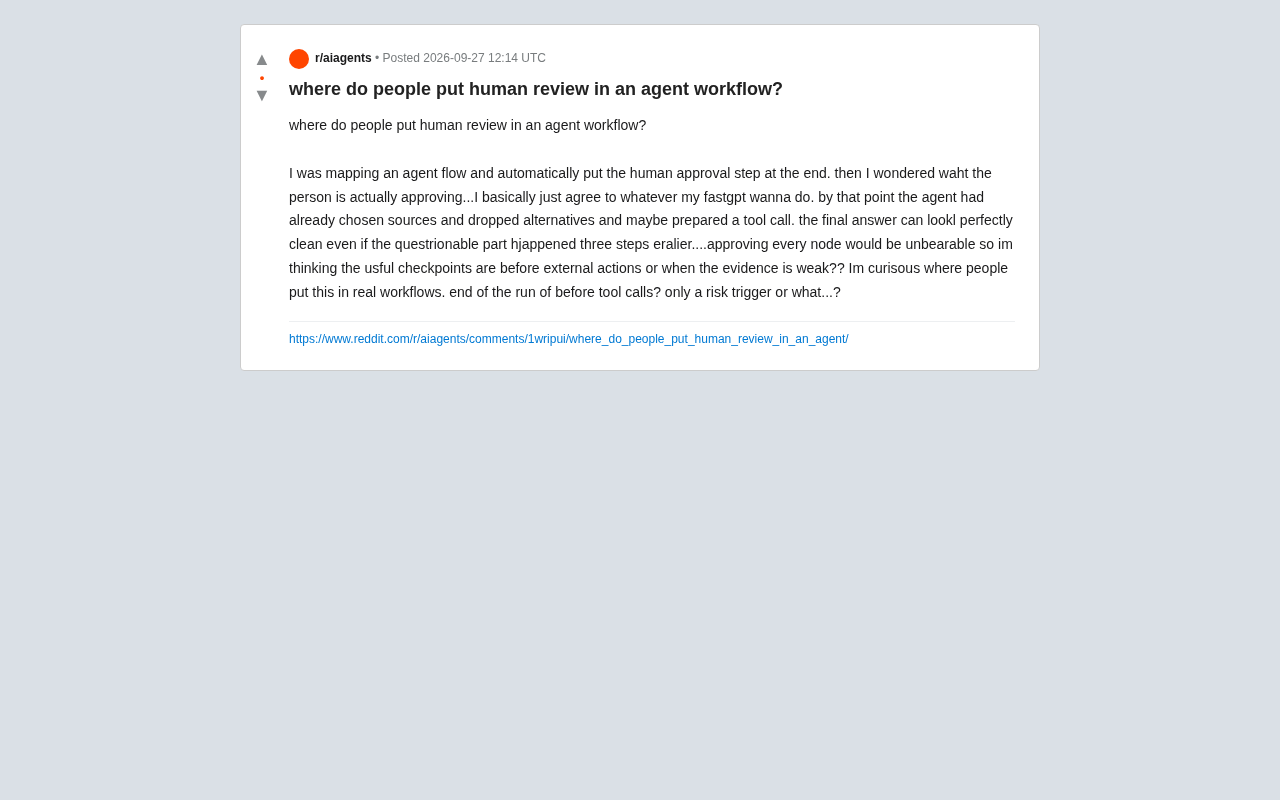
A developer designing an agent workflow had a habit of placing the human approval step at the very end of the process. But when he actually stopped to ask himself "what is the human even reviewing at this point?", the problem became clear: by the final step, the agent had already selected its sources, discarded alternative approaches, and prepared its tool calls. The final output might look clean and polished — but the moment that truly deserved scrutiny had happened three steps earlier.
This observation points to a widely overlooked issue in agent system design: where you place the human-in-the-loop determines whether it functions as a genuine control mechanism or just a rubber stamp.
Why End-of-Pipeline Approval Often Fails
Putting review at the end of a workflow is the most intuitive approach: the agent runs through the entire process, a human glances at the result, and approves it. But this design has two structural flaws.
First, information asymmetry. By the time you reach the final answer, the intermediate decision path has already been compressed or hidden. The reviewer often can't see which evidence the agent selected early on or which alternatives it discarded. The original poster put it bluntly: "I basically just agree to whatever the agent wants to do." When reviewers lack visibility into the intermediate steps, approval degrades into a formality.
Second, high cost of correction. If a problem originated early in the process — say, the wrong data source was chosen — catching it at the end means the entire reasoning chain was built on a flawed foundation, making rework extremely costly. Worse, a logically flawed process can produce a conclusion that appears airtight on the surface, making it even harder to catch.
Reviewing Every Node Isn't the Answer Either
So does that mean inserting human confirmation at every single node is the safe alternative? In practice, this path doesn't hold up.
The original poster made the point directly: "Approving every node is unbearable." The value of an agent lies precisely in its automation and speed — if every step requires a human to sign off, you might as well do it manually. Excessive human intervention completely erodes the efficiency gains agents provide, and pushes reviewers into "confirmation fatigue" — when there are too many confirmation dialogs to click through, people start reflexively approving everything, and review quality actually declines rather than improves.
So the real question isn't "should there be human review" — it's at which points does review deliver the highest marginal value.
"Confirmation fatigue" is well-documented in human-computer interaction research, and closely related to "automation bias" — when human reviewers habitually face large volumes of machine-generated output, they tend to increasingly defer to the system's judgment rather than think independently. Research shows that the higher the approval frequency and the more information packed into each decision, the greater the cognitive burden and the higher the error rate. This is why the security field long ago abandoned the naive assumption that "more review equals more safety," shifting instead to studying how to design an "attention economy" — ensuring that limited human attention is spent only where genuine judgment is needed. In agent systems, this means checkpoint design is fundamentally a resource allocation problem, not just a risk management one.
Where Are the High-Value Checkpoints?
Drawing on the original post and community discussion, a few positions clearly offer higher review returns:
Before External Action Execution
This is the most widely recognized checkpoint. When an agent is about to call a tool, send an email, write to a database, execute a transaction, or perform any other operation with irreversible side effects, human confirmation delivers the most value. The original poster also favored "gating before external actions." The reasoning is simple: mistakes in internal reasoning can be retried, but real-world actions, once taken, are difficult to undo.
When Evidence Is Weak or Confidence Is Low
The second high-value trigger point is when the agent's basis for a decision is insufficient. The original post mentioned intervening "when evidence is thin" — this is essentially risk-based dynamic review. Rather than blocking at a fixed position, let the system assess the uncertainty of the current decision and only request human input when confidence falls below a threshold. This preserves automation efficiency while bringing in human judgment exactly where it's needed.
Risk-Triggered Review
An even more refined approach is to set risk triggers. The system monitors a set of signals — the destructiveness of an operation, data sensitivity, transaction size, degree of deviation from expected behavior — and only escalates to human review when risk indicators cross a threshold. This model concentrates human effort on the small number of decisions that are truly critical.
The risk trigger concept shares conceptual DNA with the "circuit breaker pattern" in software engineering and the "halt mechanism" in financial trading systems — the system doesn't intercept everything indiscriminately, but switches into a protective mode when it detects anomalous signals. In agent scenarios, common risk signal dimensions include: reversibility of the operation (database write vs. read-only query), scope of impact (single record vs. batch modification), deviation from historical baselines (is the current decision path significantly different from similar past tasks?), and contextual novelty (is the agent encountering a situation not seen during training or testing?). Weighting and quantifying these dimensions produces a dynamic "risk score" — above the threshold, the task is automatically routed to a human review queue; below it, execution proceeds. The challenge lies in calibrating the threshold: set it too low and you recreate the full-node review problem; set it too high and the mechanism becomes meaningless.
A Layered Strategy for Practice
Taken together, mature agent workflows typically don't rely on a single review point — they use a layered combination:
- Default to automatic: Low-risk, reversible, high-confidence operations execute fully automatically;
- Intercept before actions: All calls that produce external side effects require mandatory confirmation;
- Escalate on weak evidence: When confidence falls below a threshold, proactively request human judgment;
- Maintain process traceability: Even without reviewing every node, record the intermediate decision path so that end reviewers can trace back "how did we get here."
The key shift is this: review shouldn't only ask "is the final output correct" — it should ask "is the process that produced this output trustworthy." The original poster's observation that "the questionable part may have happened three steps earlier" is the philosophical core of this entire design approach.
"Process traceability" at the engineering level typically relies on structured logging or dedicated agent tracing tools (such as LangSmith, Phoenix Arize, etc.). These tools record every LLM call's inputs and outputs, tool call parameters, and the agent's internal chain-of-thought in a tree or timeline format. For end reviewers, the ability to quickly locate "why did the agent choose data source A over B at step 3" is a critical prerequisite for assessing the trustworthiness of the final output. This also echoes a core claim in recent AI explainability research: the value of explainability isn't just in post-hoc analysis, but in real-time empowerment of human reviewers to make better decisions.
Closing Thoughts
The placement of human review in an agent workflow is fundamentally a balance between control and efficiency. Putting it at the end is convenient but ineffective; putting it at every step is safe but paralyzingly slow. Genuinely effective design means deploying limited human attention where marginal value is highest — before external actions, when evidence is thin, when risk triggers fire.
For developers building agent systems, there's no universal answer to this question — but there is a clear framework: first identify which steps are irreversible and which decisions carry high risk, then design checkpoints around those nodes, rather than reflexively stacking approvals at the end of the pipeline.
Related articles

Chain of Thought Isn't Just for AI: How Humans Can Use CoT to Improve Thinking Quality
Chain of Thought isn't just a prompt trick for large models. Starting from a Hacker News discussion, this article analyzes why CoT works for human thinking too, breaks down actionable ways to transfer it, and highlights the key differences between human CoT and machine CoT.
Cloudflare Teams Up with OpenAI: Closi…
Cloudflare Teams Up with OpenAI: Closing the Loop from Vulnerability Discovery to Defense with AI
Cloudflare uses OpenAI Daybreak to investigate security vulnerabilities and generate reviewable remediation plans, while developers use Codex to boost coding efficiency and quality.

Orca Multi-Agent Orchestration in Practice: A Guide to Parallel Collaboration with Claude and Codex
Orca is Stable AI's free open-source agent workbench supporting 34 agents like Claude Code and Codex in parallel. Learn its Git worktree isolation, multi-model orchestration, and mobile management.