Where to Find Datasets for Data Science Projects? A Practical Guide to Moving Beyond Kaggle
A practical guide to finding unique datasets beyond Kaggle for standout data science portfolios.
This guide helps data scientists move beyond overused Kaggle datasets by exploring alternative data sources including government open data platforms, public APIs, academic research datasets, and real business collaborations. It also discusses how to use synthetic data responsibly and emphasizes that what truly makes a portfolio stand out isn't the dataset's rarity, but your ability to frame business problems, tell compelling data stories, and demonstrate end-to-end thinking.
Why Your Portfolio Needs a "Different" Dataset
On the data science job hunt, nearly every beginner follows the same path: download a popular dataset from Kaggle, run some exploratory data analysis (EDA), train a model, and put it on their resume.
Exploratory Data Analysis (EDA) is a concept introduced by statistician John Tukey in 1977, emphasizing the use of visualization and summary statistics to understand data distributions, outliers, and underlying patterns before formal modeling. In modern data science workflows, EDA typically includes missing value detection, feature distribution analysis, correlation matrix computation, and generating various visualizations. However, when EDA becomes a mechanical process—applying the same automated reporting tools to every dataset—it loses its core value: deep understanding of the data and validation of business hypotheses.
This approach is rapidly losing its value—hiring managers see hundreds of nearly identical Titanic survival prediction, house price prediction, and credit card fraud projects every day. As the world's largest data science competition and dataset hosting platform, Kaggle boasts over 15 million registered users and offers an extremely low barrier to entry for beginners: free datasets, Jupyter Notebook environments, community discussions, and public solution Kernels. But it's precisely this convenience that has led to severe homogeneity. Take the Titanic survival prediction as an example: since its launch in 2012, the dataset has accumulated over 16,000 public kernels, and virtually every possible feature engineering and modeling approach has been exhausted. Using these classic datasets as the centerpiece of your job portfolio is essentially telling hiring managers that you've only completed the "introductory tutorial."
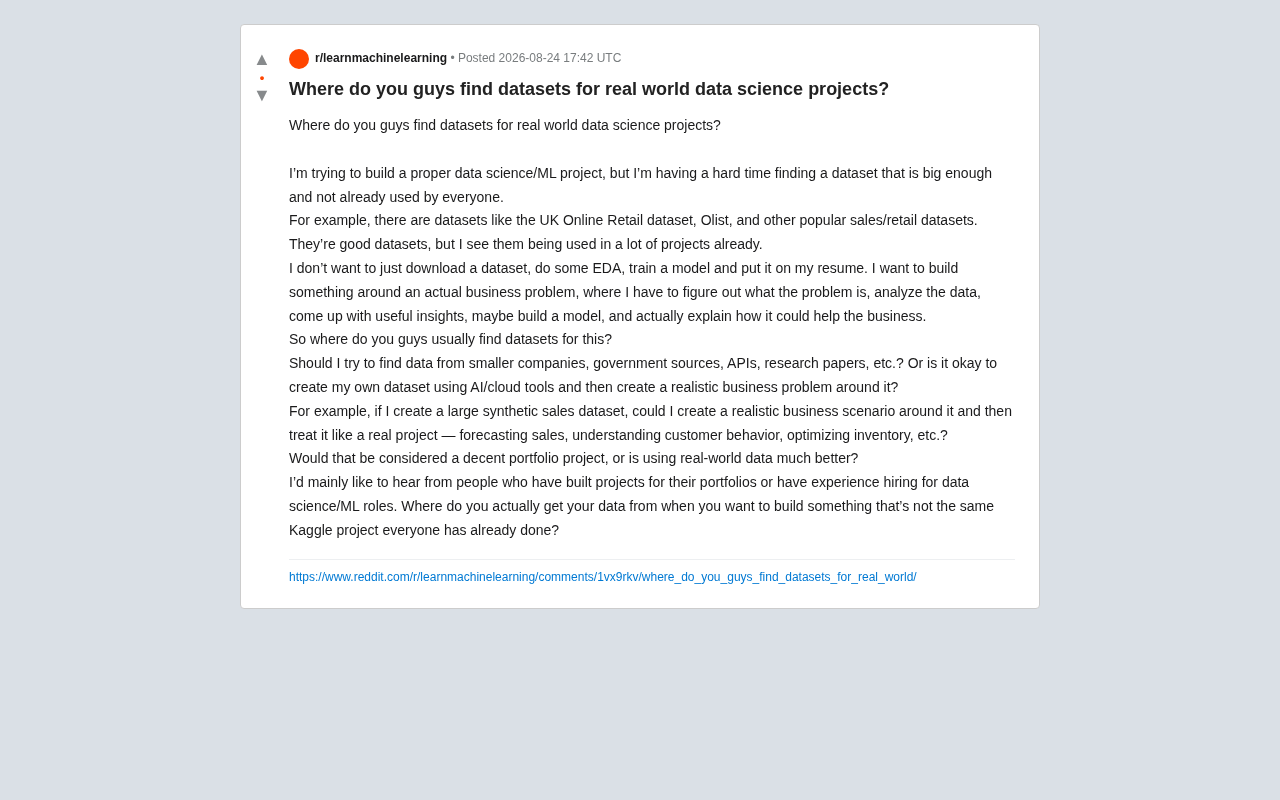
A Reddit user raised a question in the community that troubles many people: how to find datasets that are "large enough and haven't been overused" to build a project that truly revolves around a business problem. They listed common retail sales datasets like UK Online Retail and Olist, admitting that while these datasets are good, they've "been used in too many projects already."
The real core of this question isn't about "how rare the dataset is," but rather whether you can demonstrate a complete chain of thinking—from discovering problems, to analyzing them, to solving them. What hiring managers truly care about is whether you can work like a real data scientist, not just apply a ready-made modeling workflow.
Reliable Sources for Real-World Data
If you want to work with real-world data, the following categories of sources are worth exploring in depth. They can significantly reduce the chances of your project overlapping with someone else's.
Government and Public Open Data Platforms
Government open data platforms from various countries (such as data.gov in the US, the EU Open Data Portal, and local statistical agencies) provide massive amounts of real data covering transportation, energy, public health, economic indicators, and more.
The Open Data Movement originated in 2009 when the Obama administration launched data.gov, and has since expanded globally. To date, data.gov hosts over 300,000 datasets spanning topics from agricultural subsidies to airline delays. The EU Open Data Portal offers more than 1 million datasets from various European institutions. Domestically, provinces and cities have also been rolling out government data open platforms.
The advantage of this type of data lies in its large scale and authenticity, and it often requires you to handle cleaning and integration yourself—naturally building your data engineering skills. This data is typically provided in raw form, containing extensive missing values, inconsistent encodings, and messy formats, which closely simulates the real state of internal enterprise data. Being able to handle this "dirty data" is itself a highly valued skill in the industry, as it's estimated that data scientists spend 60%-80% of their working time on data cleaning and preprocessing. More importantly, few people are willing to invest time dealing with this "dirty" data, making it easier for your project to stand out.
Obtaining Dynamic Data Through Public APIs
APIs (Application Programming Interfaces) are an excellent way to obtain dynamic, time-series data and serve as the standard method for data exchange between modern software systems. In production data science environments, data rarely exists as static CSV files—instead, it's fetched in real time from various systems through REST APIs or GraphQL interfaces.
Whether it's weather APIs (like OpenWeatherMap), financial market APIs (like Alpha Vantage and Yahoo Finance), social media APIs (like the Twitter/X API), or music streaming APIs (like the Spotify API), they all allow you to build continuously updating data pipelines. Building projects through APIs means you need to handle real engineering challenges such as authentication (OAuth, API Keys), rate limiting, pagination, and data serialization (JSON/XML parsing).
Using APIs is itself a skill valued by employers because it closely mirrors how data is obtained in real production environments. You can even build a complete automated pipeline for scraping, storing, and analyzing data, demonstrating end-to-end engineering capabilities. If you can implement scheduled data fetching using Apache Airflow, Prefect, or simple cron jobs and store the data in a database, you've built a complete ETL (Extract-Transform-Load) pipeline—ETL refers to the extraction, transformation, and loading of data, which is a core process in data engineering—directly mirroring the daily work of data engineers in enterprises.
Academic Papers and Research Datasets
Many research papers publicly release their datasets. These datasets are typically designed for specific scientific or business problems and come with clear research context. Common academic dataset hosting platforms include the UCI Machine Learning Repository, Papers with Code, Zenodo, and Harvard Dataverse. Datasets on these platforms usually undergo rigorous quality control and come with detailed data dictionaries and collection methodology descriptions.
Building projects based on paper datasets not only gives you access to high-quality data but also helps you understand how problems are defined and evaluated through the papers themselves—this is the "problem framing" ability that many beginners lack. For example, you could reproduce a paper's core methodology and then attempt improvements using different algorithms or feature engineering. This "standing on the shoulders of giants" approach demonstrates both academic rigor and independent thinking.
Small Businesses and Real Business Scenarios
As the original post suggested, proactively reaching out to small businesses, local merchants, or non-profit organizations to solve their actual data problems is one of the most compelling approaches. While these projects have a higher barrier to access, once completed, they represent a unique, irreplicable piece of work with real business value. This practice is similar to the "pro bono" model used by consulting firms—you provide data analysis services to organizations in exchange for real project experience and references, which carries far more weight in job interviews than any Kaggle competition ranking.
Synthetic Data: Viable but Requires the Right Approach
The original poster raised an interesting question: can you use AI or cloud tools to generate a large synthetic sales dataset, then build a realistic business scenario around it for sales forecasting, customer behavior analysis, inventory optimization, and more?
The answer is: Yes, but it requires careful handling and shouldn't be your only approach.
Synthetic data has become an important topic in data science and privacy protection in recent years. According to Gartner's predictions, by 2030, the majority of data used in AI models will be synthetically generated. Current mainstream synthetic data generation methods include: rule-based parametric generation (using statistical distributions and business rules), GAN (Generative Adversarial Network)-based deep learning generation, and privacy-preserving synthesis using differential privacy techniques. In the Python ecosystem, SDV (Synthetic Data Vault) and Faker are two commonly used synthetic data libraries—the former can learn the statistical characteristics of real data and generate synthetic data that preserves correlations, while the latter focuses on generating realistic fictitious personal information. In enterprise practice, synthetic data is widely used in development testing environments, data augmentation, and privacy compliance scenarios.
However, the biggest risk of synthetic data in a job portfolio is "inauthenticity." If the data is randomly generated and lacks the correlations, seasonality, noise, and outliers found in the real world, then the "insights" derived from it are often meaningless—your model might be learning a pattern that you fabricated and that doesn't actually exist. If a hiring manager recognizes that the data was carelessly generated, it will actually raise doubts about your understanding of real-world data complexity. The key distinction is: are you demonstrating a deep understanding of the data generation process, or are you merely covering up your inability to obtain real data?
Three Prerequisites for Making Synthetic Data Valuable
If you do decide to use synthetic data, you should ensure the following:
- Model it based on real business logic: Include reasonable causal relationships, time trends, and customer segmentation features in the data rather than pure randomness. For example, a synthetic e-commerce dataset should reflect patterns like "weekend order volumes are higher than weekdays," "average order value drops during promotions but order volume surges," and "new customer first-order conversion rates are lower than returning customer repurchase rates"—patterns that align with business intuition.
- Clearly label the data source: Honestly state in your project documentation that the data is synthetic and explain your design rationale. Documenting the generation methods, parameter settings, and business assumptions you used is itself a demonstration of professionalism.
- Focus on methodology rather than conclusions: Synthetic data projects are better suited for showcasing your analytical framework, modeling approach, and engineering capabilities rather than "discovering some astonishing business insight." You can focus on model interpretability analysis, cross-validation strategy selection, and comparative evaluation of different algorithms.
In other words, synthetic data can be a tool for practicing and demonstrating skills, but real data is what proves your ability to handle real-world messiness.
What Determines a Project's Value Is Never the Dataset Itself
Whether you use real or synthetic data, what truly makes a data science portfolio stand out is your ability to define problems and craft a narrative.
Start from the Business Problem, Not the Data
The original poster already grasped the key point: they don't want to "download a dataset, do EDA, and train a model"—they want to "first figure out what the problem is, analyze the data, propose useful insights, and then explain how it helps the business." This business-oriented mindset is precisely the dividing line between a "data analysis exercise" and a "real data science project."
In enterprise environments, data science projects typically begin with a business pain point—rising customer churn rates, escalating supply chain costs, declining marketing ROI—rather than "I have a dataset." CRISP-DM (Cross-Industry Standard Process for Data Mining) is currently the most widely adopted methodology for data science projects, with its six phases being: Business Understanding, Data Understanding, Data Preparation, Modeling, Evaluation, and Deployment. Notably, "Business Understanding" is placed first, meaning that before touching any data, you need to clearly define business objectives and success criteria.
A good project should be able to answer: Why does this problem matter? If solved, what value does it bring to the business? How would your analytical conclusions influence decisions? What does model error cost in business terms? For example, in credit card fraud detection, false positives (flagging normal transactions as fraud) mean damaged customer experience and increased customer service costs, while false negatives (missing actual fraud) mean direct financial losses—understanding this asymmetric cost and adjusting model thresholds accordingly exemplifies a business-oriented mindset.
Tell a Complete Data Story
When evaluating portfolios, hiring managers often skim through them in just a few minutes. Therefore, a clear project narrative is crucial: from problem context, data acquisition, cleaning process, analytical findings, and modeling decisions, to final business recommendations—forming a complete logical loop.
Data Storytelling is the ability to transform data analysis results into a persuasive narrative, and it's listed as one of the most sought-after soft skills in the data science field by platforms like LinkedIn and Glassdoor. Its core framework typically consists of three elements: Data, Visuals, and Narrative—all three are indispensable. In practice, this means a good project report should not only demonstrate technical implementation but also answer the "So What" question. For example, instead of just saying "the model achieved an AUC of 0.92," say "the model can identify 78% of potential churning customers 14 days in advance while keeping the false positive rate under 5%, potentially recovering approximately $150,000 in revenue losses per quarter." This ability to translate technical metrics into business value is the fundamental distinction between a data scientist and a purely technical role.
A project that uses an ordinary dataset but tells a complete story with deep insights is far more convincing than one that uses a rare dataset but stays at the technical surface.
Conclusion: Data Is the Starting Point, Thinking Is the Destination
Finding a unique dataset is important, but it's only the first step in building an outstanding data science portfolio. The real challenge is—can you work like a true data scientist, centering your efforts around real business problems and telling a valuable story with data?
For those currently building their portfolios, it's recommended to prioritize government open data, public APIs, and research datasets—they're authentic and less likely to overlap with others' work. Synthetic data can serve as a supplement for skill demonstration, but it must be based on sound logic and honestly labeled. Regardless of which path you choose, always keep "what real problem does this project solve" at the core.
Ultimately, dataset selection is just the surface. What truly sets you apart in the job market is the complete chain of thinking you demonstrate: from identifying problems, acquiring data, cleaning and processing, analyzing and modeling, to translating results into actionable business recommendations. Every link in this chain tells hiring managers the same thing—you're ready to work like a professional data scientist.
Related articles

Chain of Thought Isn't Just for AI: How Humans Can Use CoT to Improve Thinking Quality
Chain of Thought isn't just a prompt trick for large models. Starting from a Hacker News discussion, this article analyzes why CoT works for human thinking too, breaks down actionable ways to transfer it, and highlights the key differences between human CoT and machine CoT.
Cloudflare Teams Up with OpenAI: Closi…
Cloudflare Teams Up with OpenAI: Closing the Loop from Vulnerability Discovery to Defense with AI
Cloudflare uses OpenAI Daybreak to investigate security vulnerabilities and generate reviewable remediation plans, while developers use Codex to boost coding efficiency and quality.

Orca Multi-Agent Orchestration in Practice: A Guide to Parallel Collaboration with Claude and Codex
Orca is Stable AI's free open-source agent workbench supporting 34 agents like Claude Code and Codex in parallel. Learn its Git worktree isolation, multi-model orchestration, and mobile management.