Where to Find Open-Source ML Communities? A Guide to Technical Discord Servers Worth Joining

A guide to open-source ML Discord communities like GPU MODE, Flash Linear Attention, and Marin worth joining.
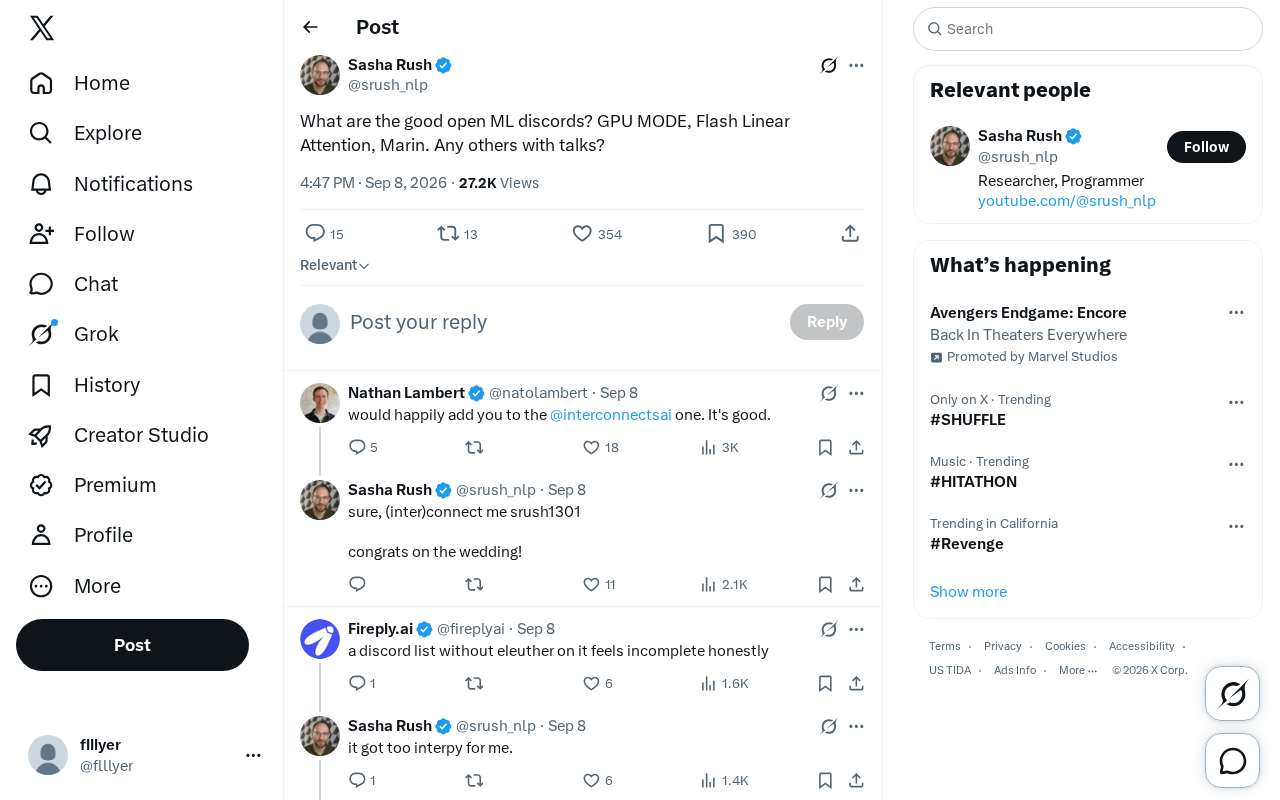
A developer's social media question about open-source ML Discord communities highlights three distinct options — GPU MODE (GPU programming & performance), Flash Linear Attention (cutting-edge attention algorithms), and Marin (collaborative open-source training) — with a focus on communities that host regular talks. The article argues that as AI evolves faster than papers can keep up, Discord communities have become essential for real-time knowledge and deep engineering discussions. It advises prioritizing small, focused communities with consistent technical content over large but shallow ones.
A Simple Question That Reveals the Value of Community-Based Learning
In an era of rapid machine learning iteration, official documentation and research papers often lag behind cutting-edge practice. A developer posed a very practical question on social media: which open-source machine learning Discord communities are worth joining? He listed a few he already knew — GPU MODE, Flash Linear Attention, and Marin — and specifically emphasized wanting communities that host talks (technical presentations).
The question seems trivial on the surface, but it touches on a core pain point for today's AI practitioners: the most advanced discussions, engineering details, and hands-on experience often don't live in papers — they circulate within active technical communities.
The Three Communities Mentioned Each Have a Distinct Focus
The three Discord communities in the original post represent three different technical directions within machine learning.
GPU MODE: The Hub for Low-Level Performance Optimization
GPU MODE is a community centered on GPU programming and deep learning performance optimization, attracting engineers focused on CUDA, Triton, and kernel optimization. For those who want to deeply understand how models run efficiently at the hardware level, this is a rare gathering place. The community regularly features in-depth discussions on operator optimization, memory management, and inference acceleration, along with frequent technical talks.
CUDA is NVIDIA's parallel computing platform and programming model — the de facto standard for hardware acceleration in deep learning. Triton is OpenAI's Python-style GPU programming language, designed to let researchers write high-performance kernels without mastering CUDA directly. GPU MODE has gained attention partly because the value of "operator-level optimization" has been amplified in the era of large models. When model architectures are converging, whoever can run core operators like matrix multiplication, attention computation, and normalization layers faster and with less memory directly controls training and inference economics. This kind of low-level optimization knowledge has a steep learning curve and is hard to extract from papers alone — making the community's code walkthroughs and hands-on sharing especially valuable.
Flash Linear Attention: Frontiers of Attention Mechanism Research
Flash Linear Attention, as the name suggests, focuses on linear attention mechanisms and their efficient implementation. As the cost of standard Transformer architectures on long sequences becomes increasingly problematic, alternatives like linear attention and state space models have become research hotspots. Communities like this tend to bridge academic researchers and systems engineers, with discussions skewing toward cutting-edge algorithms.
The standard Transformer's self-attention has O(n²) computational complexity — meaning doubling the sequence length quadruples the computation cost. This becomes extremely expensive when processing long documents, videos, or code files. Linear attention reduces this to O(n) through kernel function approximations, while Flash Attention takes a different approach: rather than changing the mathematical result, it dramatically reduces GPU memory bandwidth bottlenecks through tiled computation and IO-aware memory access patterns, achieving several-fold speedups. The name "Flash Linear Attention" combines both, signaling its focus on the intersection of linear complexity and efficient hardware implementation. Meanwhile, state space models (SSMs) like Mamba and RWKV — competitive alternatives to Transformers — are also frequently discussed in communities like this, representing a major direction in the evolution of sequence modeling architectures.
Marin: A More Practice-Oriented Open-Source Collaboration
Marin is relatively more focused on open-source model training and collaborative development. The value of communities like this lies in enabling distributed individual developers to participate together in large-scale model construction, sharing compute, data, and experience.
Why Developers Are Increasingly Relying on Discord Communities
The original post's emphasis on "with talks" reflects a broader trend: Discord has evolved from a simple chat tool into an important channel for disseminating machine learning knowledge.
Compared to traditional forums or mailing lists, Discord's real-time nature and low barrier to entry make technical exchange far more efficient. Many communities regularly organize paper readings, code walkthroughs, and expert Q&A sessions. The immediacy and interactivity of these activities cannot be replicated by static documentation. For practitioners navigating the fast-moving AI landscape, being able to access the latest engineering practices and research developments in real time is itself a competitive advantage.
Notably, these high-quality communities are often self-organized — forming around a specific technical area or open-source project, attracting a group of high-caliber contributors. They fill the gap between official channels and individual learning.
How to Find the Right Technical Community for You
If you're also looking for similar open-source machine learning communities, there are a few angles to consider: first, follow the open-source projects you're already using — many have their own official Discord servers; second, pay attention to recommendations from researchers and engineers on social media, since word-of-mouth is typically more reliable than advertising; third, prioritize communities with regular technical talks, because "having talks" signals ongoing knowledge production and active core members.
It's worth noting that community quality varies significantly, and larger doesn't mean better. The truly valuable ones are small, focused communities where discussions go deep and members are willing to share substantive insights.
Conclusion
This brief help-seeking post actually reflects a broader shift in how machine learning is learned — moving away from studying papers and documentation in isolation, toward joining active technical communities and acquiring cutting-edge knowledge through real-time exchange. GPU MODE, Flash Linear Attention, and Marin are just a few examples. Around hardware optimization, algorithmic frontiers, open-source collaboration, and other directions, there are many more communities worth discovering. For every AI practitioner, finding and deeply engaging with a high-quality technical community may prove more rewarding than reading ten papers.
Related articles

Chain of Thought Isn't Just for AI: How Humans Can Use CoT to Improve Thinking Quality
Chain of Thought isn't just a prompt trick for large models. Starting from a Hacker News discussion, this article analyzes why CoT works for human thinking too, breaks down actionable ways to transfer it, and highlights the key differences between human CoT and machine CoT.
Cloudflare Teams Up with OpenAI: Closi…
Cloudflare Teams Up with OpenAI: Closing the Loop from Vulnerability Discovery to Defense with AI
Cloudflare uses OpenAI Daybreak to investigate security vulnerabilities and generate reviewable remediation plans, while developers use Codex to boost coding efficiency and quality.

Orca Multi-Agent Orchestration in Practice: A Guide to Parallel Collaboration with Claude and Codex
Orca is Stable AI's free open-source agent workbench supporting 34 agents like Claude Code and Codex in parallel. Learn its Git worktree isolation, multi-model orchestration, and mobile management.