Which AI Agent Framework Should You Choose? A Production-Grade Pitfall Guide to 7 Leading Frameworks

A production-grade teardown of 7 AI Agent frameworks with a decision matrix to match your team's stack.
This article tackles the classic Agent developer pain point — perfect local tests, catastrophic production failures — and traces the root cause to missing guardrails and boundary controls. It dissects seven leading frameworks (LangChain, CrewAI, Microsoft MAF, LlamaIndex Workflows, Google ADK, OpenAI Agents SDK, and Mastra), exposing their production pitfalls: state loss on container restart, silent API cost spikes, and uncontrolled token burn. The core conclusion: framework selection is an engineering constraints problem, not a popularity vote. Long-term system survival depends on a rigorous observability and evaluation loop — track, evaluate, improve, repeat.
From Local Success to Production Meltdown: Every Agent Developer's Nightmare
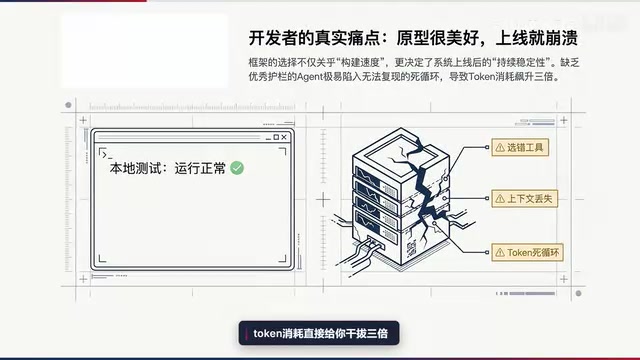
Most developers have been there: green checkmarks everywhere, local tests passing flawlessly, a genuine sense of accomplishment. Then the moment you deploy to a server, everything falls apart — context vanishes without a trace, Agents spin into infinite loops, and token consumption triples overnight. Your manager takes one look at the bill and schedules a very uncomfortable meeting.
The root cause usually isn't a weak framework. It's the absence of strict boundary controls and guardrails. Without boundaries, an Agent will gleefully burn through your budget in an endless loop. That's exactly why a "perfect local prototype" can hemorrhage tokens like a leaky faucet once it hits production.
As analyzed in several in-depth technical breakdowns, the Agent framework space is extraordinarily crowded right now — from LangChain to CrewAI to Google ADK, it's an all-out war of heavyweights. The real question is: among all these impressive-sounding new tools, which ones are actually production-ready?
Set Hard Standards Before Picking a Framework
Before you get dizzy from the buzzword avalanche, you need to get clear on your evaluation criteria. A common mistake is equating "clean abstractions" with "real productivity."
Beware the over-abstraction trap. Once an abstraction layer hides the underlying failure modes, your debugging time will far exceed whatever setup time you saved. Real productivity means the framework can reliably handle real production load with built-in persistent execution — not something you have to bolt together from a dozen external systems.
In other words, evaluating an Agent framework means looking at how it performs under real traffic, state management, and failure recovery — not how smoothly it runs in a demo.
Seven Leading Frameworks, Dissected
LangChain Ecosystem: The Swiss Army Knife for Cross-Model Prototyping
The open-source all-rounder, LangChain is the go-to choice for cross-model prototyping. But as complexity grows and you bring in LangGraph for multi-step loops and state management, watch your dependency tree carefully. Version conflicts alone can push you to the edge of sanity.
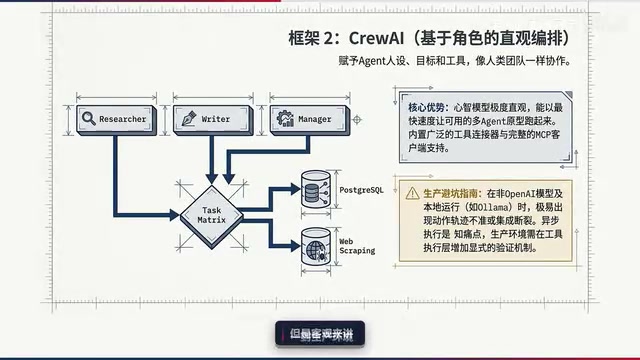
CrewAI: Intuitive Role Mapping
CrewAI's design philosophy feels like staffing a startup — assign roles and goals to each Agent, and you can get a multi-agent prototype running fast. But in production, if you swap OpenAI for another non-local model, action trajectories can go sideways. You'll need to explicitly add your own validation mechanisms before going live.
Microsoft MAF: Unified Ecosystem
MAF is a power fusion of AutoGen and Semantic Kernel. If your team is deeply invested in the Microsoft stack, it comes with guardrails like prompt injection defense built in — practically a dream framework. That said, if you're not on Azure infrastructure, you may face some painful low-level adaptation work.
LlamaIndex Workflows: The Data Pipeline Champion
This one's hardcore — no DSL, pure native event-driven design throughout. For document-heavy workloads or data processing pipelines, it's the undisputed champion. The tradeoff: step outside the LlamaIndex ecosystem and you're writing massive amounts of boilerplate code. Known issues with concurrent execution can also be genuinely frustrating.
A note on Event-Driven Architecture: This is the core design philosophy of LlamaIndex Workflows. Unlike sequential calls or DSL-based orchestration, each processing node in an event-driven model only responds to specific event types, with nodes decoupled through asynchronous message passing. This means document parsing, vector retrieval, and summarization can be triggered in true parallel rather than serial sequence. The tradeoff is debugging complexity — when race conditions or lost events occur in concurrent execution, tracing the problem is significantly harder than with synchronous calls. The absence of DSL also means no visual flowcharts or declarative configuration; developers must hand-write all state transition logic in pure Python, raising both the onboarding cost and ongoing maintenance burden.
Google ADK: Cloud-Native Out of the Box
GCP-native, ready to run, with built-in debugging — sounds great. But here's the critical pitfall: if you deploy on Cloud Run, in-memory state evaporates the moment a container restarts. Going live without configuring external persistent storage is essentially planting a ticking time bomb.
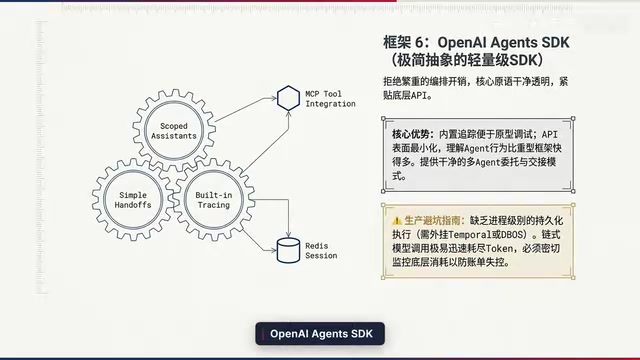
OpenAI Agents SDK: Minimal and Transparent
Clean, minimal, and highly transparent — you can see exactly what's happening at the API level. But without a process-level persistent execution tool like Temporal, chained model calls will drain your token quota like a pump. You'll need to watch your bill obsessively to prevent budget blowouts.
What is Temporal? Temporal is an open-source workflow orchestration engine designed to solve persistent execution in distributed systems. Its core capability is "workflow as code" — developers describe business logic with ordinary functions, and Temporal automatically persists execution state to a storage backend. Even if the process crashes, the server reboots, or the network drops, the workflow resumes from exactly where it left off instead of starting over. In LLM Agent scenarios, this means a long task requiring a dozen model calls doesn't need to re-consume all those tokens after a mid-run failure — dramatically reducing retry costs. Frameworks lacking this mechanism face a brutal double penalty when things go wrong: the task is lost and the bill has already been charged.
Mastra: The Production-Grade Choice for TypeScript Teams
Built for TS teams, with frontend connectors out of the box and TypeScript as a first-class citizen. But there's a hidden gotcha: if you don't use its default memory settings, Mastra will silently trigger model compression in the background as conversation volume grows — and your API costs will quietly spike without warning.
Decision Matrix: Framework Selection Is an Engineering Constraints Problem
After dissecting all seven, the conclusion is clear — even the best tool is useless if it doesn't match your team's DNA. Use this decision checklist to find your fit:
- Heavy Microsoft dependency → MAF
- GCP cloud-native → Google ADK
- Frontend TypeScript team → Mastra
- Daily data processing work → LlamaIndex
- Need intuitive role mapping → CrewAI
- Prefer minimal, low-level control → OpenAI Agents SDK
- Need cross-model flexibility → LangChain
Framework selection is fundamentally an engineering constraints problem, not a popularity contest. When the framework matches your team's DNA, everything moves faster.
What Really Decides Survival: The Observability and Evaluation Loop
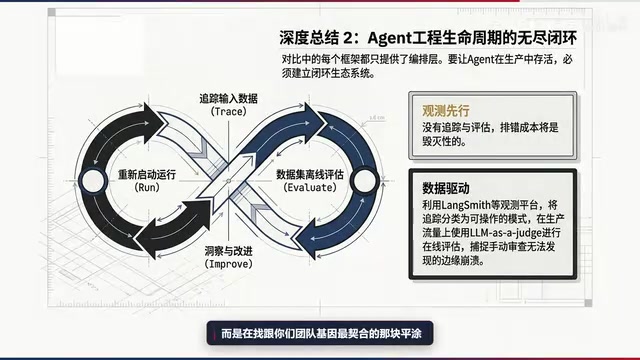
Never forget this: no matter how sophisticated your chosen framework is, it's ultimately just an orchestration layer. What actually keeps an Agent alive in the brutal reality of production is a rigorous engineering feedback loop:
- Track input data
- Run offline evaluations
- Extract insights and improve edge case handling
- Restart and iterate
This loop never ends. In Agent development, observability must come first. Without a platform like LangSmith tracking data in the background and using LLMs as online evaluation judges, debugging costs when facing massive, unpredictable real-world traffic will be catastrophic.
One final piece of hard-won advice: stop letting the illusion of a perfect local environment fool you. Embrace open standards like MCP as soon as possible, and invest your energy in workflow orchestration and state persistence. Without that solid foundation, everything else is built on sand.
The framework you choose determines how fast you can build today. Your observability and evaluation system determines how far your system can go tomorrow.
Tooling note: LangSmith is an LLM application observability platform from the LangChain team, built for tracing, debugging, and evaluating LLM-based applications. It automatically records every LLM call's inputs, outputs, latency, token usage, and intermediate reasoning chains, creating a fully traceable tree. In Agent scenarios this is critical — when a multi-step Agent hallucinates or drifts off course, LangSmith can pinpoint exactly which prompt or tool call went wrong, rather than leaving you with only the final error output. MCP (Model Context Protocol) is an open protocol standard championed by Anthropic, designed to unify the interface spec between LLMs and external tools and data sources. It allows Agents built on different frameworks to interoperate through a standard protocol, avoiding the fragmented ecosystem of every framework building its own proprietary connector layer.
Related articles

Should U.S. College Fraternities Be Banned? A Researcher's Incisive Observations
Why not just ban U.S. college fraternities? A researcher finds the key resistance comes from decision-makers' own fraternity identities and schools' "willful ignorance."

Microsoft Discovery: Accelerating Scientific Discovery with AI Agents
Microsoft's Discovery platform runs specialized AI agents to help researchers screen and prioritize the most promising compounds and experimental paths, reducing experiments and accelerating scientific discovery.

Cambridge Heavy Industries Secretly Develops Desktop-Scale Nuclear Fusion Device
Cambridge Heavy Industries is secretly developing a desktop-scale laser-driven nuclear fusion device, targeting the equipment supply market for fusion power plants. This article analyzes its miniaturization technology path, commercialization logic, and unique positioning in the fusion startup wave.