Which Book Should You Pick to Start Programming? Learning Paths and Free Resources for Beginners

A guide to building programming fundamentals with free resources, the right mindset, and hands-on practice.
Programming beginners often search for one perfect book to master all the basics, but true programming ability comes from building correct mental models and writing code. This article explains what programming fundamentals really mean, recommends free resources like Automate the Boring Stuff with Python and Harvard's CS50, and shares practical advice on project-driven learning to build a solid foundation at minimal cost.
The Classic Beginner's Dilemma
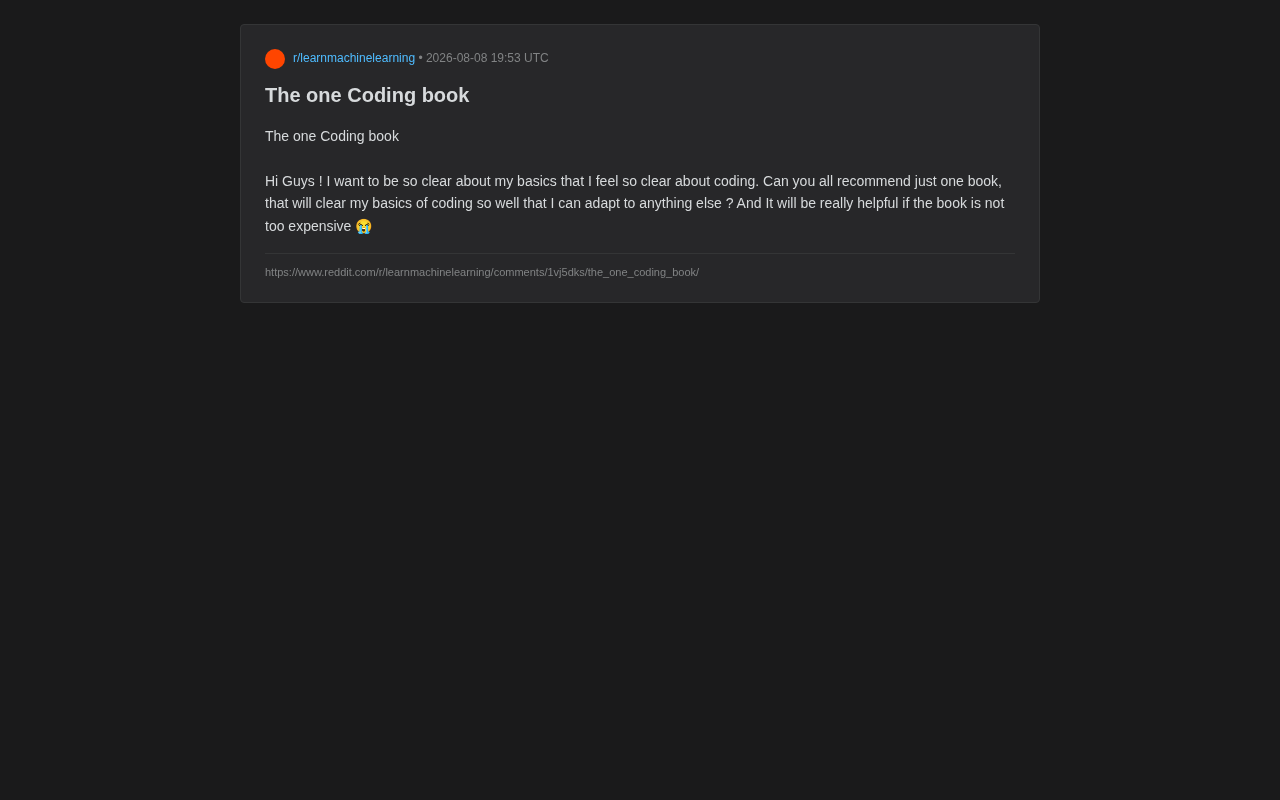
In programming learning communities, one type of question pops up almost every week: "Can you recommend one book that will help me thoroughly understand programming fundamentals, so I can easily adapt to learning anything afterward?" Recently, a learner on Reddit made exactly this request — hoping to find a book that covers the basics thoroughly enough to give them "clarity about programming," without breaking the bank.
Behind this question lies an anxiety every programming beginner experiences: faced with an ocean of tutorials, languages, and frameworks, where exactly should you start to build a truly solid foundation? This article isn't going to simply hand you a reading list. Instead, I want to use this question as a springboard to discuss what "programming fundamentals" really means and how to learn them effectively at minimal cost.
"One Book to Rule Them All" Is a Beautiful Misconception
Let's be honest upfront: no single book can prepare you for everything. Programming skills aren't acquired by finishing one book — they're built through continuously writing code, making mistakes, and debugging. Expecting one book to solve all your problems is a common cognitive bias among beginners.
But that doesn't mean choosing the right book doesn't matter. A good introductory programming book helps you build the right mental model — understanding the essence of concepts like variables, control flow, data structures, and function abstraction, rather than memorizing the syntax of a particular language.
A mental model is a core concept in cognitive science, referring to an internal representation of how the external world works. In programming, your mental model determines how you understand code execution — for instance, whether you can mentally "simulate" a loop executing step by step, or imagine how arguments are passed during a function call. Research shows that learners with accurate mental models can reason their way to solutions much faster when facing new problems, while those with flawed mental models tend to make the same types of mistakes repeatedly. Building a correct programming mental model is far more important than memorizing syntax details.
The concepts mentioned — variables, control flow, data structures, and function abstraction — form the skeleton of virtually every programming language. Variables are a way of naming data, essentially aliases for storage locations in memory. Control flow determines the order of program execution — the three basic structures of sequence, branching (if/else), and loops (for/while) can express arbitrarily complex logic, a fact proven by computer scientists Böhm and Jacopini in their 1966 structured programming theorem. Data structures are ways of organizing and storing data, and different structures (arrays, linked lists, hash tables, trees, etc.) exhibit vastly different performance characteristics in different scenarios. Function abstraction encapsulates repeated logic into reusable modules — it's the core mechanism for managing program complexity and a critical step in progressing from "writing code that runs" to "writing code that's maintainable."
What's truly "universal" isn't a book — it's these underlying ways of thinking about programming. Once you understand "what a loop is," "why we encapsulate functions," and "how data flows through memory," switching to any new language is simply learning a new way to express the same ideas.
So rather than searching for "that one magic book," adjust your goal to: find a book that helps you build programming thinking and forces you to write code.
What Makes a Book Truly "Thorough on Fundamentals"
Concepts First, Not Syntax Overload
Many so-called "beginner books" are really language reference manuals that list syntax features page by page. These are of limited help for building programming fundamentals. A truly good introductory book explains "why" before "how." For example, before introducing loops, it first helps you understand where the need for repeated execution comes from.
Hands-On Exercises: Read and Write Simultaneously
Programming is a practical discipline. If a book offers only reading with no exercises, it's almost as good as unread. When choosing a book, prioritize those that include exercises, projects, or thought questions at the end of each chapter. Ideally, after finishing each chapter, you should be able to write several dozen lines of working code.
Be Pragmatic About Language Choice
For absolute beginners, Python is usually the most friendly starting point — clean syntax, mature ecosystem, and abundant community resources.
Python was released by Guido van Rossum in 1991, with a design philosophy emphasizing code readability and simplicity ("There should be one obvious way to do it"). It uses indentation rather than curly braces to define code blocks, which forces beginners to develop good formatting habits. Python's ecosystem is enormous: data science has NumPy, Pandas, and Scikit-learn; web development has Django and Flask; automation has Selenium and Requests; and artificial intelligence has PyTorch and TensorFlow. This means the foundation you build with Python can extend directly into virtually any technical direction. Additionally, Python has one of the most active developer communities in the world — Python-related Q&A on Stack Overflow consistently ranks among the highest, and beginners can almost always find existing answers to their questions.
If your goal is a systematic understanding of computer science, you might also consider starting with a lower-level language, but for the vast majority of people, Python strikes the best balance between "solid fundamentals" and "fast ramp-up."
Low-Cost and Even Free Programming Resources
The original poster specifically mentioned wanting an affordable book, and this is entirely achievable. In fact, the programming field boasts some of the richest free learning resources in the world:
-
Free online books: Classic programming introductions like Automate the Boring Stuff with Python and Think Python are available in completely free online versions provided by their authors. The former is especially well-suited for absolute beginners, using real-world automation tasks to spark learning motivation. Automate the Boring Stuff with Python, written by Al Sweigart, follows a core teaching philosophy of "pragmatism-driven" learning — rather than presenting abstract theory first and examples second, it starts from real everyday pain points (like batch-renaming files, auto-sending emails, processing Excel spreadsheets), allowing learners to naturally acquire programming concepts while solving practical problems. This approach is particularly effective for learners without a computer science background, because it immediately demonstrates the practical value of programming, significantly reducing the risk of motivation loss. The book is published under a Creative Commons license, making it freely readable online in its entirety.
-
Interactive platforms: Free platforms like freeCodeCamp and The Odin Project offer complete learning paths from zero to project completion, with hands-on coding and instant feedback.
-
Open courseware: Harvard's CS50 is universally recognized as one of the best free introductory programming courses in the world. The instructor is charismatic, the content balances depth with engagement, and it covers the core foundational ideas of computer science. CS50 (Introduction to Computer Science), taught by Professor David Malan, is one of the most enrolled courses on Harvard's campus. The course is freely available worldwide through the edX platform, with cumulative enrollment in the millions. What makes CS50 unique is that it doesn't lock you into a single programming language — the course starts with Scratch (visual programming), transitions to C for low-level memory management, moves to Python for high-level abstraction, and finishes with SQL, HTML/CSS, and JavaScript. This multi-language progression helps learners truly understand that "languages are just tools; thinking is what matters." The course also includes extensive high-quality programming assignments (Problem Sets), each carefully designed to ensure learners develop deep understanding of specific concepts upon completion.
In other words, budget should never be a barrier to learning programming. What's truly scarce has never been materials — it's sustained focus and hands-on practice.
Three Things More Important Than "Which Book to Pick"
1. Start Immediately — Don't Fall into "Book Selection Paralysis"
Many people spend weeks agonizing over which book or language to choose, yet never write their first line of code. This is the most classic waste of time. Just pick any well-reviewed free book and get started — 99% of your real growth in programming comes from time spent at the keyboard, not time spent selecting materials.
2. Let Projects Drive Your Learning
After finishing the introductory chapters, set yourself a small project as soon as possible: a calculator, a to-do list, a small script that scrapes web data. Learning with a goal in mind will naturally help you discover gaps in your knowledge, and your learning efficiency will far surpass passive reading.
Project-driven learning isn't just a trendy educational buzzword — it has solid grounding in cognitive science. According to constructivist learning theory, knowledge isn't passively received but acquired through active meaning-making by the learner. When you learn with a specific project goal (like "build a command-line weather checker"), your brain automatically builds associative networks between knowledge points, forming more durable memories. Furthermore, project-based learning creates what psychologists call "desirable difficulties" — the roadblocks and errors you encounter while solving real problems may be frustrating in the moment, but these very difficulties force your brain into deep processing, ultimately forming more robust understanding. This is also why there's such a vast gap between "being able to read code" and "being able to write code."
3. Embrace the "Always Learning" Mindset
The programming industry evolves rapidly, and no single book can serve you forever. True experts maintain a lifelong learning habit. "Building a solid foundation" is essentially about cultivating the ability to "quickly get up to speed with new things" — and this ability can only be honed through continuously solving real problems.
Conclusion
Returning to that Reddit learner's question: if I had to give one answer, I'd recommend starting with the free Automate the Boring Stuff with Python alongside the CS50 course — together they thoroughly cover fundamental programming thinking at virtually zero cost. But the more important advice is: stop waiting for "the perfect book" — open your editor today and write your first program.
Programming fundamentals aren't learned by reading. They're learned by writing.
Related articles

Chain of Thought Isn't Just for AI: How Humans Can Use CoT to Improve Thinking Quality
Chain of Thought isn't just a prompt trick for large models. Starting from a Hacker News discussion, this article analyzes why CoT works for human thinking too, breaks down actionable ways to transfer it, and highlights the key differences between human CoT and machine CoT.
Cloudflare Teams Up with OpenAI: Closi…
Cloudflare Teams Up with OpenAI: Closing the Loop from Vulnerability Discovery to Defense with AI
Cloudflare uses OpenAI Daybreak to investigate security vulnerabilities and generate reviewable remediation plans, while developers use Codex to boost coding efficiency and quality.

Orca Multi-Agent Orchestration in Practice: A Guide to Parallel Collaboration with Claude and Codex
Orca is Stable AI's free open-source agent workbench supporting 34 agents like Claude Code and Codex in parallel. Learn its Git worktree isolation, multi-model orchestration, and mobile management.