Which Coursera Advanced AI Courses Are Worth as Much as an Internship? Top Picks

How to choose and use Coursera AI courses to build internship-level career skills.
This article examines whether advanced Coursera courses in MLOps, Generative AI (RAG, fine-tuning), and Deep Learning can rival real internship experience. It breaks down how to evaluate a course's value across three dimensions and offers three practical strategies — building beyond course boundaries, publishing your work publicly, and simulating real-world constraints — to maximize career impact.
The Core Question: Can Courses Replace Internships?
In a Reddit discussion, a learner raised a question that cuts right to the heart of the matter: What are the most valuable non-introductory (AI + domain) courses on Coursera? And can they rival a real company internship?
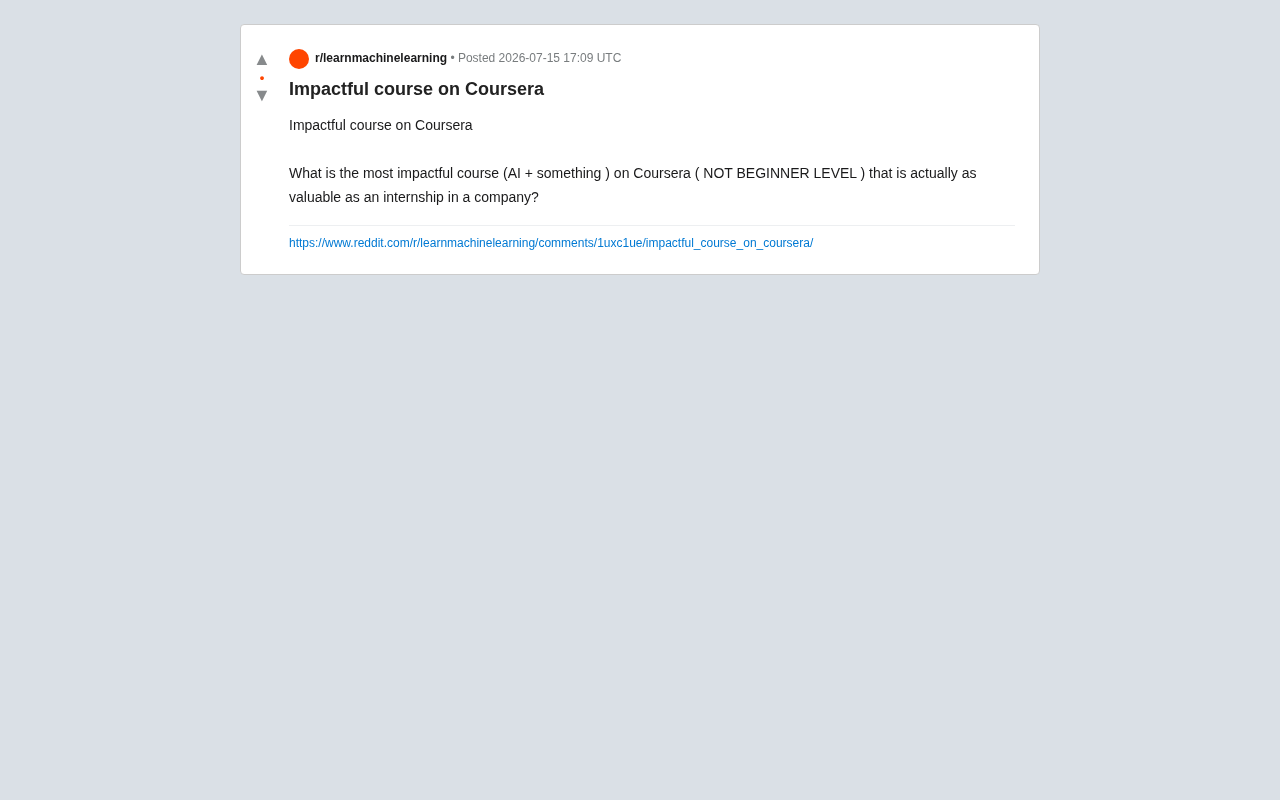
This question reflects a widespread anxiety among AI learners today: there's no shortage of online courses, but very few actually translate into career competitiveness. The job market values hands-on ability, and internships are valuable precisely because they offer real project scenarios, team collaboration, and the experience of shipping things in production. So what qualities does an online course need to approach the caliber of an internship?
Why Most Online Courses Struggle to Replace Internships
Let's face a hard truth first: the vast majority of online courses cannot fully replace an internship. Internships provide more than technical training — they offer workplace soft skills, decision-making experience under real business constraints, and a company name you can put on your resume.
But that doesn't mean courses are meaningless — what matters is their depth and practical rigor. Introductory courses tend to stop at conceptual explanations and toy-level examples. Finishing one leaves you saying "I've heard of this," not "I can do this." A truly valuable advanced AI course should walk you through an end-to-end project: handling messy data, debugging models, deploying to production, and navigating the trade-offs between performance and cost.
Three Dimensions for Evaluating a Course's Value
- Project complexity: Does it require you to independently complete a near-production project, rather than filling in code blanks?
- Engineering depth: Does it cover model deployment, monitoring, MLOps, and other real-world essentials you can't avoid on the job?
- Transferability: Do the skills map directly to the requirements listed in job descriptions?
Advanced AI Directions on Coursera Worth Focusing On
Based on community discussions and the actual demands of AI roles, the following areas offer courses closest to "internship-level" value.
1. MLOps and Machine Learning Engineering
Knowing how to train a model is no longer enough to stand out in the job market. Companies need people who can get models into production and keep them running reliably. The Machine Learning Engineering for Production (MLOps) Specialization by DeepLearning.AI on Coursera systematically covers data pipelines, model deployment, continuous integration, and monitoring — exactly the engineering practices you'd encounter most in an internship.
MLOps (Machine Learning Operations) extends DevOps principles to the machine learning domain. It emerged around 2018 and quickly became an industry necessity as companies began deploying AI models at scale. The core challenge is this: traditional software code is deterministic, but an ML system's behavior also depends on data distribution. When production data drifts (Data Drift), model performance silently degrades — far harder to detect than a program crash. The MLOps ecosystem therefore covers feature pipelines, model versioning, A/B testing frameworks, online monitoring, and automated retraining. According to a Google research report, in a production ML system, the actual model training code often accounts for just 5% of the total engineering effort — the other 95% is supporting infrastructure. This explains why candidates who only know how to build models have limited competitiveness at the enterprise level. Mastering this skill set can significantly narrow the gap between the classroom and the workplace.
2. Generative AI and Large Language Model Applications
With LLMs (Large Language Models) now at the center of industry attention, advanced content around Prompt Engineering, RAG (Retrieval-Augmented Generation), and model fine-tuning has enormous practical value — essentially a hard currency for current AI application roles.
RAG (Retrieval-Augmented Generation) was formally introduced as an architectural paradigm by Meta AI researchers in 2020. Its core idea is to combine an LLM's parametric knowledge with the retrieval capabilities of an external knowledge base, addressing the hallucination problem and knowledge cutoff limitations of LLMs. A typical RAG pipeline works like this: documents are chunked and vectorized via an embedding model, then stored in a vector database (such as Pinecone, Weaviate, or Chroma); when a user submits a query, relevant document chunks are retrieved first, then injected into the prompt as context, guiding the LLM to generate answers grounded in real sources. Vector databases are designed for efficient storage and semantic similarity search over high-dimensional vectors, typically relying on approximate nearest neighbor algorithms (ANN, such as HNSW or IVF) — enabling them to recognize that "automobile" and "car" are semantically similar rather than relying on literal string matching. RAG has been deployed at scale in enterprise knowledge base Q&A, legal document analysis, codebase assistants, and more. It's become a standard architectural pattern for AI application development post-2023 and one of the most frequently appearing technical keywords in AI engineering job postings. Prioritize courses that require you to build a complete application — such as a vector database–backed Q&A system — whose output can go directly into your portfolio.
3. Specialized Deep Learning Domains
Whether it's computer vision, natural language processing, or recommendation systems, an advanced course that has you reproducing classic papers and working with real datasets can be just as rigorous as a research internship. DeepLearning.AI's Deep Learning Specialization and its follow-on NLP and CV specializations have long been regarded by the learning community as high-quality options.
How to Get Internship-Level Results from a Course
A course is just raw material. Whether it produces internship-level value depends on how the learner uses it.
First, go beyond the course boundaries with your projects. Course assignments are carefully designed to be manageable. Real growth comes from applying what you've learned to projects you define yourself — sourcing your own data, scoping your own problems, and hitting your own stumbling blocks.
Second, make your work public. In AI and software engineering, GitHub has evolved from a code hosting platform into a de facto technical resume. Hiring managers and technical interviewers increasingly review a candidate's GitHub profile before a formal interview, assessing actual engineering habits through commit frequency, README completeness, and code quality. A project with genuine stars, forks by others, or a live deployment carries far more signal than a screenshot of a certificate. Meanwhile, a technical blog demonstrates a candidate's ability to structure and communicate technical problems — a soft skill that's considered genuinely rare at senior levels. There's also a hidden benefit to making your work public: the act of writing and deploying forces you to fill in knowledge gaps, often making it a more effective learning activity than passively watching course videos. Put your projects on GitHub, write them up as technical blog posts, or deploy them as accessible demos — this kind of tangible evidence is far more persuasive in interviews than a certificate ever will be.
Third, simulate real constraints. Try completing tasks with limited compute, incomplete data, and ambiguous requirements — that's the authentic texture of an internship.
Conclusion: Courses Are Leverage, Not a Substitute
Back to the original question: no single Coursera course can fully equal an internship. The value of an internship lies in its irreplaceable authenticity and workplace immersion. But a high-quality advanced AI course, paired with active project work and a track record of tangible output, can absolutely serve as a powerful lever for unlocking career opportunities.
For learners who can't access an internship right now, rather than agonizing over "which course is best," it's more productive to focus on how to convert course knowledge into demonstrable, practical work. The ultimate proof of a skill is what you've built — not what you've studied.
Key Takeaways
Related articles

Felix Rieseberg Personal Homepage
Felix Rieseberg's personal homepage sparks attention on Hacker News. This article covers the Slack engineer's technical background, the rise and fall of nativefier, and the value of a developer homepage as a tech calling card.

@ai-sdk/vue 3.0.306 Patch Release Syncs with [email protected] Update
@ai-sdk/vue 3.0.306 released, synced with [email protected]. A routine patch release for the Vercel AI SDK ecosystem with no public API changes; the Vue adapter layer stays version-aligned with the core package.

Gemini 4 Argon API Launches: The Era of Million-Token Output Begins
Google launches Gemini 4 Argon with sparse MoE architecture, up to 1M output tokens, and a 68.90% Vals Index score, available across API, AI Studio, and the Gemini app.