Which Machine Learning Concepts Are Actually Worth Learning? A Priority Guide from Fundamentals to the Frontier

A priority guide to which ML concepts are truly worth your time, from fundamentals to the frontier.
Facing concept overload in machine learning, this article identifies the core ideas worth investing in — transfer learning, contrastive learning, generative modeling, Bayesian thinking, and score matching — and distinguishes them from specialized or theoretical directions better saved for later. It offers a practical learning framework: build foundational understanding first, learn around real problems, and recognize the deep connections between seemingly separate concepts.
A Confusion Every ML Learner Encounters
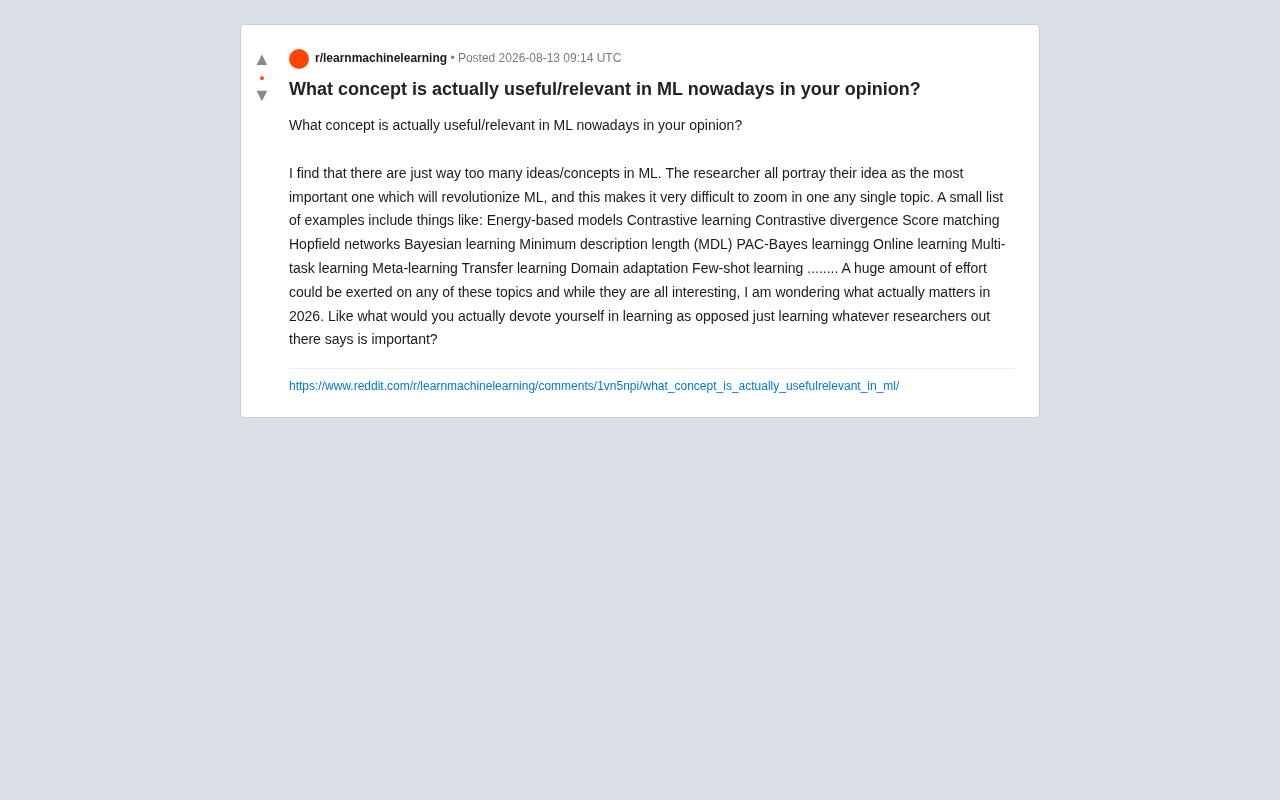
One of the most anxiety-inducing realities in machine learning is the sheer bloat of concepts. Recently, a Reddit user posed a question that resonated widely: "In today's machine learning landscape, which concepts are actually useful and relevant?"
They admitted that the ML field is overflowing with ideas and concepts, and every researcher tends to portray their own direction as "the key to revolutionizing machine learning." This atmosphere makes it difficult for both beginners and practitioners to stay focused. They casually listed a daunting inventory:
- Energy-based models
- Contrastive learning
- Contrastive divergence
- Score matching
- Hopfield networks
- Bayesian learning
- Minimum Description Length (MDL)
- PAC-Bayes learning
- Online learning, multi-task learning, meta-learning, transfer learning, domain adaptation, few-shot learning…
Their core question was intensely practical: "All these directions are interesting, but what's actually important? Where should I invest my energy, instead of blindly following what researchers claim is 'important'?"
Why Are There So Many "Seemingly Important" Concepts?
To answer this question, we first need to understand the root cause of concept inflation in ML. The academic evaluation system inherently incentivizes "novelty" — every paper needs to argue that it solves a problem others haven't, or proposes a new framework. This leads to countless concepts being repackaged, renamed, or simply presented as variants of the same idea in different contexts.
In fact, many concepts on the list above share deep mathematical connections. For example, score matching is actually one of the theoretical foundations of today's Diffusion Models; energy-based models and contrastive divergence are closely related in their training objectives; and contrastive learning is one of the core techniques in self-supervised representation learning. They aren't isolated "competitors" but rather different regions on the same knowledge map.
Energy-Based Models and Contrastive Divergence: Insights from Statistical Physics
The core idea behind Energy-based Models (EBMs) traces back to the Boltzmann distribution in statistical physics. It models data as an energy function: low-energy states correspond to high-probability data configurations, while high-energy states correspond to low-probability ones. The training objective is to adjust the energy function's parameters so that observed data sits at the energy minimum. However, the biggest challenge EBMs face is computing the partition function — a normalization constant that requires summing over all possible states, which is typically intractable in high-dimensional spaces. Geoffrey Hinton's Contrastive Divergence, proposed in 2002, was designed precisely to sidestep this difficulty: it uses short-run Markov Chain Monte Carlo (MCMC) sampling to approximate the gradient, dramatically reducing the computational cost of training. This method enabled Restricted Boltzmann Machines (RBMs) and Deep Belief Networks to become pioneers of the deep learning renaissance around 2006. Understanding this history helps us see the true origins of many "new" concepts today.
From Score Matching to Diffusion Models: An Underappreciated Theoretical Thread
Score matching was proposed by Aapo Hyvärinen in 2005, with the core idea of bypassing the partition function to directly estimate the gradient of the log-probability of the data distribution (i.e., the "score"). In 2019, Yang Song and Stefano Ermon combined score matching with Langevin dynamics to propose score-based generative models. Almost simultaneously, Jonathan Ho et al. introduced Denoising Diffusion Probabilistic Models (DDPM), whose core approach is to gradually add noise to data until it becomes pure noise, then train a neural network to learn the reverse denoising process. Researchers later proved that DDPM's training objective is mathematically equivalent to score matching — the network learns the score function at various noise levels. This unified perspective gave rise to the theoretical foundation behind today's generative systems like DALL-E, Stable Diffusion, and Sora, vividly illustrating how seemingly different concepts often converge on the same destination.
In other words, the key question isn't "which concept will win," but rather which concepts form the foundational skeleton for understanding modern ML systems.
Distinguishing "Foundational Concepts" from "Research Trends"
Facing this list, a more effective mental framework is to categorize concepts into two types.
Enduring Foundational Tools
These concepts won't become obsolete regardless of technology trends, because they describe the fundamental properties of learning problems:
- Transfer learning and the pre-training paradigm: This is the foundation of virtually all large models today. Understanding "how to transfer knowledge learned from one task to another" directly relates to the operational logic of LLMs and vision foundation models.
- Contrastive learning and self-supervised learning: From CLIP to various representation models, contrastive learning is the key to understanding modern multimodal systems. The basic principle of contrastive learning is to "pull together representations of similar samples and push apart representations of dissimilar ones." Its loss functions (such as InfoNCE loss) originate from Noise Contrastive Estimation (NCE), essentially performing a classification task: distinguishing positive pairs from negative pairs. Around 2020, methods like SimCLR, MoCo, and BYOL made contrastive learning the dominant paradigm for self-supervised pre-training in computer vision — enabling models to learn powerful visual representations from massive amounts of unlabeled images without human annotation. OpenAI's CLIP model pushed contrastive learning into the multimodal domain, building a unified representation space connecting vision and language through contrastive matching of images and text, directly laying the foundation for subsequent multimodal large models and text-driven image generation.
- Bayesian thinking: Even if you don't do pure Bayesian modeling, the intuitions behind uncertainty estimation, regularization, and model selection all originate here. The core of Bayesian methods lies in representing parameters with probability distributions rather than point estimates, combining priors with data to obtain posterior distributions. L2 regularization, from a Bayesian perspective, is equivalent to placing a Gaussian prior on parameters; Dropout can be interpreted as a form of approximate Bayesian inference; and the effectiveness of model ensembles is rooted in the idea of Bayesian model averaging. This ability to "think about uncertainty in probabilistic terms" is a foundational skill that transcends any technology cycle.
- Score matching and generative modeling fundamentals: These directly underpin diffusion models, currently the most mainstream technology for image and video generation.
Specialized Directions for Specific Scenarios
Meta-learning, few-shot learning, domain adaptation, PAC-Bayes learning, Hopfield networks, and others are more targeted at specific problems or are theoretically oriented. They have value, but for most practitioners, they're better suited to a "dive deeper when needed" approach rather than a heavy upfront investment.
It's worth noting the theoretical significance of PAC-Bayes learning. The PAC-Bayes framework combines the strengths of the PAC (Probably Approximately Correct) framework from computational learning theory with Bayesian methods, providing a generalization bound: given a prior distribution and training data, it can give a probabilistic upper bound on the expected generalization error of a model ensemble under the posterior distribution. It is one of the few theoretical tools capable of providing non-vacuous generalization bounds for over-parameterized deep neural networks, offering important value for understanding the fundamental question of "why deep networks can generalize" — although its direct application in industrial practice is limited.
Hopfield networks also have surprisingly modern connections. This recurrent neural network, proposed by John Hopfield in 1982, was originally designed as an associative memory model and was long considered to have primarily historical and pedagogical value. However, a 2020 study by Ramsauer et al. demonstrated that the attention mechanism in Transformers can be mathematically understood as an update rule of a modern Hopfield network with continuous states. This discovery provides a new theoretical perspective for understanding Transformers' memory and retrieval mechanisms, perfectly illustrating how seemingly outdated theoretical concepts can find new life in fresh contexts.
The Current Reality: Centering on Foundation Models
If we're to offer a pragmatic assessment, the center of gravity in ML has clearly shifted toward large-scale pre-trained models (Foundation Models). The term "foundation model" was formally introduced by Stanford's HAI Research Center in 2021, referring to models pre-trained on large-scale data that can be adapted to a wide range of downstream tasks. The core pillar of this paradigm is Scaling Laws — research published by Kaplan et al. in 2020 showed that language model performance follows a power law relationship with model parameters, data volume, and compute, and that this relationship remains stable across multiple orders of magnitude. The Chinchilla paper further refined the optimal parameter-to-data ratio, pointing out that many previous large models were actually "undertrained." These findings profoundly changed the resource allocation logic of ML research.
This means:
- Scaling and optimization deliver more practical improvement than clever algorithmic innovations; understanding the engineering and theory behind training large models is crucial. Guided by Scaling Laws, resource allocation has gradually shifted from "finding better algorithms" to "how to scale more efficiently" — this doesn't mean algorithms don't matter, but rather that at the current stage of technology, the returns from scale tend to be more predictable and stable.
- Representation learning (contrastive learning, self-supervised learning) remains central to understanding "what models have learned."
- Generative modeling (especially diffusion and autoregressive approaches) is currently the most active intersection of application and research.
- Alignment and fine-tuning (RLHF, instruction tuning, modern forms of transfer learning) have become the critical link for converting model capabilities into real-world value. RLHF (Reinforcement Learning from Human Feedback) is one of the core components behind ChatGPT's success. The process has three steps: first, pre-training on large-scale corpora; then training a reward model using human annotators who rank multiple model responses by preference; and finally fine-tuning the language model using reinforcement learning algorithms like Proximal Policy Optimization (PPO). DPO (Direct Preference Optimization), which emerged later, skips the reward model training step and directly optimizes the policy model from preference data. The essence of these alignment techniques is bridging the gap between the pre-training objective (predicting the next token) and the actual usage objective (being helpful, harmless, and honest).
By comparison, some classic theoretical directions (such as classical Hopfield networks and MDL) are elegant but have lower direct relevance in industrial practice — though as noted earlier, they still help build deep intuition and may connect with cutting-edge research at unexpected moments.
Advice for Learners: Build the Skeleton First, Then Add the Flesh
Returning to that Reddit user's confusion, the real answer may not be "pick one concept and grind it out," but rather a shift in mindset:
- Don't chase every trend. Researcher advocacy is inherently part of academic competition — you don't need to accept everything at face value. The incentive structure of academia means everyone will emphasize the importance of their own work, which is reasonable, but as a learner you need your own criteria for judgment.
- Prioritize foundational concepts that span multiple directions: optimization, probability and statistics, representation learning, and generative modeling. These are the universal language for understanding any new paper. Specifically, understanding gradient descent and its variants (Adam, SGD with momentum), the basic ideas of probabilistic graphical models, core concepts from information theory (KL divergence, mutual information, cross-entropy), and fundamental linear algebra and matrix decomposition form the "operating system" of ML knowledge.
- Learn by centering on a real problem. Instead of abstractly asking "which concept is important," first determine what problem you want to solve (generation, retrieval, decision-making, prediction), then work backward to identify which tools you need. For example, if you're interested in image generation, then score matching → diffusion models → conditional generation is a clear learning path; if you're focused on search and recommendation, contrastive learning → representation spaces → Retrieval-Augmented Generation (RAG) is a more relevant thread.
- Recognize the connections between concepts. When you discover that score matching, energy-based models, and diffusion models are actually interconnected, your learning efficiency will increase dramatically. The knowledge network of ML is highly interconnected — once you master a few core nodes, the cost of expanding to adjacent concepts drops sharply.
Conclusion
The explosive growth of concepts in ML is fundamentally a signal-to-noise ratio problem. Any single researcher's judgment carries bias, and the truly robust strategy is: invest your limited energy in foundational concepts that underpin current mainstream systems and won't be displaced anytime soon, while maintaining an open mind toward the frontier.
Rather than worrying about "missing the next revolutionary idea," it's better to steadily build a knowledge foundation that enables you to comprehend any new paper — that is the most reliable way to navigate the flood of concepts.
Related articles

ICANN Revokes Bulletproof Registrar Trustname's Accreditation: Impact and Analysis
ICANN has officially revoked bulletproof registrar Trustname's accreditation, severing its ability to harbor cybercrime. This article analyzes the impact on internet security governance.

ChatGPT Voice Mode Clones User's Voice: Root Cause Analysis and Security Implications
Reddit user reports ChatGPT voice mode cloning their voice. Analysis of OpenAI's disclosed unauthorized voice generation risk, technical causes, and safety guardrail limitations.

Building a Neural Network from Scratch: A Practical Guide to Backpropagation and Gradient Computation
A detailed guide on building neural networks from scratch with Python and NumPy, covering forward propagation, backpropagation, gradient checking, and numerical stability.