White House Confirms Trump Intervened in Jensen Huang's Continuation as NVIDIA CEO
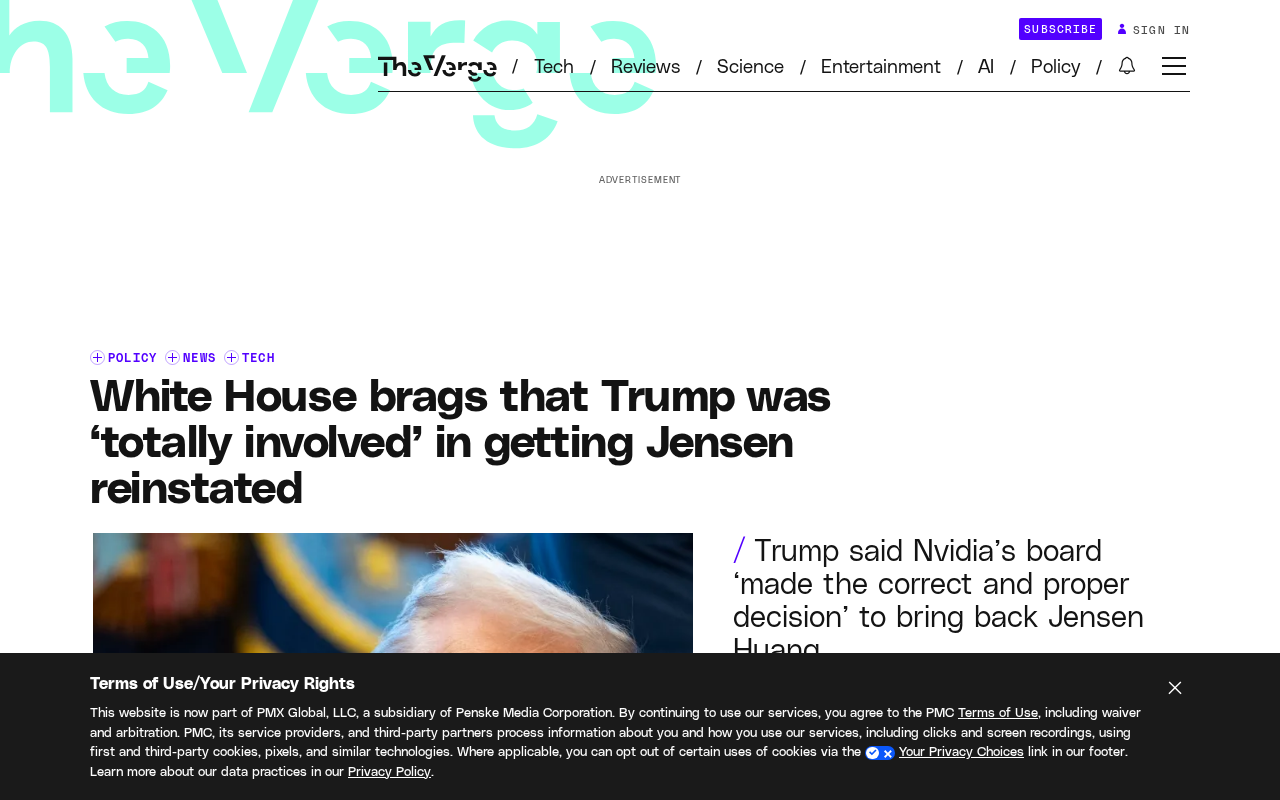
The White House confirms Trump's involvement in Jensen Huang's continuation as NVIDIA CEO, highlighting the tight intertwining of AI chip giants and political power.
White House Communications Director Steven Cheung publicly confirmed that President Trump was "fully involved" in Jensen Huang's continuation as NVIDIA CEO and called the board's decision a "great decision." This rare statement politicizes a personnel change that would normally be an internal corporate governance matter and signals that the government values the stability of NVIDIA's leadership. The article analyzes Jensen Huang's key position as the leader in AI chips, explores the controversy over the boundary of government-business relations triggered by the White House's intervention in a private company's decision, and points out that the event reflects the increasingly close relationship between AI chip giants and state political power, which may affect NVIDIA's future negotiating position on export controls and government cooperation.
Event Core: White House Proactively Discloses Trump's "Deep Involvement"
White House Communications Director Steven Cheung said in a statement: "President Trump was fully involved, and this is a great decision by the NVIDIA board." This statement directly confirmed earlier speculation—that U.S. President Donald Trump played a role in Jensen Huang's continuation as NVIDIA CEO.
Although NVIDIA's board decision-making process is typically regarded as an internal matter of corporate governance, the White House's choice to proactively disclose the president's level of involvement is itself unusual. It sends a clear signal: the Trump administration wants to frame this as an outcome of government-business collaboration, rather than a mere corporate personnel change.
Why Jensen Huang?
As NVIDIA's co-founder and CEO, Jensen Huang has led the company to become the absolute dominant player in the global AI chip sector. Against the backdrop of exploding demand for AI compute, NVIDIA's GPU products are practically hard currency for training large models. The Trump administration has previously made frequent moves on chip export controls and AI industrial policy, and Huang himself plays a delicate role in policy negotiations.
The White House calling Huang's continuation a "great decision" implies that the government values the stability of NVIDIA's leadership. For the U.S. AI industry, which depends on NVIDIA chips, CEO continuity means strategic predictability.
NVIDIA's GPUs (graphics processing units) were originally designed for game rendering, but their massively parallel computing architecture happens to fit the matrix operations required for deep learning, making them core hardware for training large models. The CUDA software ecosystem further consolidates its moat, making it difficult for developers to migrate to other platforms. After demand for AI compute exploded, NVIDIA's data center GPUs were in short supply, and its market capitalization once exceeded one trillion dollars, making it a bellwether for the global semiconductor industry. This technological monopoly means that the choice of NVIDIA's CEO concerns not only company strategy but also directly affects the compute supply security of the U.S. AI industry.
The Delicate Boundary of Government-Business Relations
From a corporate governance perspective, the White House publicly claiming that the president was "fully involved" in a private company's personnel decision has sparked discussion about the boundary of government-business relations. There is tension between the narrative that NVIDIA's board made the decision independently and the White House's statement—whether the president's intervention ensured Huang's retention, or the board received White House endorsement after making the decision, no further details have been disclosed.
Cheung's statement did not specify what actions Trump took. This ambiguity preserves room for political messaging while avoiding accusations of excessive interference in corporate affairs.
The principle of board independence in corporate governance requires that major decisions such as personnel appointments and removals be made by the board in accordance with shareholder interests, free from external political influence. The White House publicly claiming that the president was "fully involved" in a private company's personnel decision is relatively rare by convention, because it blurs the government-business boundary and may raise concerns about conflicts of interest. Historically, although the U.S. government has influenced tech companies through industrial policy, export controls, and other means, public statements directly intervening in a CEO's continuation are uncommon. This ambiguity can leave room for political messaging, but it may also weaken outside trust in the independence of NVIDIA's board.
What It Means for the AI Industry
Regardless of the specific process, this event reveals the increasingly close relationship between AI chip giants and state political power. NVIDIA's decisions are no longer merely commercial matters; they are being incorporated into the framework of industrial policy and geopolitics. Huang's continuation has, in a sense, received political backing from the White House, which may affect NVIDIA's negotiating position in the future regarding export controls, government cooperation, and other areas.
For observers watching the AI industry landscape, the White House's high-profile statement this time is a signal worth continuing to track: when leadership changes at core tech companies begin to enter the president's scope of involvement, the logic of government-business interaction in the AI industry is being redefined.
Chip export controls are a key tool for the United States to limit China's AI development, and high-end GPUs such as NVIDIA's A100 and H100 are subject to strict export restrictions to China. In response, NVIDIA has launched reduced-specification versions specifically for the Chinese market, but policy is still being adjusted dynamically. CEO Jensen Huang must balance compliance and commercial interests in control policy, and his continuation means NVIDIA's China strategy may maintain continuity. The White House's high-profile endorsement may give NVIDIA a more favorable position when seeking export licenses and participating in government AI projects, but it may also expose it to stricter scrutiny of government-business relations in congressional reviews.
Related articles

AI Proved the Riemann Hypothesis, Yet No One Understands It: The Gap Between Machine Verification and Human Understanding
An AI and a mathematician produced a 17-million-line Riemann Hypothesis proof that passes computer verification yet no one understands. This article explores the gap between machine verification and human understanding, and the division of knowledge work in the AI era.

Can AI Crack the Riemann Hypothesis? New Hope for the Million-Dollar Math Puzzle
The Riemann Hypothesis carries a million-dollar bounty. Can AI help crack this math puzzle? This article examines the conjecture's origins, the difference between verification and proof, and AI's real role and limits in mathematical research.

AI Cracks the Riemann Hypothesis? 17 Million Lines of Code Send Shockwaves Through Mathematics
In November 2026, Anthropic mathematicians and Claude complete a machine-verified proof of the Riemann Hypothesis — 17 million lines of code pass five independent theorem checks. Yet the mathematics community falls silent: does a proof no human can read through count as a solution?