White House Weighs Open-Source AI Executive Order: Policy Direction and Industry Impact Explained

The White House is weighing an executive order on open-source AI, signaling it has entered top-level policy debate.
The U.S. White House may be considering an executive order targeting open-source AI, involving national security, technology proliferation, and industry competition. This article analyzes the possible directions of the order, its real impact on developers and enterprises, and the significance of open-source AI entering the highest policy agenda.
Source and Background
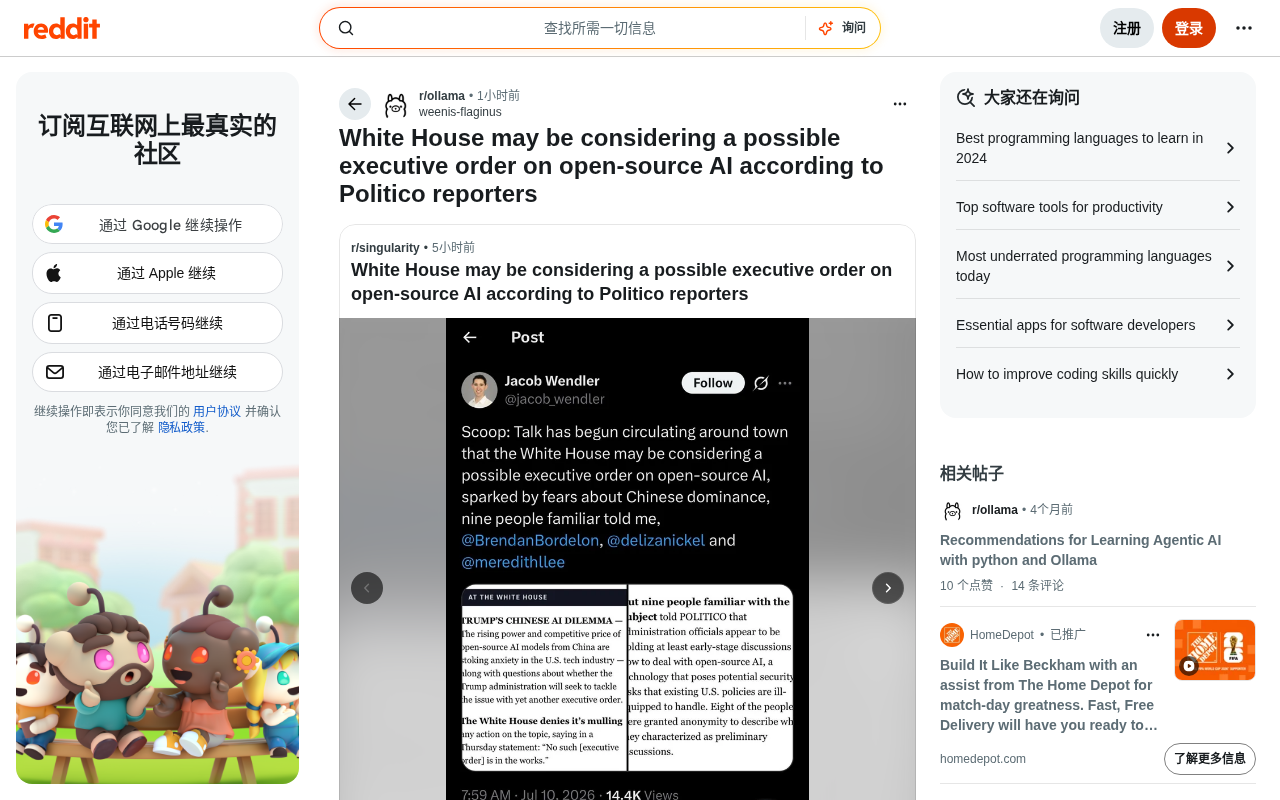
According to a Politico reporter, the White House may be considering an Executive Order targeting Open-Source AI. After spreading through the Reddit community, this news quickly drew widespread attention from AI developers, enterprises, and policy researchers.
Although the report is still at the "possibly considering" stage—with specific provisions, regulatory scope, and even whether it will ultimately be formalized all remaining unknown—such a signal alone is enough to strike a sensitive nerve across the entire AI ecosystem. Open-source models have become one of the most important forces in the AI field over the past two years—from Meta's Llama series to a batch of high-quality open-weight models like Mistral and DeepSeekAd. They have both lowered the barrier to AI technology and become a core issue that U.S. tech policy cannot avoid.
It is worth noting that what the industry commonly calls "open-source AI" differs importantly from open-weight models in the strict sense: the former requires publicly releasing training code, datasets, and a complete reproduction workflow, while the latter only releases the trained model parameter files. Most mainstream "open-source" models—such as Meta's Llama series, DeepSeek-R1, and Mistral—fall into the latter category. This distinction is extremely critical in a policy context: once weight files are publicly released, anyone can deploy them locally and bypass API-level safety filters. This "irreversibility" is precisely the core technical starting point of regulatory discussions.
Why Is the White House Targeting Open-Source AI?
The Dilemma of National Security and Technology Proliferation
The core controversy around open-source AI has always been its "double-edged sword" effect. Open-weight large models have greatly advanced academic research, entrepreneurial innovation, and technological inclusion; but once powerful model weights are publicly released, they are difficult to "take back." Regulators worry these capabilities could be maliciously exploited or flow to countries seen as strategic competitors.
The debate within U.S. policy circles over "whether frontier models should be restricted from open-source release" has never subsided. The pro-regulation side emphasizes potential risks in biosecurity, cybersecurity, and other domains; those opposed to excessive regulation argue that the capabilities of closed models are also rapidly catching up, and restricting open source would only weaken America's leadership in the open ecosystem, handing over innovation opportunities.
In this debate, the "Capability Threshold" is a recurring core tool. The Biden-era AI executive order once set 10²⁶ floating-point operations (FLOP) as the red line for training-compute regulation; researchers are also exploring using benchmark performance and dangerous capability assessments (such as bioweapon-assistance capability or cyberattack-assistance capability) to draw the boundaries of "frontier models." This approach shares the same logic as the Bureau of Industry and Security's (BIS) export controls on AI chips: define "sensitivity" levels through quantitative metrics, then correspondingly impose reporting, review, or restriction measures.
The Real Pressure of Industry Competition
Notably, in the current global open-source model landscape, open-weight models from China are performing increasingly strongly, profoundly changing the strategic assessment of U.S. policy circles. DeepSeek-R1 achieved GPT-4-level reasoning performance at extremely low training cost and fully opened its weights under the MIT license, causing a collective shock in Silicon Valley. Qwen (Alibaba), Yi (01.AI), and others have likewise continued to refresh open-source model performance leaderboards.
Some policy researchers interpret this trend as a dual warning: on one hand, it proves that compute export restrictions have not effectively curbed China's frontier AI research and development; on the other hand, Chinese teams actively choosing an open-source strategy may be using the global developer community to accelerate iteration, reverse-leveraging the network effects of the open ecosystem. This has prompted some hawkish policy figures to argue that new control points should be set at the open-source release stage to fill the effectiveness gap of chip export controls. For U.S. decision-makers, striking a balance between "encouraging domestic open source to maintain competitiveness" and "preventing the outflow of sensitive technology" is an unavoidable challenge in crafting any AI policy.
What Can an Executive Order Actually Accomplish?
Advantages and Limitations of Executive Orders
An executive order is a tool by which the U.S. president bypasses Congress to issue directives directly to federal administrative agencies. Its advantages lie in fast effect and high flexibility—it can quickly mobilize agencies like the Department of Commerce and the National Institute of Standards and Technology (NIST) to conduct risk assessments or develop guiding principles. But its limitations are equally significant: an executive order lacks the stability of law and can be easily revoked or modified as administrations change.
The AI field already has a vivid historical precedent confirming this risk. In October 2023, the Biden administration signed the Executive Order on Safe, Secure, and Trustworthy Artificial Intelligence (EO 14110), the most systematic AI executive directive to date, requiring that training of large models above a certain compute threshold be reported to the government. However, one of Trump's first actions upon taking office in January 2025 was to revoke this order, instead issuing the Removing Barriers to American Leadership in Artificial Intelligence order, emphasizing deregulation and competition-first. This history of a 180-degree policy reversal shows that executive orders have extremely limited stability in the AI governance domain, which also explains why the industry is both sensitive to and cautiously watching the "under consideration" new executive order.
Therefore, even if this executive order ultimately materializes, it is more likely to be a "framework" or "directional" statement—for example, requiring relevant departments to assess the risks and benefits of open-source AI, develop voluntary safety standards, or clarify the stance on open-source models in federal procurement—rather than directly imposing a hard release ban.
Three Possible Directions
Synthesizing industry discussions, this potential executive order could take the following directions:
- Supportive: Clearly positioning open-source AI as a national competitiveness asset, providing funding, compute, or policy facilitation to consolidate America's dominance in the open ecosystem.
- Review-based: Requiring models above a certain capability threshold to complete safety assessment or registration before open-source release. If it follows the Biden-era quantitative framework, frontier models with more than 70 billion parameters might face mandatory pre-release review, while smaller-scale community models might be exempted.
- Hybrid: Keeping small and medium-sized models open while imposing additional constraints on the most cutting-edge models, balancing innovation and safety.
There is currently no indication of which path the White House favors, which is also the most divisive focal point in current community discussions.
How Should Developers and Enterprises Respond?
For the broad community of AI developers and startups, policy uncertainty itself is a hidden cost. Open-source models are favored by the market precisely because they reduce the risk of relying on a single vendor's API, granting the ability for local deployment and autonomous control. Any signal that might tighten open-source releases will make small and medium players who depend on this ecosystem uneasy.
However, one should also maintain rational judgment: the current reporting is still at the "possibly considering" level, and there is still a considerable distance from formal policy issuance. History is full of precedents where "under consideration" executive orders ultimately came to nothing. For practitioners, a more pragmatic approach is to continuously monitor formal statements through official channels, avoiding being overly swayed in decision-making by a single media report.
Conclusion: The Signal Itself Is the Content
Perhaps the most important significance of this news lies not in the specific provisions of the executive order itself, but in the signal it releases—open-source AI has officially entered the policy agenda of the highest levels of U.S. decision-making. When the White House begins to seriously discuss how to treat open-weight models, it means the influence of this technological path can no longer be ignored by policy circles.
Whether the final policy leans toward regulation or support, the open-source-versus-closed-source debate and the balance between innovation and safety will become core propositions in AI governance for years to come. For every practitioner and researcher following the development of artificial intelligence, this is an important policy inflection point worth continuous tracking.
Key Takeaways
Related articles

Felix Rieseberg Personal Homepage
Felix Rieseberg's personal homepage sparks attention on Hacker News. This article covers the Slack engineer's technical background, the rise and fall of nativefier, and the value of a developer homepage as a tech calling card.

@ai-sdk/vue 3.0.306 Patch Release Syncs with [email protected] Update
@ai-sdk/vue 3.0.306 released, synced with [email protected]. A routine patch release for the Vercel AI SDK ecosystem with no public API changes; the Vue adapter layer stays version-aligned with the core package.

Gemini 4 Argon API Launches: The Era of Million-Token Output Begins
Google launches Gemini 4 Argon with sparse MoE architecture, up to 1M output tokens, and a 68.90% Vals Index score, available across API, AI Studio, and the Gemini app.