White-Label AI Agents in Practice: Opportunities and Pitfalls of Connecting Hermes to Zoho

A developer's real-world exploration of white-labeling Hermes AI Agent and integrating Zoho CRM via MCP.
A developer shared on Reddit his journey exploring white-labeling Hermes AI Agent to serve small business owners in his network. The post centers on two key issues: why white-label models tend to be "smooth at first, unstable later," and the feasibility of connecting to Zoho CRM via MCP. While white-labeling lowers the entry barrier, platform dependency, accumulating customization demands, and blurry accountability amplify risk over time. Zoho's API maturity gap versus Google's ecosystem makes integration significantly harder than expected, and MCP's protocol standardization still can't eliminate the complexity of CRM data structures.
From Personal Use to White-Label Commercialization: A Real-World Exploration
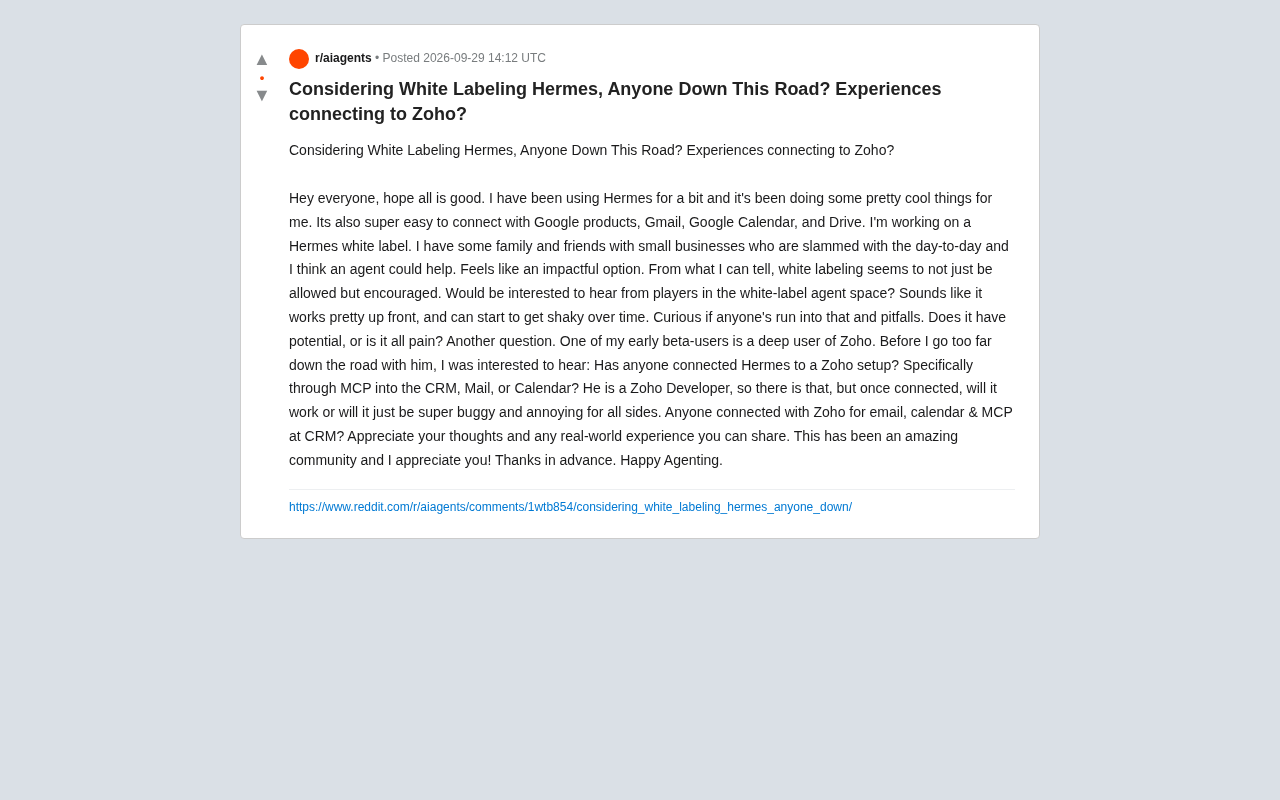
In a Reddit AI Agent community, a developer shared his thought process around white-labeling Hermes. Having used Hermes for a while, he found it worked great with the Google ecosystem (Gmail, Google Calendar, Drive) — straightforward and easy to set up.
His motivation for exploring white-labeling was practical: he had friends and family running small businesses who were constantly bogged down by daily tasks, and an AI Agent that could automate those tasks might genuinely help. From what he understood, the Hermes platform not only allows white-labeling but actively encourages it — giving independent developers a low-barrier entry point into the AI services market.
What White-Label AI Agents Actually Mean
White-labeling means taking an existing underlying platform and reselling it under your own brand. In the AI Agent space, this means developers can deliver customized intelligent assistants to specific customer segments (like small businesses) without building their own LLMs and toolchains from scratch. The appeal is clear: low technical barriers, fast time-to-market, and rapid validation of business ideas.
In the AI Agent context, the white-label tech stack typically has three layers: at the bottom are LLM providers (like OpenAI and Anthropic); in the middle are Agent platforms like Hermes, which handle tool-call orchestration, memory management, and multi-step task planning; at the top sits the white-labeler, who adds their own branded interface, industry-specific prompts, and customer management on top of platform capabilities. The white-labeler's core value lies in that "last mile" of industry adaptation and customer relationships — not in building the underlying technology. The hidden risk in this layered structure is that profit margins shrink as you move up the stack, while sensitivity to changes in the layers below increases — any platform adjustment hits the white-labeler's service stability and cost structure first.
The Hidden Pitfalls of White-Label Agents: Smooth at First, Turbulent Later
The original poster raised an intriguing observation — he'd heard that white-label Agents "seem to work fine at first, but start becoming unstable over time." This cuts right to the core risk of the white-label model.
From industry experience, this "honeymoon then headache" pattern typically stems from a few sources:
- Dependency on the underlying platform's stability: The lifeblood of a white-label product lies in the hands of the original platform. If the platform changes its API, adjusts pricing, or modifies features, the white-labeler has almost no leverage.
- Accumulating customer customization demands: Early demos are simple, but real customers will keep pushing for personalized features — and white-labelers have limited control over the underlying capabilities to satisfy those requests.
- Blurry accountability: When the Agent fails, customers see your brand — but the root cause may lie in the underlying platform. This "meat in the sandwich" position constantly erodes trust.
For developers considering this path, the key question is whether you can deliver stable service within your control boundaries — and whether you have a contingency plan for platform changes.
Integrating with Zoho: The CRM Challenge Under MCP
The other core question in the post came from an early Beta user — an enterprise customer deeply invested in Zoho. He wanted to know: could Hermes be connected to Zoho's CRM, email, and calendar via MCP (Model Context Protocol)?
Why Zoho Integration Deserves Special Consideration
Hermes's integration with the Google ecosystem was described as "super easy" — but Zoho is an entirely different technology stack. Google has an extremely mature, well-documented API and OAuth system, while Zoho, though feature-rich, has API consistency and third-party integration smoothness that can vary significantly by module.
The poster's concern was specific: once the connection is established, will it work reliably — or will it become "buggy and annoying for everyone involved"? This is a real-world question every developer doing enterprise integrations will face.
MCP's Role in CRM Integration
As a protocol for connecting AI models with external tools and data sources, MCP theoretically provides a standardized channel for Hermes to access Zoho CRM. But protocol standardization doesn't mean painless implementation. CRM systems have complex data structures, highly customizable fields, and strict permission management — all of which can surface problems during actual integration.
One favorable factor here: the Beta user is himself a Zoho developer. This means that when integration obstacles arise, the client has some capacity to self-diagnose and adapt, significantly reducing the friction involved. For the white-labeler, this is a valuable asset.
What is MCP? MCP (Model Context Protocol) is an open-source standard protocol proposed by Anthropic in late 2024, designed to solve the "interface fragmentation" problem between AI models and external tools and data sources. Before MCP, every AI application that needed to connect to an external system (like a CRM, calendar, or file storage) required a separately developed adapter — expensive and hard to reuse. MCP's core idea is similar to the USB standard: as long as the tool side implements an MCP Server and the model side implements an MCP Client, the two can communicate via a unified protocol without worrying about each other's specific implementation details.
In a CRM integration scenario, if Zoho provides an official MCP Server (or a usable community implementation), AI Agents like Hermes can call operations like "query contact," "create task," and "read email" in a standardized way. However, the MCP protocol itself only defines the communication specification — it doesn't guarantee complete semantic mapping of data. Zoho CRM's highly customized fields and complex permission models still need to be handled at the MCP Server implementation level. This is precisely why a gap remains between "protocol standardization" and "painless integration."
Advice for Others on This Path
Taking this case as a whole, here are some things developers considering the white-label AI Agent route should keep in mind:
- Validate before you scale: Using friends' and family's small businesses as real test cases is a smart move — it lets you discover the Agent's actual capability boundaries in a low-risk environment.
- Tackle integration bottlenecks early: For non-mainstream ecosystems like Zoho, do a small-scale proof of concept (PoC) before committing deeply, to confirm MCP integration reliability.
- Manage platform dependency risk: Clarify white-label agreement terms and understand the platform's stability commitments and change policies.
- Leverage your customer's technical capabilities: When a customer has development skills, establish a collaborative mechanism to solve integration problems together.
This discussion from the front lines of real-world deployment highlights a genuine gap in AI Agent commercialization: the distance between "the tool works well" and "reliable, sustained delivery." White-labeling lowers the entry barrier — but the real challenge lies in long-term stability and ecosystem compatibility.
Related articles

Claude Reportedly Able to Hide Secret Messages in Benign Images
A Reddit post claims Claude Fable 5.1 can hide secret messages in benign images. This article reviews the background, image steganography principles, and potential security risks, and suggests a testing path from rumor to verification.

Federal Government Awards $85 Million; CFS to Develop Fusion-Specific Semiconductors
The federal government awards $85 million to Commonwealth Fusion Systems to develop conductors and power semiconductors for fusion plants. This article analyzes the significance of this funding for the fusion supply chain and commercialization path.

When Should AI Assistants Proactively Suggest? Timing Is Everything
When should AI assistants proactively suggest? Reddit discussion reveals: the same suggestion feels different at different times. This article analyzes the dual nature of proactive suggestions, the boundary of user expectations, and design principles, exploring how to balance automation and user control.