Who Owns the AI Orchestration Layer? Three Architecture Choices for Enterprise System Governance

Adding an AI layer may swap portal sprawl for AI sprawl — governance and accountability are the real decisions.
A Reddit discussion from an enterprise systems practitioner asks whether layering AI on top of Workday and ServiceNow just creates a third system to maintain. The article argues that AI doesn't eliminate long-standing integration challenges around permissions, audit trails, and failure ownership — it only reshapes their complexity. A more pragmatic architecture keeps core systems in their existing roles while an independent action layer handles orchestration via APIs and browser execution. The choice of where to place that layer — inside ServiceNow, inside Workday, or independent — ultimately comes down to trade-offs between control, flexibility, and accountability costs.
When the "AI Layer" Becomes a Third System to Babysit
A practitioner working on the front lines of enterprise systems posed a sharp question on Reddit: when a company is already running both Workday and ServiceNow, does an "AI layer" just become a third system that needs dedicated attention?
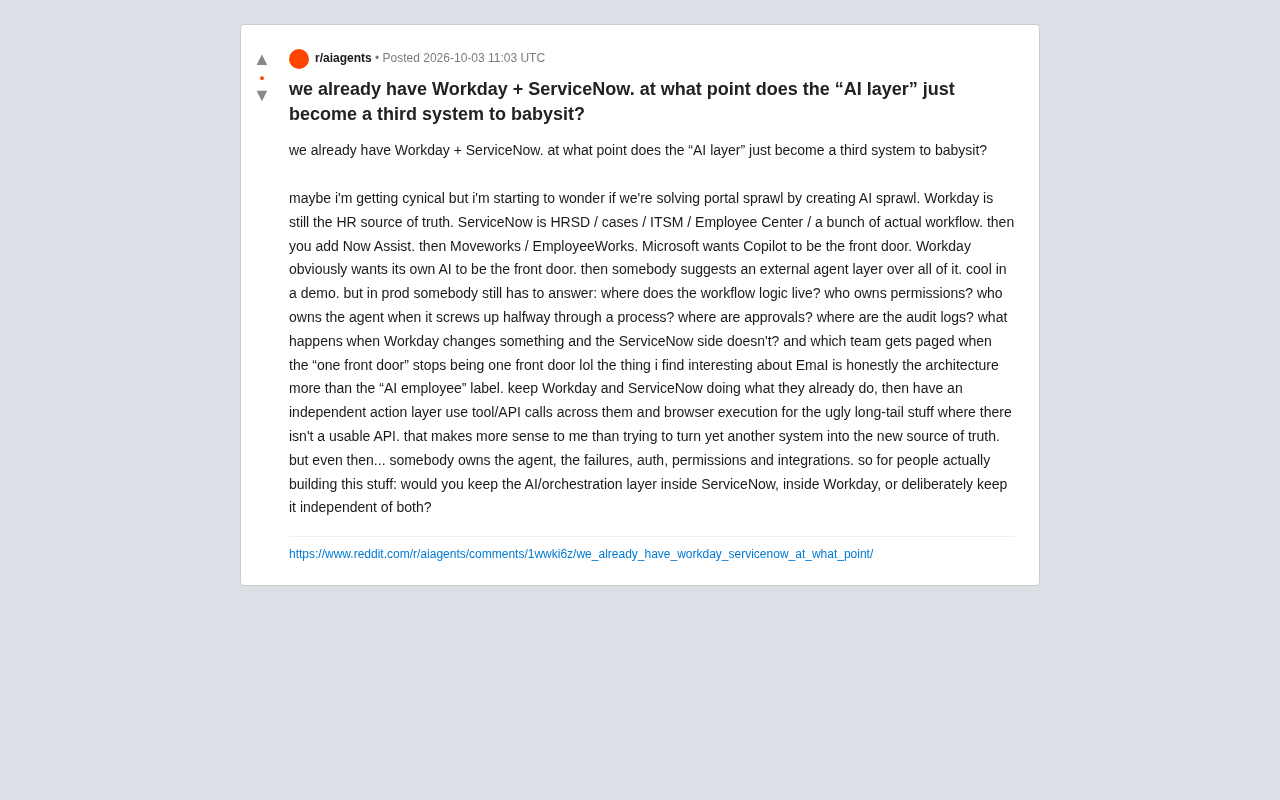
This concern is far from paranoid. Workday remains the source of truth for HR. ServiceNow carries HRSD, ticketing, ITSM, Employee Center, and a significant amount of real workflow logic. On top of all that, enterprises keep stacking AI capabilities: Now Assist, Moveworks, EmployeeWorks — Microsoft wants Copilot to be the unified "front door," and Workday naturally wants its own AI to serve as that entry point. Then someone proposes adding yet another external agent layer on top of everything else.
The author put it bluntly: "Are we solving portal sprawl by creating AI sprawl?"
Demos Look Great. Production Is a Different Story.
In a demo, a unified AI front door looks impressive. But when it hits production, a cascade of unavoidable accountability questions surfaces:
- Where does the workflow logic actually live?
- Who owns and manages permissions?
- When an agent fails halfway through a process, who is responsible?
- Where do approvals happen? Where are the audit logs?
- What happens when a field changes on the Workday side but ServiceNow doesn't sync?
- When the so-called "single front door" stops being single, which team do you call?
At their core, these questions are the timeless ownership and accountability boundary problems of enterprise integration. AI hasn't eliminated this complexity — it's made the chain of responsibility even murkier by introducing a new actor that takes autonomous actions. An agent capable of executing actions across systems can, if it fails midway, generate far higher investigation and remediation costs than a traditional scripted integration.
Ownership and accountability boundaries are a foundational challenge in enterprise integration architecture. In the era of point-to-point integration or ESBs (Enterprise Service Buses), each integration link typically had a clearly designated owning team. With AI agents that autonomously act across systems, a single failed operation might span the HR system, the IT service desk, and an external API — with no single team able to fully reconstruct the failure scene. Service management frameworks like ITIL — with their change management and incident management processes — also struggle to adapt when agents trigger actions autonomously. Traditional processes assume every change has an identifiable initiator and an approval chain, but agent actions are often triggered by a user's natural language request, pass through multi-step reasoning and tool calls, and are difficult to audit with sufficient granularity and completeness.
An Independent Action Layer: A More Pragmatic Architecture
What genuinely interests the author about products like Ema isn't the "AI employee" marketing label — it's the underlying architecture. The core idea is: let Workday and ServiceNow keep doing what they're good at, without disrupting their established responsibilities, and then have an independent action layer traverse between these systems via tool calls and API calls. For the "ugly long-tail" scenarios where no API is available, browser execution serves as the fallback.
This approach is considerably more sensible than "turning yet another system into a new source of truth." It acknowledges a reality: the data authority of core enterprise systems shouldn't be casually transferred. AI's value lies in orchestration and execution, not in displacing data sovereignty.
Why Browser Execution Matters
Browser execution deserves its own spotlight. In practice, a large number of enterprise processes are bottlenecked by legacy systems or third-party interfaces that don't expose open APIs. Traditional integration hits a wall here, while letting an agent operate a browser the way a human would covers exactly this long-tail need. This is also a meaningful differentiator for an independent action layer compared to embedded AI.
Browser execution typically relies on a combination of computer vision and DOM parsing, enabling AI agents to operate web interfaces like a real user — clicking buttons, filling forms, reading page content. Representative technical approaches include automation frameworks like Playwright/Puppeteer, as well as multimodal models designed specifically for GUI interaction that have emerged in recent years. Its limitations are equally significant: a UI redesign can break automation scripts instantly, operation speed is far slower than API calls, and it's difficult to scale in high-concurrency scenarios. Browser execution is therefore better suited as a "long-tail fallback" rather than the preferred integration path for core workflows. For organizations in a position to push internal systems to expose APIs, building out an API layer first remains the more maintainable direction.
The Core Debate: Where Should the Orchestration Layer Live?
Even with an independent action layer architecture, the author candidly acknowledges: the ownership problem doesn't go away. The agent itself, its failure handling, authentication, permissions, and integrations — someone ultimately has to own all of it.
So he posed the final question to engineers actually building these systems: where would you put the AI/orchestration layer?
- Inside ServiceNow: Close to the workflow and ticketing system, with relatively mature permissions and audit mechanisms — but you're locked into a single platform ecosystem.
- Inside Workday: Close to the HR source of truth with good data consistency — but workflow capabilities and cross-system reach are constrained.
- Deliberately kept independent of both: Maximum flexibility and cross-system orchestration — but you take on full responsibility for authentication, permissions, auditing, and failure attribution from scratch.
None of these options has a universal right answer. Each represents a different trade-off between control, flexibility, and the cost of accountability. Embedding inside either existing platform means entrusting the fate of your orchestration logic to that vendor's roadmap. Staying independent means building an entire governance capability yourself.
This architectural choice typically maps to the classic engineering trade-off between Build and Platform Lock-in. Embedding the orchestration layer inside ServiceNow or Workday is essentially a bet that the platform vendor will continue investing in AI orchestration capabilities and will accommodate your organization's customization needs on their roadmap. Historically, enterprises that over-relied on a single HCM or ITSM platform often found themselves in a vulnerable position when vendors adjusted product strategy or pricing. The independent orchestration layer approach more closely resembles a "build your own middleware" philosophy — it requires the team to have capabilities in authentication (cross-system OAuth/SAML), fine-grained permission models (RBAC/ABAC), and distributed fault tracing, with a higher upfront investment, but resilience across platform generations. Open-source agent frameworks (such as LangGraph and CrewAI) and the emerging standardized MCP protocol are actively working to lower the barrier to building independent orchestration layers.
Takeaways for Enterprise Technology Decision-Makers
This discussion has value precisely because it surfaces the real questions that marketing language tends to obscure. For teams evaluating enterprise AI solutions, a few things are worth keeping in mind:
Don't be seduced by narratives like "unified front door" or "AI employee." Ask first for clear answers on the hard questions: workflow logic, permissions, auditing, and failure accountability. AI doesn't magically dissolve the complexity of system integration — it just changes the shape of that complexity. The real decision isn't "should we add an AI layer" but rather where is the most governable place to assign responsibility for orchestration.
When the "single front door" is no longer single during an outage, the team that gets the call is the true protagonist of this architecture debate.
Related articles

Felix Rieseberg Personal Homepage
Felix Rieseberg's personal homepage sparks attention on Hacker News. This article covers the Slack engineer's technical background, the rise and fall of nativefier, and the value of a developer homepage as a tech calling card.

@ai-sdk/vue 3.0.306 Patch Release Syncs with [email protected] Update
@ai-sdk/vue 3.0.306 released, synced with [email protected]. A routine patch release for the Vercel AI SDK ecosystem with no public API changes; the Vue adapter layer stays version-aligned with the core package.

Gemini 4 Argon API Launches: The Era of Million-Token Output Begins
Google launches Gemini 4 Argon with sparse MoE architecture, up to 1M output tokens, and a 68.90% Vals Index score, available across API, AI Studio, and the Gemini app.