Who Should You Learn AI From? A Four-Stage Learning Path from Andrew Ng to Karpathy
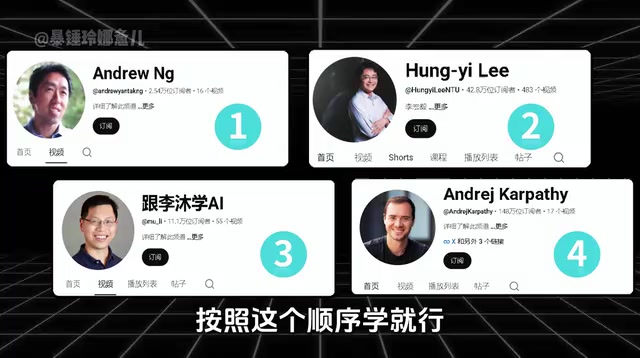
Four top AI instructors map to four learning stages — from concepts to deep model understanding.
This article outlines a popular AI learning roadmap built around four progressively deepening stages. Andrew Ng's *AI for Everyone* builds conceptual awareness with zero coding required; Hung-yi Lee's courses use accessible analogies to explain machine learning and LLM principles; Mu Li's *Dive into Deep Learning* bridges theory and hands-on practice; and Andrej Karpathy's content helps advanced learners understand the inner workings of large models. The article also cautions that this is a resource guide, not a complete curriculum — real AI skills still demand substantial hands-on practice.
Overwhelmed by the flood of AI tutorials and courses out there? A popular learning roadmap circulating on Bilibili offers a clear answer: instead of randomly watching videos, lock in on four widely recognized top instructors and progress in order — from conceptual foundations to deep technical understanding. Here's a breakdown of the logic behind this learning path and who it's best suited for.
Why Learning Order Matters More Than Learning Volume
AI knowledge spans an enormous range — from abstract machine learning theory to hands-on model training and real-world deployment. Without a clear path, it's easy to fall into the trap of "watched a ton of courses but still can't build anything."
The core principle of this roadmap is: learning order matters more than learning volume. The four instructors each correspond to a distinct stage of AI learning — conceptual awareness, principle understanding, hands-on practice, and deep-level insight. This progressively deepening structure prevents the frustration that comes from beginners diving into the deep end too early.
Four Instructors, Four Learning Stages
Stage 1: Andrew Ng — Understand What AI Actually Is
For complete beginners, the roadmap recommends starting with Andrew Ng's AI for Everyone. The biggest selling point of this course is that you don't need to write a single line of code or have any technical background. The sole goal is to understand what AI is, what it can do, and where its limits lie.
This step may seem simple, but it's frequently skipped by people who are too eager to jump ahead. Building a solid mental model of AI upfront saves a lot of detours later and helps avoid both over-hyping and underestimating AI's capabilities.
Andrew Ng is a professor at Stanford University, former head of Google Brain, former Chief Scientist at Baidu, and co-founder of the online education platform Coursera. His influence in AI education is immense — his early machine learning course has been taken by millions worldwide and is widely regarded as a "bible" for AI beginners. AI for Everyone is specifically designed for non-technical audiences, focusing on how AI projects work, how companies apply AI, and how to collaborate effectively with AI teams. It's ideal for product managers, executives, or anyone who wants to understand AI without writing code.
Stage 2: Hung-yi Lee — Turning Headache-Inducing Concepts into Plain English
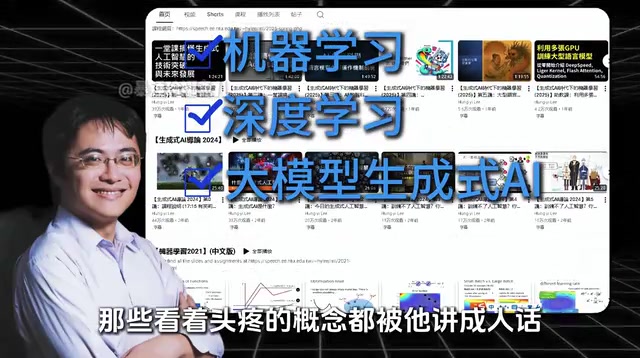
Once you have a basic understanding of AI, the next step is grasping the underlying principles. The roadmap recommends Hung-yi Lee's series on machine learning, deep learning, large language models, and generative AI.
His teaching style is often described as "turning concepts that make your head hurt into plain language." He excels at using accessible analogies to break down complex logic, helping learners move from "I've heard of it" to "I actually understand how it works." This stage is about answering the question of why — not just what.

Stage 3: Mu Li — From Understanding to Doing
Understanding the principles is one thing; turning that knowledge into practical skills is another. The roadmap points to Mu Li's Dive into Deep Learning (D2L) as the critical bridge from theory to practice.
The course walks learners through model training all the way to real project implementation, step by step, writing code and running models along the way. The value of this stage lies in building hands-on capability — you only truly own the knowledge once you've typed the code, tuned the parameters, and gotten a project to run.
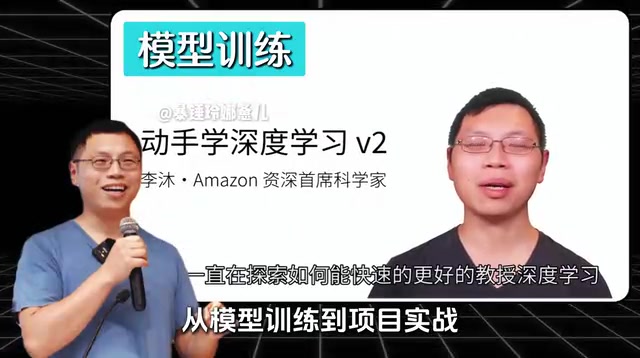
Dive into Deep Learning (D2L) is an open-source textbook co-authored by Mu Li and several collaborators. It has been adopted by hundreds of universities worldwide and provides Python code, runnable Jupyter Notebooks, and accompanying video lectures on Bilibili — a rare combination of theory, code, and live Q&A all in one place. Mu Li previously served as Principal Scientist at Amazon AWS. The curriculum covers the full deep learning stack, from linear neural networks, CNNs, and RNNs to attention mechanisms and Transformers. The approach is code-first: learners run every example directly in a cloud environment, dramatically lowering the barrier to getting started.
Stage 4: Andrej Karpathy — See Through the Inner Workings of Large Models
The final instructor is Andrej Karpathy. As a technical expert deeply involved in cutting-edge large model development, he has a gift for dissecting complex LLM internals and making them comprehensible.
This stage is aimed at learners who already have a solid foundation, helping you understand what's really happening inside AI at a fundamental level. Grasping how a model works internally is the dividing line between "being able to call an API" and "being able to innovate" — and it's the foundation for going further in the AI field.
Andrej Karpathy previously served as Director of AI at Tesla, overseeing the computer vision system for Autopilot, and later joined OpenAI to work on early development of the GPT series. His YouTube tutorial series — including "Neural Networks: Zero to Hero" — is renowned for building neural networks from scratch and explaining GPT architectures line by line. His target audience is learners who already have programming experience and want to genuinely understand how Transformers and large language models (LLMs) work. Unlike the more structured course formats of the other instructors, Karpathy's style is closer to "reinventing the wheel together" — by implementing a simplified GPT from scratch, learners develop an intuitive understanding of attention mechanisms, word embeddings, autoregressive generation, and other core concepts, rather than staying at the level of calling APIs.
Who Is This Path For?
The strength of this roadmap is its clearly defined levels and gradually increasing entry points. It's especially well-suited for:
- Complete beginners: Starting with Andrew Ng's introductory course means you won't be scared off right away.
- Those with some awareness but no hands-on skills: Jump in at Hung-yi Lee's or Mu Li's courses.
- Advanced learners who want to go deeper: Karpathy's content fills in the gaps in understanding large model mechanics.
One important caveat: the original material is fundamentally a resource guide, not a complete hands-on curriculum. Real AI capability still requires a tremendous amount of practice and project experience. Following the right instructors is just the starting point — sustained effort is what ultimately matters.
Takeaway
The core value of this roadmap is using four widely respected instructors to break AI learning into four clear stages: awareness → principles → practice → deep understanding. For beginners paralyzed by the sheer volume of available resources, a well-tested path is itself enormously valuable. As for claims like "double your salary after finishing" — treat those as clickbait and take them with a healthy grain of salt.
Related articles
Waymo Restarts San Antonio Operations: Back on the Road Five Months After Flood Incident
Waymo resumes San Antonio Robotaxi service ~5 months after a vehicle was swept away in flooding. A look at what happened, why it took so long, and what it means for AV safety in extreme weather.
What Is AIOps? How AI Is Reshaping IT Operations
AIOps applies AI and machine learning to IT operations for anomaly detection, alert noise reduction, and root cause analysis — shifting teams from reactive to proactive.
CCC Sends Its Invitation: 40C3 Hacker Congress Themed "Model Citizens"
CCC announces its 40th Chaos Communication Congress (40C3) under the theme "Model Citizens," inviting hackers worldwide to examine surveillance and algorithmic governance.