Why Adaptive Optimizers Struggle to Train Large Convolution Kernels: DCT-Rep Offers a Zero-Parameter Solution
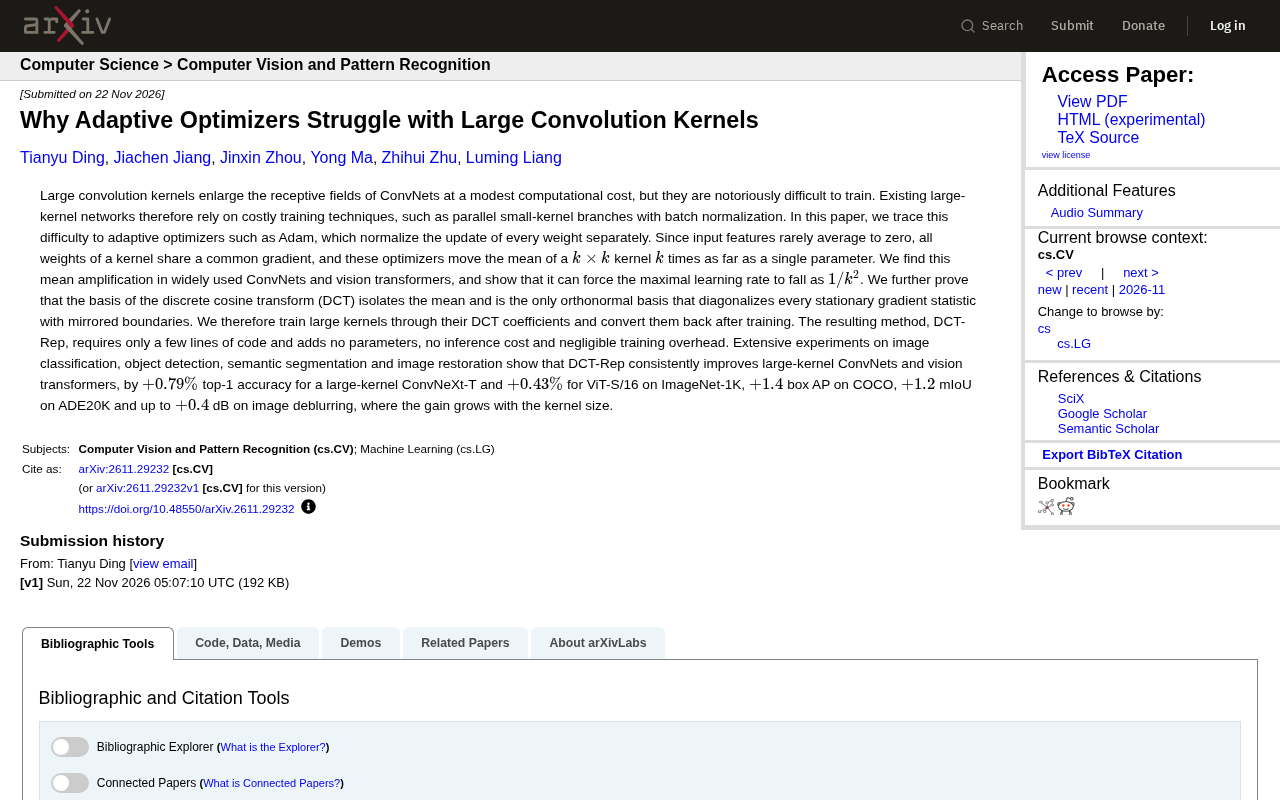
New paper shows adaptive optimizers amplify the shared gradient mean of large kernels; DCT-Rep offers a zero-cost training method.
The article interprets a new paper on why large convolution kernels are hard to train. The authors find that adaptive optimizers like Adam normalize each weight separately, while kernel weights share the same gradient mean, amplifying it by roughly k times and reducing the maximum learning rate as 1/k². The paper proves the DCT basis can isolate the mean and is the only orthogonal basis diagonalizing stationary gradient statistics under mirror boundaries, and proposes DCT-Rep: train large kernels in DCT coefficient space, then convert back. It adds no parameters or inference cost and requires minimal code changes, consistently improving ImageNet-1K, COCO, ADE20K, and deblurring, with gains growing with kernel size. Limitations: only validated on vision tasks, relies on mirror boundary assumption, and absolute gains are modest.
Large convolution kernels can expand the receptive field of a convolutional network at a relatively small computational cost, but training them has long been difficult. Existing large-kernel networks often rely on costly tricks such as parallel small-kernel branches and batch normalization to stabilize training. A new paper points to adaptive optimizers like Adam as the root cause: they normalize updates for each weight individually, while the weights of a convolution kernel share the same gradient mean, causing the mean to be amplified by roughly a factor of k. The authors propose training large kernels using discrete cosine transform (DCT) coefficients, then converting back to the original space after training—a method called DCT-Rep. It requires only a few lines of code, introduces no additional parameters, and adds no inference cost.
The Root of the Large-Kernel Training Problem: Mean Amplification Effect
The paper's core observation is that input features rarely have zero mean, so all weights of a k×k convolution kernel share a common gradient component. Adaptive optimizers like Adam normalize each weight separately, which amplifies the push on the kernel's mean to k times that of a single parameter. The authors find this mean amplification phenomenon in widely used ConvNets and vision Transformers, and prove that it causes the maximum usable learning rate to decrease with 1/k². This means the larger the kernel, the more unstable training becomes, requiring the learning rate to be compressed very low, which slows convergence.
This explanation echoes common engineering practices in large-kernel networks: parallel small-kernel branches and batch normalization essentially suppress the influence of the shared gradient. But these are extra structural overheads, whereas the paper points out that the problem lies in the optimizer's parameterization, not the network architecture itself.
Adaptive optimizers and per-parameter normalization: Adaptive optimizers such as Adam and RMSProp maintain independent second-moment estimates for each weight and use them to normalize that weight's gradient update, making effective step sizes across different weights more uniform. This per-parameter normalization is advantageous in scenarios with sparse gradients or large scale differences, but it implicitly assumes that the gradient statistics of each weight are independent. When a group of weights (such as all elements within a convolution kernel) share a strongly correlated gradient component, per-parameter normalization does not weaken this common component; instead, it amplifies its push in parameter space by the number of parameters. Understanding this is the prerequisite for grasping the "mean amplification effect": the problem is not a flaw in Adam itself, but a mismatch between Adam and the shared-gradient structure of convolution kernel weights.
The Special Nature of the DCT Basis: The Optimal Basis for Isolating the Mean
The authors further prove that the basis functions of the discrete cosine transform can isolate the mean, and are the only orthogonal basis that diagonalizes stationary gradient statistics under all mirror boundary conditions. This mathematical property explains why training in the DCT coefficient space avoids mean amplification: the mean is placed on a single coefficient, and the remaining coefficients are no longer disturbed by the shared gradient component.
Based on this, DCT-Rep's approach is straightforward: transform the convolution kernel into the DCT coefficient space for training, then convert back to the original space after training. Since DCT is an orthogonal transform, this process does not change the model's expressiveness or add any parameters. At inference, the converted kernel is used directly, so there is no additional inference cost, and training overhead is negligible.
Discrete Cosine Transform (DCT): DCT represents a finite-length real signal as a weighted sum of cosine functions at different frequencies. Its basis functions have even-symmetric extension (mirror boundary) properties, giving good energy compaction, which is why it is widely used in image compression such as JPEG. Mathematically, DCT is an orthogonal transform, and the inverse of the transform matrix equals its transpose, so no information is lost and inner products are preserved before and after the transform. For a convolution kernel, arranging the k×k weights into a vector and applying a 2D DCT is equivalent to parameterizing the same kernel with a different set of basis functions. The first basis function of DCT is constant (corresponding to the "mean" or DC component), while the remaining basis functions have zero mean and are mutually orthogonal—this is precisely why it can isolate the shared mean onto a single coefficient.
Experimental Results: Comprehensive Gains in Classification, Detection, Segmentation, and Restoration
The paper conducts extensive experiments on image classification, object detection, semantic segmentation, and image restoration. DCT-Rep brings consistent improvements to both large-kernel ConvNets and vision Transformers: on ImageNet-1K, large-kernel ConvNeXt-T improves top-1 accuracy by +0.79%, and ViT-S/16 by +0.43%; on COCO, box AP improves by +1.4; on ADE20K, mIoU improves by +1.2; and on image deblurring, gains reach up to +0.4 dB.
A key trend is that the gains grow with kernel size. This is consistent with the theoretical prediction that the mean amplification effect increases with k, and also shows that DCT-Rep is particularly effective for large-kernel scenarios. Compared with structural changes such as parallel small-kernel branches, this method that only changes training parameterization is lighter and easier to transfer to existing models.
The relationship between large-kernel convolutions and vision Transformers: Large-kernel ConvNets refer to convolutional networks that use 7×7 or even larger convolution kernels (such as ConvNeXt's 7×7 depthwise convolution) to expand the receptive field. Self-attention in vision Transformers can also be viewed as a global, data-adaptive aggregation operation, and its patch embedding and some variants likewise involve linear transformations with large receptive fields. The paper observes mean amplification in both architectures, showing that the phenomenon is not unique to convolutions but arises from the combination of "a group of weights sharing a gradient mean + per-parameter adaptive normalization," so applying DCT-Rep to ViTs is equally effective.
Practical Significance and Limitations
From an engineering perspective, the value of DCT-Rep lies in its "zero cost": no additional parameters, no change to the inference graph, and minimal code changes. For teams already using large-kernel ConvNets or ViTs, this is a low-risk direction to try. The paper also repositions the difficulty of large-kernel training from a "structural problem" to an "optimizer parameterization problem," offering a new perspective for future research.
It is worth noting that the paper's current results are concentrated on vision tasks; whether it applies to other modalities or non-stationary gradient scenarios has not been verified. The optimality of the DCT basis relies on the mirror boundary assumption, and the boundary handling in actual networks may affect the results. In addition, although the gains are consistent, their absolute magnitude is modest, and the benefits may be limited on models that have already been fully tuned.
Key Takeaways
- Adaptive optimizers normalize each weight of a large kernel separately, causing the shared gradient mean to be amplified by roughly a factor of k, with the maximum learning rate decreasing with 1/k².
- The DCT basis can isolate the mean and is the only orthogonal basis that diagonalizes stationary gradient statistics under mirror boundaries.
- DCT-Rep trains large kernels in the DCT coefficient space, with zero additional parameters, zero inference cost, and minimal code changes.
- It consistently improves classification, detection, segmentation, and deblurring tasks, with gains growing as kernel size increases.
One-line Summary
A new paper shows that adaptive optimizers amplify the shared gradient mean of large kernels, and proposes DCT-Rep, a zero-cost training method.
Paragraph Summary
This article interprets a new paper on the root cause of large convolution kernel training difficulties. The authors find that adaptive optimizers like Adam normalize each weight separately, while convolution kernel weights share the same gradient mean, causing the mean to be amplified by roughly a factor of k and the maximum usable learning rate to decrease with 1/k². The paper proves that the discrete cosine transform (DCT) basis can isolate the mean and is the only orthogonal basis that diagonalizes stationary gradient statistics under mirror boundaries, and based on this proposes DCT-Rep: training large kernels in the DCT coefficient space, then converting back to the original space after training. The method adds no parameters, no inference cost, and requires minimal code changes, bringing consistent improvements on ImageNet-1K, COCO, ADE20K, and image deblurring tasks, with gains growing as kernel size increases. The article also notes its limitations: it has only been validated on vision tasks so far, its optimality relies on the mirror boundary assumption, and the absolute gain magnitude is modest.
Related articles

Prompt Engineering for Beginners: From Writing Prompts to Engineering Thinking
Starting from the essence and four functions of prompts, this article systematically explains the six-step process, four success criteria, learning value, and practical limitations of prompt engineering to help you build a complete understanding.

Anthropic Launches Nasdaq IPO: AI Giant's Listing and Risk Disclosures
Anthropic officially launches its Nasdaq IPO under ticker ANT, with market valuation expected to potentially exceed SpaceX's record. The prospectus devotes nearly 100 pages to AI risks, while first-half revenue grew over 14x but net losses widened sharply, reigniting the AI bubble debate.

Rust cURL Clone Uses 4,832 unsafe Blocks—Is the Memory Safety Myth Broken?
A Rust cURL clone uses 4,832 unsafe keywords, challenging Rust's memory safety narrative. We analyze what unsafe really means, compare Fil-C, and examine rewrite motives.