Why AI Benchmarks Are Hitting Their Ceiling: Causes of Saturation and How to Respond

AI benchmarks are saturating, making scores unreliable — the evaluation paradigm must evolve.
As leading AI models approach near-perfect scores on mainstream benchmarks like MMLU, GSM8K, and HumanEval, these tests are losing their ability to differentiate model capabilities. This article examines the causes of benchmark saturation — including genuine capability leaps and data contamination — and explores emerging evaluation approaches like dynamic benchmarks, multi-dimensional assessment, and real-world task testing that aim to restore meaningful AI measurement.
When AI Scores Stop Being Meaningful
In recent years, every time a new large language model is released, we see vendors showcasing high scores across various benchmarks. From MMLU to GSM8K, from HumanEval to HellaSwag, these leaderboards were once considered the "gold standard" for measuring model capabilities. Each benchmark has its own focus: MMLU (Massive Multitask Language Understanding) covers multiple-choice questions across 57 subjects, testing models' broad knowledge and reasoning abilities; GSM8K is a dataset of 8,500 elementary math word problems specifically designed to evaluate multi-step mathematical reasoning; HumanEval tests code generation capabilities, requiring models to produce correct Python code given function signatures and docstrings; and HellaSwag evaluates commonsense reasoning and language understanding by asking models to select the most plausible sentence continuation. These benchmarks were viewed as highly discriminative evaluation tools between 2020 and 2022, but with the release of GPT-4, Claude 3.5, Gemini, and other models, top scores on many benchmarks have surpassed 90% or even 95%.
However, a concerning trend is emerging: an increasing number of mainstream benchmarks are approaching "saturation" — model scores are converging near perfect marks, and the gaps between them are compressed to the point of being nearly indistinguishable.
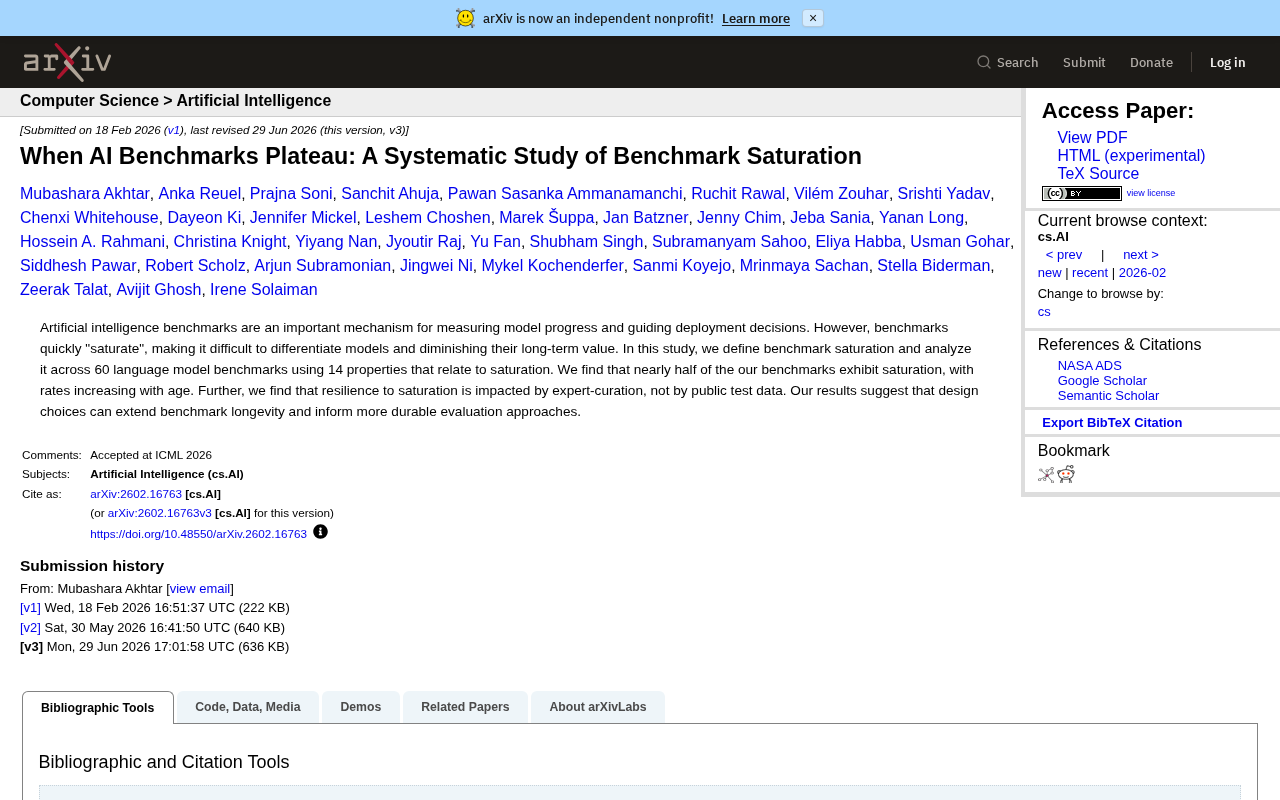
A systematic study titled When AI Benchmarks Plateau: A Systematic Study of Benchmark Saturation focuses precisely on this phenomenon. It attempts to answer a critical question: when benchmark scores collectively hit their ceiling, how much genuine information about model capabilities can we still extract from these numbers?
What Is AI Benchmark Saturation
From Discriminability to Ceiling Effects
Benchmark saturation refers to the point at which model performance has improved enough that benchmarks can no longer effectively differentiate between the capabilities of different models. This phenomenon is known in psychometrics as the "ceiling effect" — when the difficulty ceiling of a test instrument falls below the actual ability of the subjects being tested, the score distribution exhibits severe negative skewness, with scores clustering at the top of the scale, leading to significant declines in both reliability and validity.
Here's an intuitive example: if an exam consists entirely of "giveaway questions" for top students, then whether they score 95 or 98, the test cannot reflect who truly has a higher level of ability. In the context of AI benchmarks specifically, when multiple models score in the 95-99% range, the standard error may already exceed the score differences between models, meaning any ranking could be the product of statistical noise rather than a genuine reflection of capability ordering.
For AI benchmarks, saturation implies several core problems:
- Declining discriminability: Top models' scores are squeezed into a narrow high-score band, where minor score differences may stem from random fluctuations rather than real capability gaps.
- Deteriorating signal-to-noise ratio: When the remaining room for improvement is minimal, measurement error, data noise, and evaluation methodology biases all become amplified.
- Overfitting risk: Models may achieve high scores by having "seen" similar questions in their training data rather than genuinely mastering the corresponding abilities.
The Value of Systematic Research
Unlike scattered observations, this study takes a systematic approach to quantifying the degree of benchmark saturation. Rather than simply pointing out that "some leaderboard is approaching full marks," it attempts to establish a framework for assessing the "remaining lifecycle" of different benchmarks and the practical impact of saturation on model comparison conclusions.
This systematic perspective is crucial. In practice, researchers and companies often make significant decisions based on benchmark scores — choosing which model to deploy, determining whether a technical approach is effective, and evaluating the return on R&D investment. If these scores have already lost their discriminative power, then conclusions built upon them may not hold up.
The Deeper Causes Behind Benchmark Saturation
Genuine Leaps in Large Model Capabilities
First, we must acknowledge that benchmark saturation is partly a good thing — it reflects the rapid advancement of large model capabilities over the past few years. Many tasks considered extremely challenging in 2020 can now be handled with ease by frontier models. When a benchmark is "conquered," it itself demonstrates technological maturity.
The Hidden Danger of Data Contamination
However, saturation is not entirely attributable to genuine capability improvements. One factor that cannot be ignored is data contamination. When benchmark test questions and answers enter a model's training corpus through various channels, the model may "memorize" answers rather than truly reasoning them out. In such cases, high scores are illusory and cannot generalize to real-world scenarios.
Data contamination can occur through multiple pathways. The most direct is benchmark test questions themselves being included in training corpora — many benchmark datasets are published on GitHub or academic websites, while LLM pre-training data typically includes large-scale internet crawls (such as Common Crawl, an open dataset containing billions of web pages). More subtle forms of contamination include: benchmark questions being indirectly collected when discussed in blogs or forums; synthetic data generation processes inadvertently replicating benchmark patterns; and even instruction datasets used during fine-tuning containing samples highly similar to benchmarks. Research shows that even partial contamination (where a model has only seen the questions but not the answers) can significantly boost scores, because models can leverage format recognition and distribution matching to "guess" correct answers. While organizations like OpenAI and Google perform decontamination, the massive scale and complex origins of training data make complete elimination of contamination virtually impossible.
As benchmark data on the internet is repeatedly crawled and used, virtually no public benchmark can be fully immune to contamination. This is why an increasing body of research emphasizes the use of "private," "dynamic," or "continuously updated" evaluation sets.
Implications of Saturation for the AI Industry
The Need for Harder, More Diverse Benchmarks
The most direct response to saturation is designing more challenging new benchmarks. Several evaluations that have emerged in recent years — emphasizing complex reasoning, multi-step tasks, and real-world tool use — are precisely responses to this trend.
To address saturation, both academia and industry have introduced various new evaluation approaches. GPQA (Graduate-Level Google-Proof Q&A) has questions designed by domain PhD students, ensuring answers cannot be obtained through simple searches, specifically testing deep domain expertise; SWE-bench requires models to solve real GitHub issues, involving understanding large codebases and submitting patches that pass automated tests, greatly increasing task complexity and realism; MATH and its upgraded versions use competition mathematics problems to test deep reasoning chains; LiveBench employs a continuously updated question pool, replacing portions of questions monthly to combat data contamination; and Chatbot Arena adopts a human blind-evaluation ELO ranking mechanism, establishing model rankings through real users' pairwise comparisons, completely bypassing the limitations of fixed question sets. The common characteristics of these new benchmarks are: harder, more dynamic, and closer to real-world usage scenarios.
Benchmark design is shifting from "can the model get it right" to "can the model handle complex, open-ended tasks well."
A Paradigm Shift in AI Evaluation
The deeper implication is that the evaluation paradigm itself may need transformation. Single-score leaderboards are revealing their limitations. Future evaluations will likely place greater emphasis on:
- Multi-dimensional assessment: Looking beyond accuracy to also consider robustness, consistency, safety, and more. Robustness evaluation examines the stability of model performance when facing adversarial inputs or distribution shifts — for example, whether different phrasings of the same question yield consistent answers. Consistency focuses on output variance across multiple samples or similar questions. Safety assessment covers the ability to refuse harmful requests, the degree to which hallucination (where models generate plausible-sounding but factually incorrect content) is avoided, and the precision of following instruction boundaries. Additionally, efficiency metrics (inference speed, cost), long-context processing capabilities, and state tracking in multi-turn dialogues are receiving increasing attention. Stanford's HELM (Holistic Evaluation of Language Models) project is a representative implementation of this multi-dimensional evaluation philosophy, systematically evaluating models across dozens of dimensions rather than producing a single ranking.
- Dynamic and adversarial testing: Continuously generating new questions to combat contamination and overfitting.
- End-to-end evaluation in real scenarios: Moving beyond the laboratory to verify model performance in actual applications.
Maintaining Critical Thinking About Benchmark Scores
For practitioners, perhaps the most practical reminder from this research is: don't blindly trust benchmark scores. When you see a model "leading" competitors by one or two percentage points on an already-saturated benchmark, remain skeptical — that gap likely has no statistical significance and may not reflect real-world usage experience at all.
Conclusion: Redefining How We Measure AI Capabilities
Benchmarks once served as a crucial engine driving AI progress, providing the entire field with a common yardstick and comparable goals. But as this systematic study reveals, when more and more yardsticks are "maxed out," we must rethink how to measure intelligence.
Benchmark saturation is not an endpoint but a signal — reminding us that the way we measure AI capabilities needs to evolve in step with AI's own progress. The real challenge isn't getting models to score higher on tests, but designing evaluation systems that can continuously, fairly, and authentically reflect model capabilities. In an era where AI capabilities are advancing rapidly, this may be a more urgent challenge than chasing leaderboard positions.
Related articles

Workbuddy for Absolute Beginners: How a Desktop AI Agent Fits Into Real Workflows
A beginner's guide to the Workbuddy desktop AI agent: installation, claiming credits, file management, and building automated workflows—compared with CodeX for fit and cost, helping professionals shift from AI question-askers to AI managers.

OpenAI's New Agent Stack: Computer Use, Decisions API, and Ultra-Fast Workflows
OpenAI Dev Day unveiled a new agent stack: Computer Use outperforms humans, Decisions API delivers ultra-low-latency classification via Luna, Agents API opens the same Computer Use capabilities, and GPT-6.1 Sol costs only one-seventh of Astra. Core updates, benchmark data, and developer insights.

Liang Wenfeng Open-Sources DeepInfo Inference Framework, Takes On U.S. Ban
DeepSeek open-sources its DeepInfo inference framework after its models, featuring GPU/CPU cross-pipelining, small-model prediction with large-model verification, and full Huawei Ascend and NVIDIA chip support—facing the U.S. federal ban head-on. This article analyzes its significance for AI deployment and open-source strategy.